Welp, new record – TWENTY-ONE DNFs this month. Freaking YIKES.
As usual, several of these were objectively great, and I honestly don’t know why I wasn’t clicking with them; some were just not-for-me, no harm no foul; and of course, some really were just bad.
Sigh.

Darker Than the Starless Night by Rebecca Brodkey
Genres: Adult, Fantasy, Queer Protagonists
Representation: F/F
PoV: Third-person, past-tense
Goodreads
A tale of gods and titans, the humans caught between them, and the chemistry that binds it all together
Yom has found a simple solution to avoiding the obsessive thoughts that have haunted her since burying herself beneath powdered drugs, bodies, and coin. But when her gang’s leader demands loyalty at all costs, Yom’s position as the gang’s head chemist comes under threat. Forced to investigate, she crosses paths with a cagey royal archivist named Quia as they unearth a horrifying conspiracy to reopen the ancient war that ripped the world in two.
Quia offers a tenuous cross the dangerous network of provinces to reach the queendom’s capitol, and seek the one mythical person capable of halting the forces of war. On the treacherous odyssey, Yom reckons with blood-thirsty crime lords, the queen’s personal guard, bounty hunters, forest spirits, old gods, and the specter of a friend she lost as a child—her first love—who might still be alive out there. The chemist must face her addiction to powder, her growing feelings for Quia, and the obsessive thoughts that threaten to tear her mind in two, lest she lose herself in her quest to save the world.
Pretty much an instant DNF, just for clunky, heavy prose. Not completely egregious, but nothing I’m willing to put up with.
maybe the thugs she heard whispers of prowling the edges of the city, known only as Stags.
I do not like this phrasing. Are you saying the thugs are the ones prowling the edges of the city? Or are the whispers are the ones prowling?
The sound severed Yom.
The context is that this sound causes Yom to snap into disassociation, but I think that phrasing is awful.
Her mind warred with itself the hardest after the lights went out.
Just awkwardly phrased.
If Yom had been dry, she would have been embarrassed by how heavily she was panting.
I have no idea what this means; I read this scene three times and Yom is not described as wet or even sweaty. ???
The smells of the market taunted Yom’s empty stomach. She had to close her eyes so she wouldn’t be too tempted to abandon their task.
I’m not sure how closing your eyes cuts off delicious smells.
The yellow jumper was roughly knit and unevenly dyed, surely not a mother’s touch.
This is a very strange sentence that gets stranger the more I think about it. What is it, exactly, that’s supposed to not be the sign of a mother’s touch? The bad dye? The poor knitting? What do you mean by a mother’s touch in this context? I’m confused.

Blue Futures, Break Open: A Novel by Zoë Gadegbeku
Genres: Adult, Fantasy, Historical Fantasy, Magical Realism
Representation: Black cast
ISBN: 1959000403
Goodreads
Blue Basin Island is the final resting spot of formerly enslaved Africans whose souls have flown from Earth—not to heaven or purgatory but toward freedom and a new life. Lucille, the island’s seamstress, takes two forms. She lives among the inhabitants in human form and, along with the evil-repelling blue of the houses, her divine form protects people from the violence of the their former lives. Yet, even there, outside of time, the souls are not totally insulated from the world in which they were enslaved. Each time a Black person anywhere is harmed, a piece of Blue Basin an earthquake leaves hundreds of thousands dead, and bricks crumble on the island; when police kill a Black child asleep in her bed, the blue paint on homes throughout the island drips and then runs from the walls. Lucille must hold the island together, but she struggles to juggle the responsibility of ensuring everyone’s safety while also seeking and losing her own private love. Grounding the story in African folklore and dipping into the rich literary tradition around African people with the power of flight, Zoë Gadegbeku visualizes the destination at the end of the flight and the new life that awaits them.
This is beautiful, but the writing style / storytelling style is throwing me. It’s a little bit magical realism, and a bit oral storytelling, and I’m not enjoying it. But it’s very obviously a taste thing, not a quality thing. I’m hoping I might enjoy it more at a later date.

The Hearth Witch's Guide to Magic & Murder (The Hemlock Saga #1) by Kiri Callaghan
Genres: Adult, Fantasy, Queer Protagonists
Representation: F/F
PoV: Third-person, past-tense, multiple PoVs
ISBN: 1464233446
Goodreads
"For all intents and purposes, we are still blissfully separated from the mortals, but there have been…complications."
When a rise in London's supernatural crime puts Fey society at risk of discovery, the Winter Council turns to an unlikely solution: Avery Hemlock, the changeling they sentenced to 500 Years of Nightmares. Inherently lacking social grace and missing approximately two centuries of world knowledge, Avery must find a way to acclimate and solve the case or lose her probationary freedom.
After being left at the altar and dropping out of medical school, Saga Trygg attempts to rekindle her faith in life, humanity, and witchcraft. But when her new neighbor, Avery, accidentally reveals the Fey that have been living among humanity all along, Saga realizes magic is far more than prayers, intention, and candles.
Each faced with navigating an unfamiliar world, the two form an unexpected partnership—but shortly into Avery's investigation, they discover the threat might be closer to Saga than either of them imagined, and Avery will do anything to protect the first friend she's had in more than two hundred years.
Reader, I did not even make it to chapter 2.
Like all magic, the chant came in many languages, both fey and mortal, but the words roughly translated always meant the same: Bless the wretched, the crimes they make, the world of weeping, and the tolls they take.
What do you mean, ‘the words roughly translated always meant the same’? a) that is in fact how translation works, thank you for explaining that to me, b) that phrasing is horrific. It should at least be ‘the same THING’. Perhaps ‘the words, roughly translated, always meant more or less the same thing:’, I don’t love that but it would be acceptable.
I’m not even gonna touch the fact that the thing rhymes, or the implication that it will also rhyme when translated.
Gideon’s brow furrowed, and he carefully removed the black leather glove from his left hand. Pale fingers splayed and reached forward, iridescent strings of magic lighting up briefly as he made contact before vanishing from sight again.
Do you have any idea how many times I had to reread that before I understood that some kind of magic barrier was appearing when his hand drew near it? Abominable phrasing. ABOMINABLE. ‘as he made contact’ contact with WHAT?!
He stepped over the fast-decaying remnants of the spell and approached the pedestal with a clinical disposition.
With a what?
“We’re on a bit of a tight schedule, I can’t abide dawdling.”
“I have two centuries’ worth of pins and needles impeding my movement,” Avery spat, but it did nothing to slow the Archfey’s pace. “Perhaps your secretary can arrange something, so my legs might have a precious second to acclimate?”
‘impeding my movement’? ‘ACCLIMATE’? Maybe you’re trying to make this character sound formal because they’re hundreds of years old, but what you’ve done is make them sound like an alien who swallowed a thesaurus.
The downpour startled her into stillness.
Shut up.
He walked down the steps to the vehicle where his driver was already waiting, opening the door as the Archey approached.
Quick question, who opened the door?
ALAS NO.

Apparently, Sir Cameron Needs to Die by Greer Stothers
Genres: Adult, Fantasy, Queer Protagonists
Representation: Bi MC with panic attacks, M/M
PoV: First-person, past-tense; third-person, past-tense
Published on: 3rd February 2026
ISBN: 1835413811
Goodreads
In this hilarious, off-the-wall queer fantasy romance, a reclusive sorcerer is forced to protect a cowardly knight after a prophecy ties their fates together.
Funny, touching and inventive, this book is perfect for fans of Mortal Follies, A Marvellous Light and Dreadful.
All his life, Sir Cameron has stayed as far away from danger as possible. He is, quite frankly, too handsome to die a violent and pointless death in battle. But when the Church hands down a prophecy to his fellow knights predicting that the only way to defeat their nemesis, the mad sorcerer Merulo, is to kill Cameron, he finds himself in a situation too sticky for even his considerable wiles. Short of ideas, Cameron throws himself on the mercy of the one person who now actually wants him to survive: the mad sorcerer.
Merulo isn’t thrilled to be babysitting a spoilt, attention-seeking knight, but fate has tied them together. And transmogrifying Cameron into a vulture is at least a great source of entertainment. Cameron, meanwhile, is on a voyage of self-discovery. It turns out he’s really, really into surly sorcerers who lock him up and tell him what to do. Who knew?
As a legion of knights surround their stronghold, the sorcerer’s poisonous ambitions draw ever closer to fruition. Cameron is quite invested in not dying, but he finds he’s also invested in Merulo. And sometimes, supporting the sorcerer you care about means taking an interest in their hobbies. Even if that hobby is trying to kill God.
Even if it might get you killed, too.
I received this book for free from the publisher via NetGalley in exchange for an honest review. This does not affect my opinion of the book or the content of my review.
I don’t know why ‘silliness’ and ‘very simple prose’ go together so often, but they do here and it means I have no interest in continuing on. I made it to 25%, and it’s perfectly fine, I don’t think it’s a bad book. But the vibe is very childish, it’s not my flavour of funny, there are some hints of interesting things below the surface of the worldbuilding (this might be set in the future of our world? the elf PoV character is addicted to a drug that makes her feel emotions?) but not enough to hold my attention.
The comp titles in the current blurb are ridiculous: between the tone, writing style, and general aesthetic, Apparently, Sir Cameron is nothing like the Last Binding trilogy or Mortal Follies. Comping this to Dreadful is much fairer, but the prose in Apparently is noticeably easier/less complex. That’s not a bad thing! Sometimes you want to read something that allows you to completely shut your brain off; that can be a huge relief. Apparently is absolutely a book that will let you do that.
I think if you want an extremely readable, light-hearted, tongue-in-cheek queer snark-story, you’re likely to have fun with this – especially if you’re a fan of cowardly ‘heroes’ bucking expectations. (We stan a protagonist who is not ashamed in discovering he has a bondage kink!)

Queen of Faces (Queen of Faces #1) by Petra Lord
Genres: Fantasy, Queer Protagonists, YA
Representation: Trans MC
PoV: First-person, past-tense; multiple PoVs
Published on: 3rd February 2026
ISBN: 1250362989
Goodreads
A desperate girl at a cutthroat magical academy faces a choice between life and death: become an assassin for the enchanted elite or watch her decaying body draw its last breath.
Anabelle Gage is trapped in a male body, and it’s rotting from the inside out. In Caimor, where the magical elite buy and swap designer bodies like clothes, Ana can’t afford to escape her tattered form. When she fails the entrance exam to the prestigious Paragon Academy, her last hope of earning a new body implodes. As the clock ticks down to her last breath, she’s forced to use her illusion magic to steal a healthy chassis—before her own kills her.
But Ana is caught by none other than the headmaster of Paragon Academy, who poses a brutal ultimatum: face execution for her crime or become a mercenary at his command. Revolt brews in Caimor's smog-choked underworld, and the wealthy and powerful will stop at nothing to take down the rebels and the infamous dark witch at their helm, the Black Wraith.
With no choice but to accept, Ana will steal, fight, and kill her way to salvation. But her survival depends on a dangerous band of an impulsive assassin, a brooding bombmaker, and an alluring exile who might just spell her ruin. As Ana is drawn into a tangled web of secrets, the line between villain and hero shatters—and Ana must decide which side is worth dying for.
I received this book for free from the publisher via NetGalley in exchange for an honest review. This does not affect my opinion of the book or the content of my review.
This is very YA. What do I mean by that: the language/prose is very plain; the worldbuilding is frustratingly simplistic; and the opening chapters, at least, are full of telling-not-showing. (Possibly this will smooth out as the book goes along; plenty of books go hard on telling in the first few pages but don’t keep it up much past that.) There’s a fair bit of ‘but why???’ naming of proper nouns – for example, a mage’s signature spell is called their Codex. Why? Codex is a real word with a real meaning that doesn’t have anything to do with what YOU mean. You could have called it something like a signature, or invented a word for it! Then there’s the ‘ancient empire of the Star Prophets’, a very big deal lost civilisation, and, just – I love star-related things in fantasy, but ‘Star Prophets’ is just…so obvious? So blunt? I don’t know what the word I want is.
Gah.
The worldbuilding in general was frustrating, but the system of the chassis – the temporary bodies everyone uses – was absolutely fantastic. I cannot give it enough points. Yes, it’s relatively simple, but an elegant, clever kind of simple. You can transfer your ‘Pith’, your self, into any unoccupied body – but even if you have one of the priceless bodies that don’t grow older, your Pith will still age, which means that no one is immortal. And you might think that physical injury isn’t necessarily a big deal, at least if you’re rich enough to swap into a new, unharmed body – but nope! Enough blood loss damages the brain, which damages your Pith, and that damage affects any new body you take. We meet one character early on who is missing some toes because of blood loss he experienced in a previous body; severe enough blood loss can result in the Pith/brain deciding it’s missing an arm, or something even more important. I loved all of this; it means people in this world still have plenty of reason to avoid physical injury, and that generational change is still a thing. Would I have loved a world where neither of those things were true, if a storyteller really dove into the ramifications? Yes. But I massively admire an author who builds in believable reasons for people in a very different world to still act like humans the reader would recognise.
I don’t want to mark this down for being YA – that’s not fair; it’s not the book’s fault that what I really wanted was this as an Adult story. I did feel like it was talking down to its teenage readers more than necessary, but judged as a YA novel, it has an interesting magic system, a very sympathetic, loveable protagonist, in a world that doesn’t look quite like anything else I’ve come across before, playing with a lot of complicated themes that we don’t often see intersect in YA SFF. The writing is not at all bad, just simpler that I personally prefer. So objectively, I think this is at minimum a four-star read – it’s just not for me.
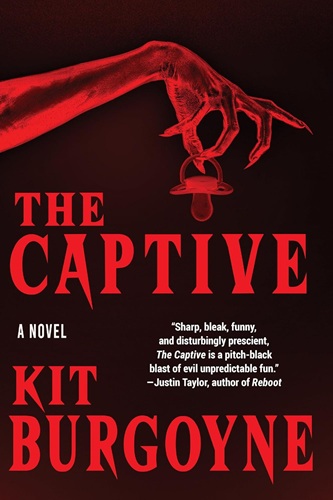
The Captive by Kit Burgoyne
Genres: Adult, Horror
PoV: Third-person, present-tense; multiple PoVs
ISBN: 1835412025
Goodreads
A darkly comedic, cinematic horror about a revolutionary group who kidnap an heiress, only to discover she's pregnant with the antichrist, and she's about to give birth.
From Ned Beauman, the Man Booker Prize-longlisted author of The Teleportation Accident and Clarke Award-winning author of Venomous Lumpsucker. Perfect for fans of Grady Hendrix and Joe Hill.
Underground revolutionary group The Nail and their newest member, Luke, have kidnapped 23-year-old heiress Adeline Woolsaw, whose wealthy parents run the Woolsaw Group, a vast outsourcing company. They run everything from prisons and hospitals to military bases – quietly suffocating the country with the help of powerful friends in government.
The Nail's to use the kidnapping to draw attention to the Woolsaw Group and their terrible practices. But with Adeline bundled into their van, The Nail discover two things. The first is that she's just about to give birth. And the second is that this isn't a normal baby. In fact, it has devastating supernatural powers. Because the father of this baby wasn't a man, it was… something else. Something that her parents make human sacrifices to on an altar in the basement of their Highgate mansion. And all this time the Woolsaw Group has been preparing the ground for the Woolsaws' real an infernal new kingdom that will rise with Adeline's son sitting on its throne.
It’s fine? But maybe kinda mis-marketed: the supernatural stuff isn’t given nearly enough attention, it’s much more about the anti-capitalist terrorists and their shenanigans. Which is okay, but not what I was looking for at all.
Super readable, like an airport read; I made it to 44% in a couple of hours. But I was here for the Omen kid and he was barely on-page except as a kind of footnote/set-dressing thing.
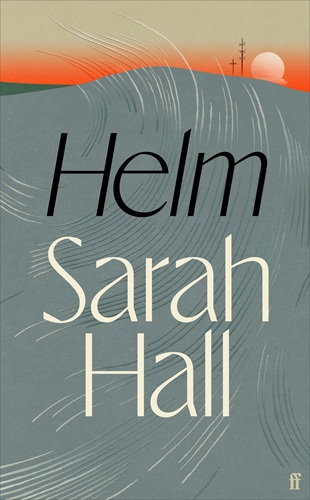
Helm by Sarah Hall
Genres: Adult, Speculative Fiction
PoV: Third-person, present-tense; multiple PoVs
ISBN: 0571383572
Goodreads
A wondrous, elemental novel from 'a writer of show-stopping genius' (Guardian).
Helm is a ferocious, mischievous wind - a subject of folklore and wonder - who has blasted the sublime landscape of the Eden Valley since the very dawn of time.
This is Helm's life story, formed from the chronicles of those the wind the Neolithic tribe who tried to placate it, the Dark Age wizard priest who wanted to banish it, the Victorian steam engineer who attempted to capture it - and the farmer's daughter who fell in love. But now Dr Selima Sutar, surrounded by measuring instruments, alone in her observation hut, fears the end is nigh.
Vital and audacious, Helm is the elemental tale of a unique life force - and of a between nature and people, neither of whom can weather life without the other.
The first chapter, which was from the pov of Helm, the wind, was magnificent. But after that, the story shifts to follow a number of humans at different points in history, and I was so bored. The writing’s not bad at all, it’s somehow both smooth and sharp, but it couldn’t make a whole lot of nothingness into something interesting.

The Dead Withheld by L.D. Lewis
Genres: Adult, Fantasy, Queer Protagonists
Representation: Queer Black MC
PoV: Third-person, past-tense
ISBN: 1966503083
Goodreads
MEET DIZZY
Private investigator.
Blues enthusiast.
Deadwalker witch.In this sapphic paranormal neo-noir, follow Dizzy's exploits in the neon-drenched desert city of San Guin as a break in the cold case of her wife's murder leads to her stepping on the toes of some ambitious demons.
"Filled with hot succubi girlfriends, adorably damned henchmen, and soul-sucking demons, this is a must read for fans of wounded, badass, lesbian investigators."
-Suzan Palumbo, author of Countess and Skin Thief"A perfect noir infused with magic, secrets, and all the tantalizing trappings of a night out in the underworld."
-Ladz, author of Ice Upon a Pier"At turns terrifying, explosive, joyous, and bittersweet, Lewis's novella of ghosts, demons, and the damned truly has a beating heart of humanity at its core."
-Martin Cahill, author of Audition For The Fox
I received this book for free from the publisher, in exchange for an honest review. This does not affect my opinion of the book or the content of my review.
I wanted to love this so much, but the prose feels awkward and the writing rhythm is very jarring – I was constantly wishing the author had added more commas, because there’s a lot of long sentences that fall flat because there’s no breaks in them. And the phrasing was semi-constantly very awkward – overwritten,
Examples, so you can decide for yourself if the prose will bother you;
“Evening, friend,” she greeted the dead patron in respect.
This phrasing is very awkward. In respect?
She knew better than to reach for Lonnie’s hand, to try and touch her or she may disappear.
Given that this is written in past-tense, shouldn’t ‘may’ be ‘might’? And to my ear, it needs a comma after ‘touch her’.
Dizzy fled the stage as a new pitch grew in her ears. She crossed the dining room to the bar in the back and the pitch grew louder until it was clearly discernible as a scream.
Again, ‘clearly discernable’ is such an awkward way to phrase what you mean here!
Her eyes were white like the dead always were.
That doesn’t make sense; you mean ‘like the eyes of the dead always were’, I think? Or ‘like the dead’s always were’, I think that’d work too.
But if these quotes don’t bother you and you think I’m bonkers, then please go ahead because the protagonist and premise of this novella are VERY cool. It’s only the writing that bothered me.

The Two Lies of Faven Sythe by Megan E. O'Keefe
Genres: Adult, Queer Protagonists, Science Fantasy
Representation: F/F, secondary nonbinary character
PoV: Third-person, past-tense; dual PoVs
ISBN: B0DL5J35K2
Goodreads
A search for a missing person uncovers a galaxy-spanning conspiracy in this thrilling standalone space opera from award-winning author Megan E. O'Keefe.
The Black Celeste is a ghost story. A once-legendary spaceship collecting dust in a cosmic graveyard known as the Clutch. Only famed pirate Bitter Amandine knows better, and she’ll do anything to never go near it again. No matter the cost. Faven Sythe is crystborn, a member of the near-human species tasked with charting starpaths from station to station. She’s trained to be a navigator her entire life. But when her mentor disappears, leaving behind a mysterious starpath terminating in the Clutch, she is determined to find the truth. And only Amandine has the answers.
What they will find is a conspiracy bigger than either of them. Their quest for the truth will uncover secrets Amandine has long fought to keep buried – secrets about how she survived her last encounter in the Clutch, and what’s really hidden out there amongst the stars...
I read to the 20% mark and just…had no interest in continuing on. The Made Of Crystal aesthetic in the beginning is my favourite kind of Fantasy-Pretty, and I liked how magical the navigators’ powers felt, but…there just wasn’t any hook? I liked all the characters fine, there’s nothing here I actually object to or think was done poorly. I’m just not interested by any of it, and I simply do not have time for books I’m not interested in!

Thirsty by Lucy Lehane
Genres: Adult, Fantasy, Queer Protagonists
Representation: M/M
PoV: Third-person, past-tense; dual PoV
ISBN: 1250329671
Goodreads
A high-heat, low-drama vampire romance where the only stakes are true love.
A revenge plot sets sparks flying in this screwball paranormal romantic comedy of enemies-to-lovers, chaotic supernatural friend groups, and scorching chemistry from debut author Lucy Lehane.Charlie needs to revamp his career. Writing advice columns was hard enough before the whole internet was dying to know how to date the undead – but Charlie’s as human as they come. And he has no idea how to answer the messages flooding his inbox, like My Workplace Slack Is Haunted; Should I Cross Dimensions For a Fling? and How Exactly Do You Smash A…
When a chance nocturnal meeting at a local coffee shop sees him reuniting with Lorenzo – a vampire with an axe to grind – Charlie thinks he’s found his ticket to immortal career success. But Lorenzo has plans of his to get revenge on Charlie for separating Lorenzo from the love of his life years ago. When Lorenzo draws Charlie into his world of monsters and mayhem, he finds new friends and old souls that span centuries of existence, yet are somehow just as lost as the two of them. But as Charlie and Lorenzo grow unexpectedly closer, the secrets they dwell under might just crush them.
Can their love survive demons and drama? And which will prove deadlier… bloodlust or betrayal?
"A frisky, campy paranormal joyride." - USA Today bestselling author Timothy Janovsky
"My all-time favorite kind of surprisingly soft, adorably grumpy, and sizzling hot." - S.A. MacLean
I received this book for free from the publisher via NetGalley in exchange for an honest review. This does not affect my opinion of the book or the content of my review.
Way too much telling-not-showing right away – the first chapter was pretty great, but the second went downhill fast, telling us all everyone’s reasons and feelings and whatnot instead of putting them on the actual page. The tone’s light and easy, some quirks of the worldbuilding are refreshingly unexpected (trolls! consensual hauntings!) but nothing was making the book stand out. If anything, quite a lot felt tired – especially the fact that Charlie lies about to Lorenzo about why he wants to learn about supernatural culture. I hate that trope, getting close under false pretences, lying for NO REASON: it can die in a fire. Absolutely not for me.

Goldheart (Foxglove & Feud #1) by Tess Carletta
Genres: Adult, Fantasy, Queer Protagonists, Romantic Fantasy
Representation: Brown gay MC with selective mutism, Black bisexual MC, autistic Black demi lesbian MC, brown trans lesbian MC, MC with ADHD and clinical anxiety
PoV: Third-person, past-tense; multiple PoVs
ISBN: 9798988101574
Goodreads
Senna Kane was taken from his bed as a child and raised to be the Goldheart, the highest ranking guard in his kingdom charged with protecting the prince. They dwell in a kingdom veiled in utter darkness to protect from the sun sickness, a deadly disease that causes its victims to grow plants from their bodies when they touch sunlight. Senna agrees to help his prince venture outside their dark land to seek a cure in the rival neighboring kingdom, Redwind. There, they find allies who welcome the magic the sun sickness brings. Among them is Captain Emrys Calloway, the princess' handsome guard who encourages Senna to do reckless, impossible things, like learn to wield the sun's magic himself.
GOLDHEART is a story about chosen family, choosing love, and the impossible feat of staying good in times of darkness.
I received this book for free from the author, in exchange for an honest review. This does not affect my opinion of the book or the content of my review.
Another one where I couldn’t stand the prose.
She bounded in like a storm, a flash of terror before the thunder of her movement.
I just straight-up don’t understand what this means. How does one bound like a storm? How is movement thunder, given that thunder is sound?
Like the life-sucking teeth of a viper, Mother Mabel’s hand clawed into Senna’s hair
…viper teeth DON’T suck life, though? I guess you could argue they inject death, what with the venom…?
He had questions of his own, but he suspected a woman in fine clothes like these had better things to do than subdue his confusion.
‘subdue his confusion’?
He had to crane his neck to get a good look at the empty poison bottle on her shelf, but the bead of bright light swirling around inside it was unmistakable.
…so it’s not empty, is it?
When his voice finally managed to spill out over his lips, it usually sounded like snipped up sandpaper.
What does snipped up sandpaper sound like? Different from not-snipped sandpaper? Speaking of, what does not-snipped sandpaper sound like?
Queen Phaedra sat at her desk with the same regal terror with which she sat on her throne.
What does ‘regal terror’ mean? And is she emanating it, or experiencing it? Does she feel regal terror when she sits on her throne? I mean, that could be fair, I bet being on a throne in front of all your court or whatever is anxiety-inducing…
your shortcomings are proving too insurmountable.
How can something be too insurmountable? A thing is either insurmountable or it isn’t, it can’t be a little bit insurmountable.
“I have oft given you the benefit of my endless fount of mercy, but even wells grow dry.
It can’t be ‘endless’ and run dry.
Ignoring the sinking dread of his heart
‘Of’? Not ‘in’?
He reached for his sword, but before he could produce it from his sheath
Why would you phrase it that way? ‘Produce it from his sheath’? This bit gets worse, watch
He reached for his sword, but before he could produce it from his sheath, one of the pointed daggers pressed beneath his bottom rib.
On the very next page, referring to one of those daggers;
the blunt tip nearly slicing a tear in Senna’s leather jacket.
You just said they were sharp! And how does a BLUNT anything ‘nearly’ tear leather?!
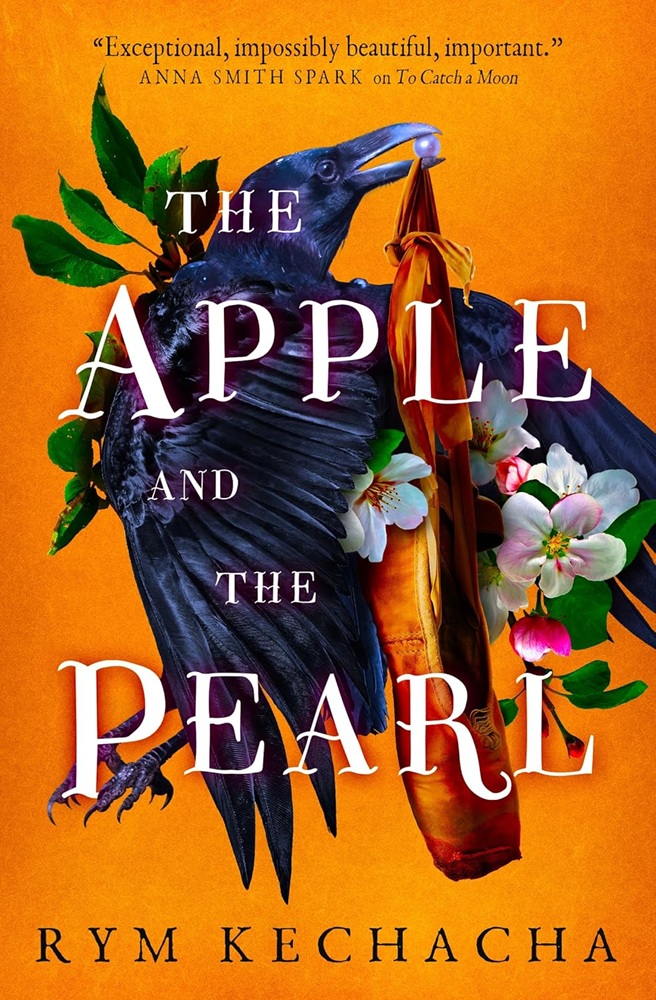
The Apple and the Pearl by Rym Kechacha
Genres: Adult, Fantasy, Magical Realism
PoV: Third-person, past-tense; multiple PoVs
Published on: 3rd February 2026
ISBN: B0F7RTZZVB
Goodreads
A richly atmospheric fantasy set across one day, as a ballet troupe of lost souls perform an ancient dance for the faerie realms, knowing they could be snatched away by their audience of faerie princes, imps and sprites at any moment.
For fans of The Night Circus by Erin Morgenstern, Caraval by Stephanie Garber, Pantomime by Laura Lam and The Queen of the Night by Alexander Chee.
As dawn breaks on All Souls Day, the lingering mists part to unveil an unending vista of serried gravestones. Between them looms a theatre like a haunted house from a horror film and the sleek iron carapace of a steam train - the Pearl. On board are the cast, orchestra and crew of a travelling ballet company, performing a show called The Apple and the Pearl.
Nine o' clock in the morning and as he stumbles toward the restaurant car the lighting director, Zach, is introduced to a new recruit, Lara. "Have you ever worked in ballet before?" he asks her and quickly follows up with, "Have you had any contact with the supernatural?"
Everyone from the principal ballerina to the first violinist, from the wardrobe mistress to the newest members of the corps de ballet does everything they can to get the show on stage and looking fantastic. But in the world of The Apple and The Pearl these artists also have to contend with the malevolent glamour of an audience of Fae creatures only too eager to snatch them away into the Otherworld.
I received this book for free from the publisher via NetGalley in exchange for an honest review. This does not affect my opinion of the book or the content of my review.
I really liked Kechacha’s deeply strange debut, but The Apple and the Pearl is – at least as of 37% in, which is where I DNFed – functionally Lit Fic, not fantasy.
Literally ONE of the dozen-plus PoVs is any kind of interesting; a changeling who was kicked out of Faerie as a teen and has spent his life trying to get back there. Everybody else is painfully banal, with painfully banal concerns and thoughts. Pages and pages of people thinking about everyday romances or the new coworker or what they’ll do with their lives when they go back to living in the human world. Making calls to senile parents and dealing with bounced cheques. Even the music and dancing is reduced to a bunch of technical terms that mean nothing to me. Where’s the magic and wonder, the art, the fear of being stolen by faeries?
I have no critiques for the prose, though it only really gets to shine in the rare fantastical moments. The characters all feel very much like real people, perfectly believable. But this is so terribly boring as a story, a reading experience. Not at all what I signed up for.
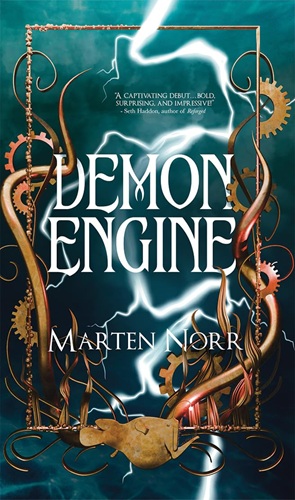
Demon Engine by Marten Norr
Genres: Adult, Fantasy, Horror, Queer Protagonists
Representation: Trans MC
PoV: Third-person, past-tense; multiple PoVs
ISBN: B0F2GVPTWZ
Goodreads
Sally Delavega, the best demon-binder the world has ever seen, would do anything to banish the two hundred ghosts trapped in his head—even if it means swimming up from the bottom of his tankard. When the Navy that destroyed his life comes sailing back to offer enough coin to get the job done, Sally agrees. All he has to do is help the crew of the Steadfast track down the ancient abyssal that lies sleeping at the heart of their drowned world. Why the Navy wants the demon isn’t Sally’s problem. But as they sail on, Sally begins to dredge up disturbing truths about how the world flooded and their ancient eldritch quarry that might just want to be found…
Imaginative and poignant, funny and bizarre, Demon Engine brings us a bold, queer high-seas adventure that asks how deep we might venture for what we aren’t willing to lose.
I received this book for free from the publisher, in exchange for an honest review. This does not affect my opinion of the book or the content of my review.
This is objectively great – unique, detailed worldbuilding; wonderfully fleshed-out characters; weird magic that is nonetheless easy to wrap my head around. The prose isn’t my favorite, but it’s good. Queerness and strangeness everywhere.
But I’m just not clicking with it, have to force my way through every page and don’t want to pick it up again every time I set it down. Maybe it’s the grim flavour of everything, all of these very traumatised characters struggling through a very harsh world? And I’m surprised by how much I’m not enjoying the maritime setting – it’s been a while since I read a story set on a ship, but I’ve never disliked it before, or I wouldn’t have picked up Demon Engine!
So it’s probably just me, especially because I can’t point to anything I thought the book was doing poorly. Putting it on the try-again-later pile.
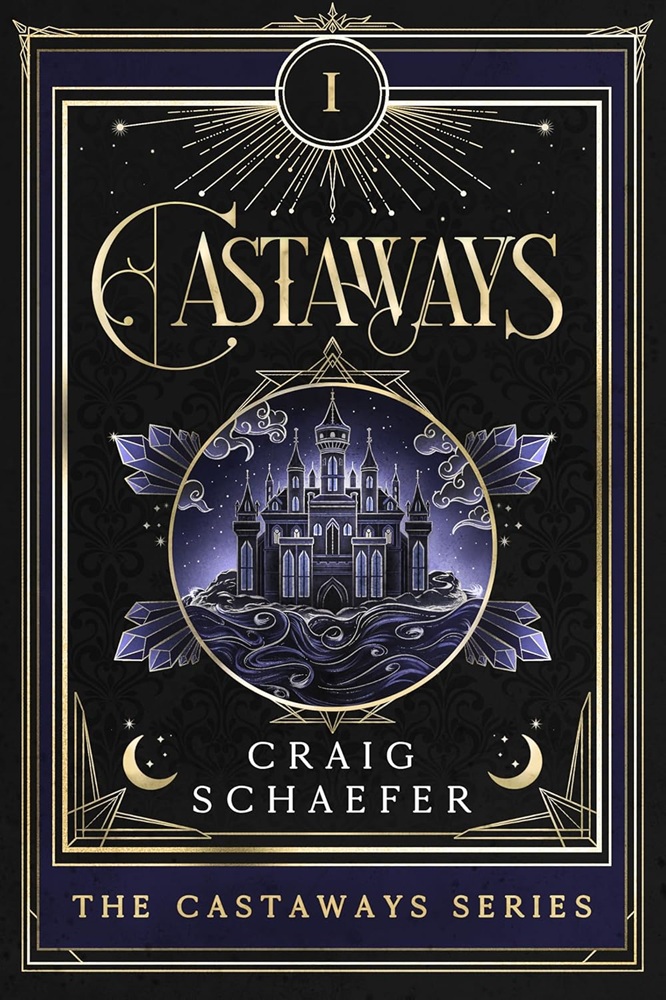
Castaways (Castaways, #1) by Craig Schaefer
Genres: Adult, Fantasy, Portal Fantasy, Queer Protagonists
Representation: Queer MC, F/F
PoV: Third-person, past-tense; multiple PoVs
ISBN: 1944806350
Goodreads
"Under our tutelage here at the Academy, you will receive a thorough instruction in occult history and practice, and learn to traffic with certain clandestine powers. You will face many ordeals, but you will emerge stranger than you have ever been. I'll change your life forever...if you'll let me."
Trapped in a dead-end town and a dead-end life, Amy Nettle dreams of escaping her abusive father and starting over, somewhere far away. The arrival of a black envelope heralds just that, in a way she never could have imagined. Whisked away to the Saunders Academy, a Gothic manse in the heart of an eternal storm-tossed ocean, Amy is one of dozens of teenagers plucked from dozens of parallel Earths and selected for an education in witchcraft. It seems too good to be true...except.
Except no one will tell them why they were chosen, or what happens after graduation. Or why the dormitories on the fourth floor are completely empty. There are tentacled leviathans and carnivorous mermaids in the water, a saboteur stalking the halls, and danger lurks around every corner. Worst of all, failure means the Arch of a one-way trip back to where you came from, without your memories or your magic.
Falling in with a crew of misfits, Amy realizes they're all in the same boat: with nothing but ruin waiting back home, failure is not an option. Then there's Vail, an enigmatic tomboy who makes her heart flutter. For the first time in her life, Amy has something to lose.
Amy and her new friends will have to untangle the dark secrets at the heart of the Saunders Academy and master its mysteries, because there are only two choices left: graduate, or die.
This is very easy to read…and I found it terribly boring. Almost everything feels very flat: the characters are all pleasant, but there’s no spark to them, and both the friendships and the budding romance seem paper-thin. I didn’t feel any of the connections that I was meant to believe were so important, and honestly the vast majority of the secondary characters could vanish without my noticing, they have so little impact or presence. And why was everyone sharing their deepest darkest secrets and insecurities so quickly? Why does Amy confess her dread of being considered a leader to the school custodian she’s never had a real conversation with before? All the first-years are meant to have come from lives they’re desperate not to go back to, so I don’t understand why they’re all so trusting. Shouldn’t the things they’ve been through make them less trusting, not more?
Take the romance (budding, they hadn’t kissed yet by the time I DNFed). When they arrive at the Academy, Vail is going through very bad drug withdrawal. Amy stays up with her their first night and does the best she can to take care of Vail through it. This is a lot to do for a complete stranger with no warning, but I took it as a way of showing us that, you know, Amy is a really compassionate person, a really GOOD person, so that was fine. What I found confusing was how…they were best friends immediately, after that? When Amy considers a kind of back-up escape plan if the Academy doesn’t work out, she reflexively plans to take Vail with her – and they’ve only known each other a day or two at that point. I didn’t get what Amy LIKED about Vail – being compassionate is one thing, but it’s also exhausting, and it is okay to get exhausted taking care of people, it’s hard, you just shouldn’t take it out on the person you’re taking care of, ideally. But Amy doesn’t get exhausted, it never seems to be hard for her to be there for Vail 24/7, up to and including tutoring her, and I couldn’t tell what she was getting out of the friendship. But they’re besties, edging towards romance. ??? It’s not that Vail is a terrible person or anything like that, but their relationship seems incredibly one-sided – and Amy is 17 or 18, I think, in a very stressful environment. How is she managing to be this saintly all the time?
The teachers, on the other hand, were all brilliant characters, and I loved how odd a group they make. Every last one of them was fascinating, and I’d have happily read a book about them instead: the Victorian ghost who lives in an old-school movie projector as the school’s librarian; the snarky, devastatingly practical combat-magic teacher who won’t teach his students to attack others before they learn to defend others; the fantasy!Pacific Islander responsible for teaching them to navigate interworld travel; the earnest, likeable newbie with a possibly bloodsoaked past. They were all distinct, and they were all just…objectively interesting, honestly. And maybe it’s hard to make teenagers objectively interesting in that way, maybe it requires life experience teenagers for the most part just don’t have…but the teachers made the students look a lot worse by contrast, in terms of them being very meh and one-dimensional.
There’s plenty of funny moments, some genuinely hilarious, but everything that wasn’t meant to be comedic was… shallow? Synthetic? Toothless? Felt rote, I think that’s the word I want, like we were just going through the motions. Which is extra bizarre because none of the other Schaefer books I’ve tried had that problem at all: they’ve always been incredibly vivid, so I don’t understand what went wrong here. Castaways leans hard on unanswered questions to keep the reader turning pages – why is there no fourth-year class, why does the headmistress expect half of Amy’s year-group to die, what’s the big reveal about the school bully going to be – but for that to work I need to be invested in getting the answers, and everything felt so emotionally muted that I really wasn’t. (Also, many of the mysteries are of the very annoying Why Aren’t You Wondering About This Amy??? variety. Why are you not investigating all the unsubtle hints that you being able to see magic is extremely unusual, Amy? Why are you just shrugging when teachers keep telling you you are Bright in some magic way they won’t explain, and that being Bright is very dangerous for you? Etc. This always drives me nuts, and it drove me nuts here too.) It’s like…there are just too many mysteries. That is a thing which it is possible to have. Above a certain threshold, you have so many unanswered questions that they cancel each other out and all cease to matter. The tension goes out of all of them. It’s like they all become white noise. There’s so much I don’t know that I can’t be invested. I know nothing, why am I even here, why should I bother? And that was EXACTLY the case here.
Where was the wonder at discovering magic is real, and getting to work it? Where’s the fear, the exhaustion, the frustration? Where’s the joy of making incredible friends in a place where you get to escape a life you really wanted to escape? Where’s the passion of getting to dive into all these things you want to learn? Give me feelings!
The school in general, and the aesthetic, didn’t do it for me. Everything is rundown, there are only four subjects, after first year you’re all selected for one of four club-things named after tarot suits, and they sure look like Hogwarts houses. (I cannot believe one of the club things is literally The Evil House. Are you kidding me. Yes I know you’re implying it’s more complicated than that, but by 60% of the way through the book they still appear to be just very vicious bullies.) The magic system can’t seem to decide if it’s soft or hard, with the result that I understood nothing of how it worked and it all felt very wishy-washy, despite having some very unique bits and pieces here and there (like using Magic Tarot to travel between worlds). The school is an island surrounded by a planet-sized ocean of monsters, and it’s weird how easy it is to forget about that. I wanted wonder, I wanted horror, I wanted to have my breath ripped out of me, and it wasn’t happening.
I made it to 60% and didn’t care about one single major character, mystery, or plotline. I vaguely wish all the characters well, but I don’t want to stick around for their stories. Sigh.

Snake-Eater by T. Kingfisher
Genres: Adult, Fantasy, Horror, Contemporary Fantasy
Representation: Neurodivergent MC
PoV: Third-person, past-tense
ISBN: 1835410057
Goodreads
In an isolated desert town, a young woman seeking a fresh start is confronted by ancient gods, malevolent supernatural forces, and eccentric neighbours. A witty horror-tinged fantasy, perfect for fans of Silvia Moreno-Garcia, Chuck Tingle, and Rachel Harrison.
When Selena travels to the remote desert town of Quartz Creek in search of her estranged Aunt Amelia, she is desperate and short of options. Fleeing an unhappy marriage, she has exactly twenty-seven dollars to her name, and her only friend in the world is her dog, Copper.
On arrival, Selena learns Amelia is dead. But the inhabitants of Quartz Creek are only too happy to have a new resident. Out of money and ideas, Selena sees no harm staying in her aunt's lovely house for a few weeks, tending to her garden and enjoying the strange, desolate beauty of the desert. The people are odd, but friendly, and eager to help Selena settle into her new home.
But Quartz Creek's inhabitants share their town with others, old gods and spirits whose claim to the land long predates their human neighbours. Selena finds herself pursued by disturbing apparitions, visitations that come in the night and seem to want something from her.
Aunt Amelia owed a debt. Now her god has come to collect.
27% in and I’m falling asleep. It’s perfectly lovely – I want Selena to have all the good things and Copper is a Most Excellent Doggo – but I’m very bored. My trend of loving only the books T Kingfisher self-publishes first continues.
It’s slow and kinda cosy and there’s lots of heartwarming other-people-are-basically-good,-actually going on. There’s lots of little giggles scattered throughout. I can see why plenty of other readers do or will love this. But it’s just not holding my interest at all.
So, not objectively bad by any means, and I might come back to it when I’m in the mood for cosy. But at least for right now, not a book for me.

Witchlore by Emma Hinds
Genres: Fantasy, Queer Protagonists, YA, Contemporary Fantasy
Representation: Nonbinary MC, NB/M
PoV: First-person, present-tense
ISBN: 1250369509
Goodreads
Holly Black meets Lex Croucher in this contemporary fantasy about a love story to raise the dead.
At Demdike College of Witchcraft, Orlando is an outcast. Not just for being the only shapeshifter in a college of witches. Not just for being a really bad shapeshifter, with no control over their magic or when their body switches between male and female forms. But because their girlfriend Elizabeth died - and it was Lando's fault.
Then charming new boy Bastian arrives with a proposition: he knows a spell that can raise Elizabeth from the dead. It's dangerous but Lando will try anything. But as Lando's attraction to Bastian grows, questions start to arise. Who is Bastian? What does he really want? And who will survive the resurrection spell?
For fans of V.E. Schwab and Rainbow Rowell, Emma Hinds' Witchlore is a spellbinding contemporary fantasy where the passion is as real as the magic.
I received this book for free from the publisher via NetGalley in exchange for an honest review. This does not affect my opinion of the book or the content of my review.
I don’t think this is bad – I really like how much the teenagers FEEL like teenagers, think and act like teens: not too dumb to be believed, not far too wise for their life experiences, occasionally ridiculous in VERY believable ways. There’s a lot in here about transphobia (nonbinaryphobia?) within the queer community that felt really necessary to talk about, with Lando’s primary bully being an openly gay student who persecutes them specifically because he hates how they transform between male and female. Witchlore is very…socially aware like that? Both Lando and their love interest deal with absentee parents, the love interest is Black and the book doesn’t sweep the racism he experiences under the rug, and I feel like it’s been a while since I ran into YA that didn’t idealise being a teenager, that acknowledged how hard being a teenager is.
Which makes it sound like a very dreary angst-fest, and at least the first half didn’t strike me that way. It’s a very easy read, the book trots along at a good pace, and the zingy one-liners we got occasionally both felt natural and helped lighten the mood when necessary. The British setting was convincing enough to make me homesick, and I got a real kick out of all the slang and references and things!
I just…wasn’t interested. I made it 40%, and I still wasn’t invested in any of it. I think I was told a lot but didn’t get to feel much of the story – it’s pleasant and easy to read, but it’s also kinda flat, a lot of the time? I never felt the tension, the urgency of any of it. The worldbuilding is very simple, but simple doesn’t have to mean boring, and here it did; nothing about it stood out at all. Lando doesn’t have much personality, is really only defined by their (in fairness, very legit) angst; they have no hobbies, no special interests, no beliefs beyond transphobia is fucking stupid (again, legit, but I really want a fair bit more than this!) Whereas Bastian, the love interest, had a very defined personality and I kinda wish he’d been the lead instead.
(Or at least I did, until I learned the nonsense he pulled later.)
I skipped to the last chapter, and while the twist/reveal gets full points for being really unique – I never would have seen that coming – I really disliked it. That’s a matter of personal taste, though, I don’t think the answer to the big mystery was a bad one, it just happened to tick a bunch of my No Thank Yous. I do think it’s objectively bad that I was able to read the final chapter and understand absolutely everything, because there was so much heavy-handed info-dumping to explain everything that had happened. That was very clumsily done. (And the reveals that several very stupid tropes had been used in the lead-up to the ending…urgh.)
Suffice to say, nothing about the ending made me want to go ahead and finish the book, and I’m really grateful I didn’t waste any more time with it. It’s not a terrible book, but I’m left feeling extremely meh about it, and it’s not one I’d recommend. If you want queer YA fantasy that digs into gender in a contemporary setting, let me point you towards the Scapegracers trilogy by ha clarke instead!

Queer as Folklore: The Hidden Queer History of Myths and Monsters by Sacha Coward
Genres: Adult, Nonfiction, Queer Protagonists
ISBN: 1800183372
Goodreads
Queer as Folklore takes readers across centuries and continents which reveals the unsung heroes and villains of storytelling, magic and fantasy. Featuring images from archives, galleries and museums around the world, each chapter investigates the queer history of different mythic and folkloric characters, both old and new.
Leaving no headstone unturned, Sacha Coward will take you on a wild ride through the night from ancient Greece to the main stage of RuPaul’s Drag Race, visiting cross-dressing pirates, radical fairies and the graves of the ‘queerly departed’ along the way. Queer communities have often sought refuge in the shadows, found kinship in the in-between and created safe spaces in underworlds; but these forgotten narratives tell stories of remarkable resilience that deserve to be heard.
Join any Pride march and you are likely to see a glorious display of papier-mâché unicorn heads trailing sequins, drag queens wearing mermaid tails and more fairy wings than you can shake a trident at. But these are not just accessories: they are queer symbols with historic roots.
To truly understand who queer people are today, we must confront the twisted tales of the past and Queer as Folklore is a celebration of queer history like you've never seen it before.
I’ve been trying to read this since last year, and I give up.
This is not about folklore, it’s about history. Every single topic is bent backwards so Coward can connect it to a historical personage or phenomenon in the last 200 years and then tell us all about that person or thing, instead of exploring or explaining the actual folkloric thing. This was so extremely not what I wanted, or what this book claimed to be. I grant you folklore and history are very intertwined, but they’re still not the same thing.
For example, the section on Western demonology spent so much time on Aleister Crowley, John Keats, the film The Exorcist, and the Satanic Panic about Dungeons and Dragons back in the 80s. The D&D stuff led into the homophobic/transphobic abuse directed towards modern drag queen storytime events, and like – what is any of this doing in here? I want to hear about actual demonic folklore, not why conservatives think I’m a demon!
The parts that were actually about demons and angels and whatnot were great, albeit short and shallow as you’d expect from a book attempting this wide an overview, but it was so much effort to get to them through all the maddening filler. I quit when I reached Part Four, which features chapters on aliens, pirates, sci-fi AI, and superheroes, none of which I’d consider folklore.
(I don’t know how to articulate why starting a chapter about aliens with David Bowie pisses me off so much – from one angle, I can see how that’s kind of cool, and if you closed the chapter with a bio on Bowie and his alien imagery to illustrate how the queer community has adopted alien iconography or whatever, that might be fine? But a) what are aliens doing in a book of folklore and b) what are you doing opening the chapter on aliens with a human being???)
Going back to my copy of Cassell’s Encyclopedia of Queer Myth, Symbol and Spirit: Gay, Lesbian, Bisexual and Transgender Lore, which remains the best example of what I want from a book of queer folklore/mythology, even with the lack of references. (It’s not like Coward cited many sources either.)

The Red Winter by Cameron Sullivan
Genres: Adult, Fantasy, Historical Fantasy, Horror, Queer Protagonists
Representation: Bisexual MC, M/M
PoV: First-person, past-tense
Published on: 24th February 2026
ISBN: 1250362776
Goodreads
A devastating love story. A bewitching twist on history. A blood-drenched hunt for purpose, power, and redemption.
In 1785, Professor Sebastian Grave receives the news he fears the terrible Beast of Gévaudan has returned, and the French countryside runs red in its wake.
Sebastian knows the Beast. A monster-slayer with centuries of experience, he joined the hunt for the creature twenty years ago and watched it slaughter its way through a long and bloody winter. Even with the help of his indwelling demon, Sarmodel – who takes payment in living hearts – it nearly cost him his life to bring the monster down.
Now, two decades later, Sebastian has been recalled to the hunt by Antoine Avenel d’Ocerne, an estranged lover who shares a dark history with the Beast and a terrible secret with Sebastian. Drawn by both the chance to finish the Beast for good and the promise of a reconciliation with Antoine, Sebastian cannot refuse.
But Gévaudan is not as he remembers it, and Sebastian’s unfinished business is everywhere he looks. Years of misery have driven the people to desperation, and France teeters on the edge of revolution. Sebastian’s arcane activities – not to mention his demonic counterpart – have also attracted the inquisitorial eye of the French clergy. And the Beast is poised to close his jaws around them all and plunge the continent into war.
Debut author Cameron Sullivan tears the heart out of history with this darkly entertaining retelling of the hunt for the Beast of Gévaudan. Lifting the veil on the hidden world behind our own, it reimagines the story of Europe, from Imperial Rome to Saint Jehanne d’Arc, the madness of Gilles de Rais and the first flickers of the French Revolution.
“An absolute feast of a rich, red, sinfully delicious. I've rarely been this satisfied—or this hungry for more.” —Alix E. Harrow, New York Times bestselling author of Starling House
“So bloody good. The Red Winter is absolute ripper entertainment—miss it at your peril!” —Shelley Parker-Chan, bestselling author of She Who Became the Sun
“A gorgeous tangle of history and fresh-made myth. You'll eat this one up.” —Cassandra Khaw, bestselling author of Nothing But Blackened Teeth
“Charming, haunting, ambitious, and a great deal of fun.” —T. Kingfisher, New York Times bestselling author of A Sorceress Comes to Call
At the Publisher's request, this title is being sold without Digital Rights Management Software (DRM) applied.
I received this book for free from the publisher via NetGalley in exchange for an honest review. This does not affect my opinion of the book or the content of my review.
Just a couple weeks ago I was predicting this would be one of my six-star reads of 2026. Now I’m striking it from the Unmissable list.
I loved the prologue, which was giving me all the lushness I could possibly ask for. But once we hit the main book, I…started struggling. I think more because this is not a me-book than because it’s objectively bad; the aesthetic is bleaker, grimier, than I wanted, and the prose isn’t the kind of gorgeous that can make up for that – if anything, it’s only a step or two above the very plain, blunt writing style I can’t stand. The book as a whole I’d call historical horror rather than historical fantasy; there’s a lot of gore, and Sullivan works hard to make it extra disturbing, but without a lot of loving sensory detail it wasn’t landing as more than ick for me. There’s no sense of wonder to the magic, it’s all either plain or ugly, and how it works is extremely vague – I never had a clue what was or wasn’t possible in any given moment. And then – surprise! The Christian god is objectively real, actually, and its forces are a major source of trouble for the main characters. Was not looking for that at ALL. And the central relationship of the book – Sebastian and his demonic Guest, Sarmodel – they have some fun banter at times, but it felt like they were almost always being nasty or arguing with each other, and that’s just not fun to read. I wanted to see more moments of softness between them than I was getting.
Most of that, I think, are just issues of taste; what I don’t like, another reader is going to adore. But I do have a few genuine critiques. The great doomed romance seemed to come out of nowhere; we get a chapter or two that’s an overview of the protagonist and love interest spending time together, and suddenly Sebastian is head over heels. Why? What about this love interest is appealing to him? We barely have any idea who he is yet! I couldn’t buy into it at all. The footnotes pissed me off – the author uses them to explain vital bits of plot and worldbuilding that should be in the main text, like what such and such kind of demon or talisman or whatever is while we’re interacting with it in the scene; the effect is like Sebastian is hand-waving at us, can’t be bothered to explain anything properly. Halfway through this tome and I still wasn’t sure if anima, the energy demons eat from humans, is the same thing as a soul – kind of important, I’m going to have a much more complicated relationship with Sarmodel if he’s eating the souls of all these people.
I read to 47% and was just not enjoying myself; I kept pushing past 25% out of some weird sense of obligation, telling myself it was going to get better. It did not. I wouldn’t call it a bad book – I can understand why lots of readers are going to go wild for it – but it is powerfully Not For Me, unfortunately.

Firstborn of the Sun by Marvellous Michael Anson
Genres: Adult, Fantasy
Representation: Yoruba-inspired cast and setting
PoV: Third-person, past-tense
ISBN: 1405967609
Goodreads
Lọ́rẹ has fiery blades and ice in her veins. One of these is a secret that will get her killed. In the land of Oru, everyone is born with agbára—the ability to summon energy from the sun. Everyone, that is, except Lọ́rẹ. She keeps this secret close to her heart, knowing her mother was killed for the same reason.
When the gods declare Lọ́rẹ’s best friend, Alawani, a priest of the holy order. He will be stripped of his agbára in a trial that has never yielded more than two survivors each time the gods call. Unwilling to risk his life for the gods that cursed her, Lọ́rẹ breaks into the temple. In a desperate act to channel agbára and save him, something else comes forth from her hands—a destructive shadow magic that draws on the energy of everyone and everything around her.
She and Alawani escape, but not before she catches the attention of the Holy Order. While on the run, Lọ́rẹ discovers her true identity and learns that Alawani’s grandfather, the Holy Order’s leader, murdered her mother. He will stop at nothing to ensure that Lọ́rẹ is the last of her kind. Lọ́rẹ finds herself choosing between Alawani and the magic within her.
I’m not spending 500+ pages following a heroine who attacks people, on a public street, WITH DAGGERS, if they call her a coward. Sorry, that’s a level of Straight-Up Stupid I can’t put up with. Goodbye.

Ragwort (The Eythin Legacy Book 2) by Sam K. Horton
Genres: Adult, Fantasy, Historical Fantasy
PoV: Third-person, present-tense; multiple PoVs
ISBN: 1837865876
Goodreads
A year on from the loss of Lord Pelagius Hunt of Mirecoombe, new Keeper Nancy Bligh is still struggling. She can banish the spirits and keep peace between the spriggans and piskies, but every time Nancy sleeps, she dreams of drowning. She is haunted by loss, and by whispers from all around of The Mother, and Nancy's witchcraft.
As the only witch left, Nancy is eager for any guidance she can have. When she discovers the possibility that her grandmother, the most powerful witch of her time, might still live, she seizes her chance.
Desperate for answers, Nancy journeys across the Cornish wilds to find her grandmother and uncover the secrets of The Mother, before it is too late.
I received this book for free from the publisher via NetGalley in exchange for an honest review. This does not affect my opinion of the book or the content of my review.
33%, after months and months and MONTHS of trying to make myself read this, and I’m calling it quits. I’m not willing to call it a bad book, but it’s really not holding my attention at all – I have to brace myself every time I pick it up again, and force my way through each chapter. And what on earth is the point of that?
Horton’s take on the fae is wonderful, wild and strange and steeped in Cornish folklore, and I still love everything about the worldbuilding, the mythos, that I did in book one. Nancy remains great. But the actual story just…doesn’t seem to interest me at all? Maybe because the storyline of Ragwort is much more familiar to me – poor Nancy is alone in the world, with many unanswered questions, surrounded by people who keep being inexplicably, even ridiculously mysterious at her. Something Is Coming and she must go on a quest to find out what it is. I’m not saying you can’t make that compelling, because you can, but I was not compelled in this case.
And I think I’m having more trouble with the prose this time around than I did with book one. To be clear: it’s not that the prose is bad! It just reminds me a lot of RJ Barker’s – both Barker’s and Horton’s have very distinct, unconventional rhythms that are initially jarring, but are very absorbing when you adjust to them. Except I don’t seem to be adjusting this time around; I just keep twitching, and editing it in my head as I read, which is unproductive and also feels kinda rude to Horton. (Sorry.)
I would really like to think that I’ll come back to this eventually…but I probably won’t, because I just don’t care about where the story’s going, and the actual reading of it feels like a slog.

Yelen and Yelena Genres: Adult, Fantasy, Queer Protagonists
Representation: Bisexual aromantic MCs
PoV: Third-person, past-tense
ISBN: B0DVF6K6RX
Goodreads
In a rural corner of the Provinces simmering with civil unrest, Laundress Yelena's village is afflicted by a dangerous fungal rot-plague. When she is falsely accused of dark sorcery, Yelena is evicted from her cottage and forced into the rot-infested forest...
Yelen is a forgotten tyrant, turned into a monster hundreds of years ago and desperate to distance himself from the power-hungry brute he once was... But he craves companionship and an end to his lonely existence.
When the wind leads Yelena to Yelen, she discovers a kindred spirit in the aromantic, bi-attracted monster, and their relationship quickly escalates. But being a guest in a cursed castle with a lonely, amorous Beast is not all fun and games - while exploring, Yelena makes a disturbing discovery about the rot-plague's source, and starts showing symptoms of infection herself. Can Yelen and Yelena work together to find a lasting cure for the rot seeping beyond the castle walls, or will the castle's curse claim another victim?
YELEN & YELENA is a standalone, monster-loving 'tour de force', perfect for fans of
Beauty and the Beast
re-imaginings, Silvia Moreno-Garcia's Mexican Gothic, and T. Kingfisher's
What Moves The Dead.
Look no further for a deeply atmospheric
Dark Gothic Fantasy with a Hopepunk core, and a sapphic riff on
Orpheus & Eurydice
subplot.
I received this book for free from the author, in exchange for an honest review. This does not affect my opinion of the book or the content of my review.
This is objectively great, and I don’t want to finish it. I made it to 70% in fits and starts, and the thought of pushing through to the end is exhausting.
It’s an AMAZING idea to take Beauty & the Beast and give it aromantic leads – I know this isn’t the first time it’s been done, but this has probably been my favourite example so far. Yelena, our POV protagonist, is spiky and practical in wonderful combination, someone who loves sex and is unashamed of that. (Good on her: also, more ace-spectrum characters who aren’t sex-repulsed, yessss!) She and her community are only a step or two above serfs, and many of them, Yelena included, lose their homes because the rich and mighty want to develop the area; in leaving, Yelena stumbles upon the castle of Yelen, aka the Beast, and the story runs from there.
The worldbuilding isn’t super extensive, but what there is is great. I especially liked how, for once, the Beast’s curse has national ramifications; it’s not just that this lordling was turned into a monster, but part of the same curse has spread a horrific plague, for which there’s no cure or treatment. Yelena’s much less interested in turning Yelen human again – she is an unrepentant monster-fucker, we love that for her – than in ending the plague, which I think we can all agree is way more important. The plague really gives the curse a very different slant than it has in most versions of the B&B story; a lot of us could get behind a curse that punishes just one jerk who totally deserved it, but this? It’s tied directly into the worldbuilding; the one who cursed Yelen is one of the old, fallen gods, and the struggle between the old and new faiths is woven throughout the book, not just in the origins of the curse and Yelena and Yelen’s quest to break it, but also in the lives of other characters. The goddess – ex-goddess? – who placed the curse isn’t just mad with Yelen; she wants to be remembered, worshipped, and I think (don’t quote me on this, it’s been a while since I read that part) the plague was part of that, and/or punishing people for not worshipping her? But there are also much smaller details of worldbuilding that charmed me; in this world, water carries laughter, as in, if you laugh near water, the body of water will carry the sound of you on throughout its course. The wind carries warnings (which it is unwise to dismiss!) Little things like that bring the setting to life, infuse it with wonder in amongst the bleakness of plague and poverty.
Yelena and Yelen’s aromanticism is plot-relevant for both of them, in a way I really liked. For one thing, Yelen’s curse is a direct result of aphobia; he’s punished not for treating romantic partners badly, which would be one thing, but for not being able to love people that way – which, wtf. Yelena’s aromanticism causes a fair bit of strife in her life before Yelen, when people are mad that she can’t/doesn’t love them back romantically. And of course, Yelen and Yelena both know the other one can’t feel romantically for them, so – can they trust each other? Yelen in particular goes through phases of suspicion or worry about what’s in all this for Yelena, which does feel kind of fair. (Though I loved her response!)
…which begs the question of, why don’t I want to finish this? Because everything I’ve written up is, objectively, awesome. And the answer is, I have no idea. It’s not the writing – the prose is great. The worldbuilding’s lovely, and the two main characters are wonderfully interesting, as all great leads need to be. This is a book I’d strongly recommend to anyone interested in less-conventional fairytale retellings, or aromantic fantasy, and/or monster-fucking. But I just don’t feel the spark for it?
I would like to try out this author’s other books – hells, I’m hopeful that I could come back to Yelen and Yelena at some point, and enjoy a second attempt. But for now the thought of pushing on with it feels heavy, and I’m too tired. Fingers crossed I can come back to it in a few months and love it then!
And FINALLY we come to the end!
Did you DNF anything this month?



You don’t do things in respect? Is this going to turn out to be a surprise regional phrasing? I had no idea, I’ve always saluted the dead in respect, when necessary. I’m north eastern US if that turns out to be relevant. Except when you use the /respect emote in FF14 it also says you salute in respect so I don’t think it can be regional. Also “clearly” is a common emphasis word, it’s like “really”, you could also say something was “really discernible” but it would sound a bit awkward so I’d have also gone with “clearly”. To me this is familiar phrasing and now I’m asking myself “do I listen to too many podcasts, is this podcaster speech?” I may have picked this phrase up from podcasts. I have listened to a concerning number of podcasts. I’m running through every time I’ve heard a podcaster begin a sentence with “clearly” and it is a lot, to the point where I’m going to watch out for myself doing it in future.
Huh! Either ‘in respect’ is regional, or possibly MY version/s are regional. (Or both? I guess both could be true. Maybe American vs British English?) So, no, I don’t do things in respect – I’d say I do things out of respect, or with respect. But if it turns out to be a normal part of US English then I’ll have to remove it from the review, ‘caus that’s not a fair thing to penalise for.
No, I don’t think ‘clearly’ is podcaster speech, I think that’s very normal speech! My issue is that specific sentence, not ‘clearly’ being used as an emphasis word in general. ‘Clearly discernable as a scream’ sounds very awkward to my ear. It’s not WRONG at all, it just sounds awkward to me. If the sentence had been ‘until it was clearly a scream’ I think it would have flowed better. (Now I absolutely want to start a drinking game for podcasters saying opening with ‘clearly’, though!)