

It’s Wyrd & Wonder, and for SIX YEARS STRAIGHT, that has meant putting together lists featuring cool magic systems, and cool magical abilities.
I fear that some year, I will fail. BUT IT IS NOT THIS YEAR!
That being said, quite a few of the ones on this list are less interesting in-and-of-themselves, and more because of how they interact with, or affect, the rest of the worldbuilding in the books they’re in. I think that still counts, but I’ll understand if not everyone agrees with me!
Anyway: ENJOY!

Wiz Duos - Book 3 by Ruthanna Emrys, Andrew Knighton
Genres: Adult, Fantasy, Contemporary Fantasy, Queer Protagonists
Representation: Queer Jewish MC, queer cast; gay MC, secondary character of Arabic descent
Goodreads
Two novellas in one book
The Sheltering Flame by Ruthanna Emrys
Three old friends fleeing from their lives in academia take on a unique restoration project in the hills of New England, only to find that the stewardship of their crumbling new property comes with a magical obligation. When a desperate teenager turns up on their doorstep claiming sanctuary, it brings them into direct conflict with an ancient power of the land – one who rules over its debtors without mercy. The Hearth’s new keepers have 24 hours to save their new friend, fulfill their unexpected obligations, and claim the future they didn’t know they wanted.
Walking a Wounded Land by Andrew Knighton
Ghosts linger amid the fields and streets of England, waiting to be summoned by those who can walk their paths. Paul is one of the walkers, returned home to follow in a friend's last footsteps and learn how he died. But the land is a place of conflict, caught between connection and control. To find peace, Paul will have to confront his own past and other people's power, in a poignant tale of grief, justice, and walking your own path.
In Walking a Wounded Land, one of the two novellas in this book, Andrew Knighton presents us with a magic system that works by…walking. In essence, walking in a certain way, in certain places, allows practitioners to access the – not ghosts, but psychic impressions left by other people who have previously walked in the same place. That may not sound like much, but Knighton does an excellent job at making it powerful and meaningful. Practitioners of this kind of magic feel very strongly about the history of the land – in places like England, where the story is set, some roads and pathways are incredibly old, and practitioners can access all of that history. But they can also pull up memories of far more recent events, which can mean a lot when you’re dealing with a recent death. The way this magic interacts with legal and cultural land boundaries is fascinating, and at one point we see how someone stirs up the history in a pathway to make all those psychic impressions act like hauntings of a site. There’s a lot more that can be done with this kind of magic than you’d expect!
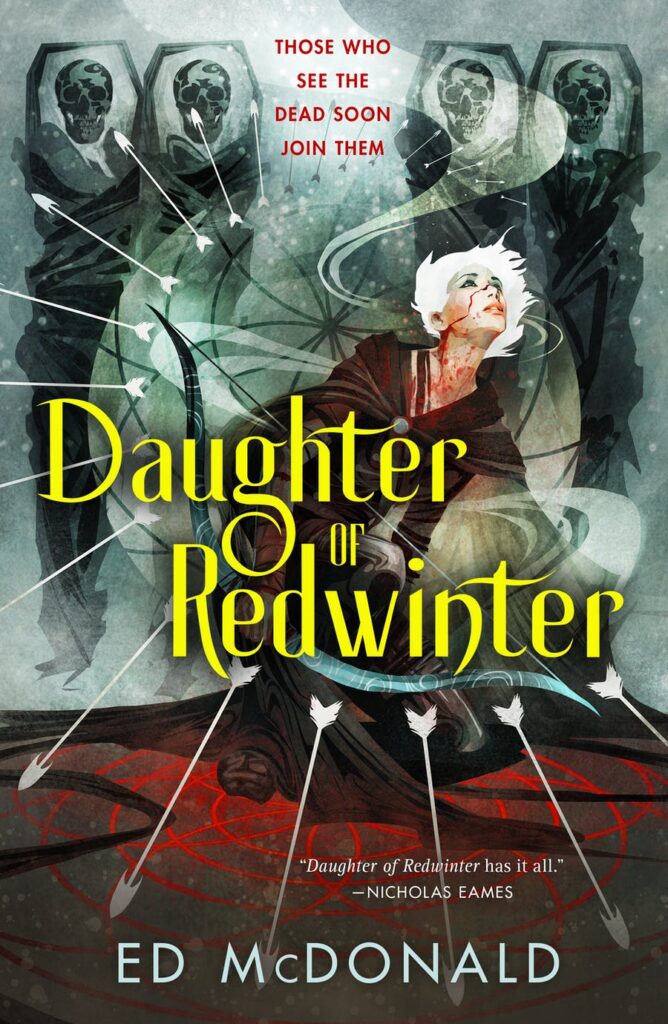

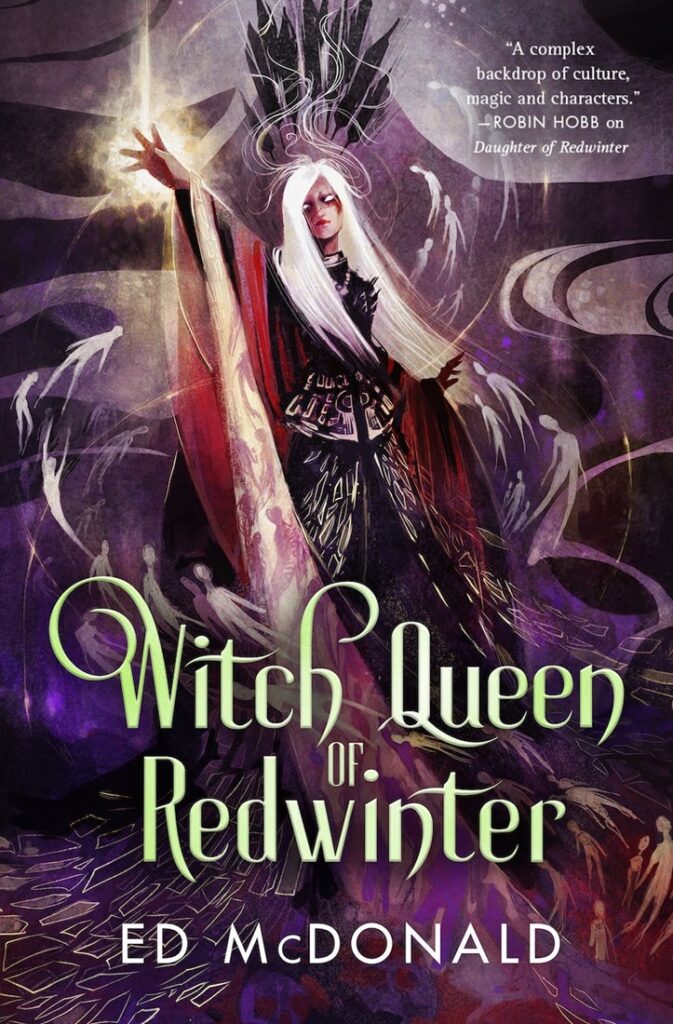
Daughter of Redwinter (The Redwinter Chronicles, #1) by Ed McDonald
Genres: Adult, Fantasy, Epic Fantasy, Queer Protagonists
Representation: Bisexual MC
Goodreads
Those who see the dead soon join them.
Raine can see--and more importantly, speak--to the dead. It's a wretched gift with a death sentence that has her doing many dubious things to save her skin. Seeking refuge with a deluded cult is her latest bad, survival-related decision. But her rare act of kindness--rescuing an injured woman in the snow--is even worse.
Because the woman has escaped from Redwinter, the fortress-monastery of the Draoihn, warrior magicians who answer to no king and who will stop at nothing to retrieve what she's stolen. A battle, a betrayal, and a horrific revelation forces Raine to enter Redwinter. It becomes clear that her ability might save an entire nation.
Pity she might have to die for that to happen...
I admit that even after three books, I don’t fully understand the magic here, but it’s fascinating. People who work magic (mostly known as Draoihn) do so by accessing what are called Gates, something they learn to do through meditation and focus. It’s described in the books thusly;
The Draoihn enter a series of existentialist trances that allow them to expand their consciousness into the world around it, become one with it and then affect it. To do so, they open a Gate in their mind.
The Gates are called Eio, Sei, Taine, Fier, Vie, Skal, and Gei. Each one confers different magical powers – opening Eio massively expands a person’s physical senses, Fier lets you affect or enter the minds of others, Vie grants a person the ability to manipulate living matter, and so on. According to the guide at the back of Daughter of Redwinter, there are about a thousand Draoihn of the First Gate, but only one hundred of the Second. The higher the Gate, the fewer people there are who can access it; only thirty people can open Taine, the Third Gate, and there are only TWO who can open Vie, the Fifth Gate.
Gei, the Seventh Gate, isn’t real, it’s a theoretical construct. But Skal, the Sixth Gate, is…odd. This is the Gate that confers all kinds of necromantic powers, but no amount of meditation or practice will allow a person to access it if they don’t meet certain criteria. (And no, it’s not some boring thing like you having to be born with the right power or whatever. It’s something you have to DO, or have happen to you.) As you will perhaps guess, Raine, the trilogy’s protagonist, meets the criteria…
My review of Daughter of Redwinter
My review of Traitor of Redwinter
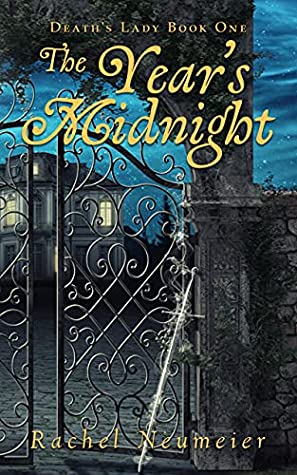



Death's Lady: The Complete Trilogy (Death's Lady #1-3) by Rachel Neumeier
Genres: Adult, Fantasy, High Fantasy, Portal Fantasy
Goodreads
A gifted psychiatrist, Daniel Dodson is perfectly aware that he's in a tough place personally following the death of his wife. Then a mysterious new patient offers a welcome professional distraction.
The world of swords and magic that Tenai so vividly remembers obviously isn't real. The deadly enmity and long war that left such deep emotional scars plainly symbolize something else. But Daniel uses the signposts of those confabulated memories to aid Tenai in building a new life for herself in the real world...
...until Tenai's enemies pull her back into her world of dark magic and darker betrayal. Daniel, pulled with her, finds himself fighting to protect Tenai, his own daughter Jenna, and himself in a struggle that threatens to plunge the world back into a war that may never end.
There’s two things about the magic in the Death’s Lady series that I think is noteworthy: one, no one and nothing can be sacrificed against their will. This is due to a Jesus-like figure in the past of the fantasy world, who died so that sorcerers could never again sacrifice other people without their consent. (Although this Jesus-like figure sounds way less friendly than the Christian one, for the record.)
The second thing is: magic doesn’t work if you don’t trust the person casting it on you. That has such fantastic implications: battle-magic isn’t really a thing in this world, for example, because you can’t use magic on your enemies, and if you have any reason at all to be wary of the person offering you healing magic, your injury isn’t going anywhere.
Both these things have had a massive impact on this setting’s history and development, naturally.

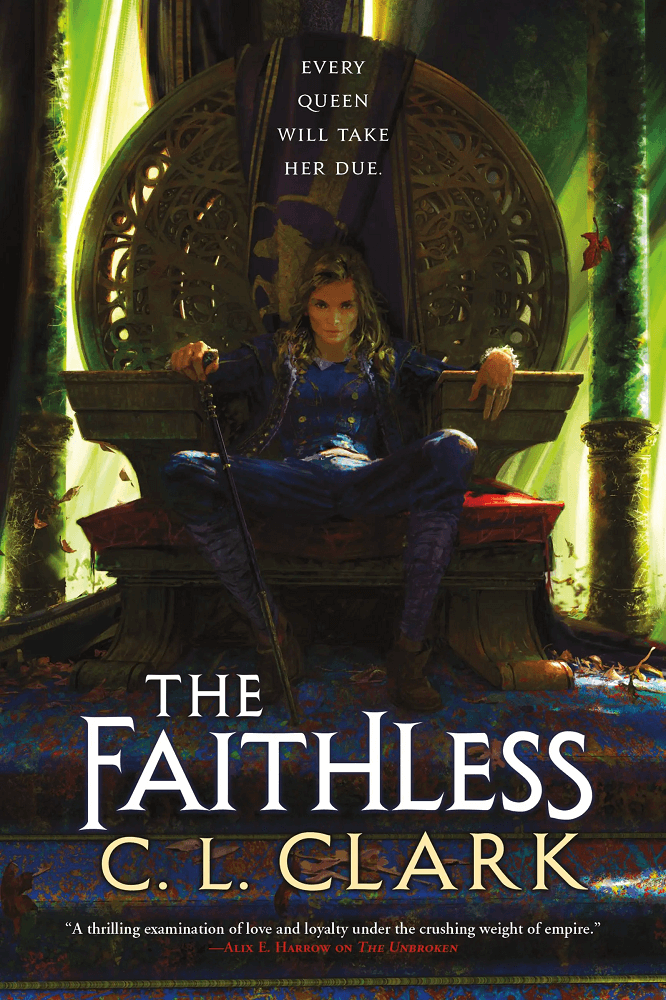

The Unbroken (Magic of the Lost, #1) by C.L. Clark
Genres: Adult, Fantasy, High Fantasy, Queer Protagonists
Representation: North African-inspired sapphic MC, disabled sapphic MC, F/F
Goodreads
Touraine is a soldier. Stolen as a child and raised to kill and die for the empire, her only loyalty is to her fellow conscripts. But now, her company has been sent back to her homeland to stop a rebellion, and the ties of blood may be stronger than she thought.
Luca needs a turncoat. Someone desperate enough to tiptoe the bayonet's edge between treason and orders. Someone who can sway the rebels toward peace, while Luca focuses on what really matters: getting her uncle off her throne.
Through assassinations and massacres, in bedrooms and war rooms, Touraine and Luca will haggle over the price of a nation. But some things aren't for sale.
In the Magic of the Lost trilogy, magic itself is relatively simple; it’s tied to the gods, and followers of different gods can perform different kinds of magic. But only if they believe. In this world, magic requires total faith, not in the spell you’re casting, but in your god. Mages who lose their faith, for whatever reason, are no longer able to do magic – though if I remember correctly, there’s at least one character who can cast magic again after regaining her faith.
What makes this approach interesting to me is that – you would think it would not be hard to have faith! Given that you can SEE magic working! It is objectively real, right in front of you. If you see it work, shouldn’t that be enough to convince you, forever, that the god in question is real?
Well, no. Because that’s not actually how humans work. We disbelieve in things we see all the time. Which is something I’ve never seen other belief-based magic systems acknowledge; this feels like a much more realistic, Adult take on the concept. Plus, there are so many reasons to lose faith in a god, regardless of the objective reality of magic; I think I remember one character who loses faith because of the terrible things happening to her people, and she can’t believe in a god who would let these things happen. I don’t remember if that was more of a ‘this god doesn’t exist’ or ‘this god may exist but doesn’t deserve my faith’, but either way it’s a complex approach to faith-magic that I really liked.
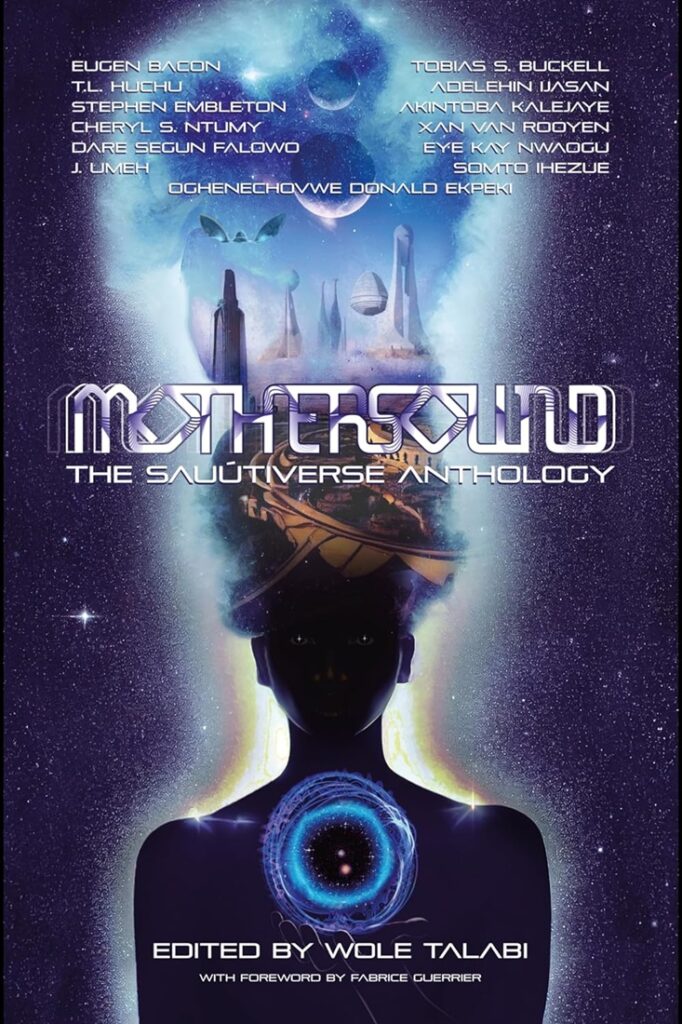
MOTHERSOUND: The Sauútiverse Anthology by Wole Talabi, Eugen Bacon, Tobias S. Buckell, Oghenechovwe Donald Ekpeki, T.L. Huchu, Adelehin Ijasan, Stephen Embleton, Akintoba Kalejaye, Cheryl S. Ntumy, Xan van Rooyen, Dare Segun Falowo, Eye Kay Nwaogu, J. Umeh, Somto Ihezue
Genres: Adult, Queer Protagonists, Science Fantasy
Representation: African-inspired settings and cast, some queer MCs
Goodreads
“The Sauútiverse is a mind-blowing, highly imaginative and deeply compelling sandbox. The wide range and excellent quality of these stories are a testament to that, offering yet another formidable trove of authors of African descent. In Mothersound, Talabi and company have offered us something seminal. This book will continue to influence the canon of Afrocentric futurisms for years to come.” — Suyi Davies Okungbowa, award-winning author of The Nameless Republic trilogy
----
The Sauútiverse is the first in an exciting new Shared World series guaranteed to entertain readers and introduce them to a new world of science fiction and fantasy by talented African writers. Featuring stories set in Sauúti—an Africa-inspired science-fantasy secondary world created by Africans, for the world—this world is like Black Panther meets Wild Cards with all the rich spacefaring worldbuilding of Dune.Sauúti, a five-planet system orbiting a binary star, is rooted deeply in a variety of African mythology, language, and culture. The Sauútiverse weaves in an intricate magic system based on the sounds of oral traditions and music, and includes science-fiction elements of artificial intelligence and space flight, including both humanoid and non-humanoid creatures.
----
“Mothersound: the Sauutiverse Anthology, is a rare and distinct Afrocentric treat that hums in the unity of a collective enriched with universal storytelling and the many languages of Mother Africa.” - Nuzo Onoh, Queen of African Horror, and recipient of the 2022 Bram Stoker Lifetime Achievement Award.
----
Sauúti is filled with wonder, mystery, and magic.Sauúti awaits you.
------
“The Sauútiverse is a powerful original collective concept, and this debut anthology clearly shows collaboration can create more than the sum of its parts while remaining firmly true to its African heritage and taking that boldly into the future.” — Ivor W. Hartmann, writer and editor of AfroSF.
-----
Mothersound: The Sauútiverse Anthology is first large scale production to come out of this shared world. The anthology contains short stories and novellas set in this fictional civilization based on a blend of African cultural worldviews. The anthology contains:
🪐120,000 words
🪐14 short stories and novellas
🪐Dozens of works of artContributing authors and artists include:Eugen Bacon, Tobias S. Buckell, T.L. Huchu, Oghenechovwe Donald Ekpeki, Somto Ihezue, Adelehin Ijasan, Stephen Embleton, Akintoba Kalejaye, Cheryl S. Ntumy, Xan Van Rooyen, Dare Segun Falowo, Eye Kay Nwaogu, J. Umeh.
Art by Stephen Embleton and Akintoba Kalejaye.
------------------------
"Fantastika at its best. The Sauútiverse invites a reader to drown in a poetic world, built with a Tolkenian attention to gripping detail, and full of creatures who excite the imagination in a dream-like rollercoaster. The illustrations are works of art in themselves, adding spice to the stories..." - Dilman Dila, internationally acclaimed and award-winning social activist, filmmaker and author.
The Sauútiverse is an incredibly cool, incredibly detailed shared universe created by ten African writers; it has since had a bunch more writers join. It’s a huge science-fantasy setting inspired by African mythology, cultures, and philosophy – which makes it WILDLY different from pretty much anything most Western readers have come across before!
There’s lots to love about it, but I’m featuring it here because of its magic. In the Sauútiverse, magic is sound, which also means that magic is language. The closer any language in this setting is to the ‘high language’, Sauúti, the more powerful it is for magic. (Given that this galaxy includes many different peoples with many different languages, all of them trying their best to recreate Sauúti…it can be a source of conflict.)
But sound is not just language. Magic is worked in this setting with resonance and frequencies as much as with words. Yes, you need Sauúti – but the Sauútiverse story-bible says that ‘there is a certain frequency or resonance that must be reached in order to perform the highest magic’. It’s not as simple as ‘speak the magic words’.
Even Sauúti is only a reflection of the Mothersound – this universe’s equivalent of the Big Bang (or maybe the First Word). This is very literally the first sound, which kickstarted the universe, and it’s believed that everything and everyone in the universe contains a tiny part of the Mothersound. Quite a few of the Sauútiverse’s magical traditions are devoted to trying to recreate the Mothersound, one syllable at a time. Your teacher has their piece of the Mothersound, and during your own initiation, you discover another piece of it, which you add to the piece your teacher taught you. In this way generations build up their knowledge of the Mothersound, one tiny bit at a time.
One thing I really like about the magic in this setting is that anyone can do it. In theory. Your innate ability to use magic is something you can improve – with personal growth. People who don’t see themselves or their surroundings clearly aren’t going to be able to work very strong magic, if they can work any at all.


A Book of Tongues (Hexslinger, #1) by Gemma Files
Genres: Adult, Fantasy, Historical Fantasy, Horror, Queer Protagonists
Representation: Gay MC, bisexual MC, M/M
Goodreads
Two years after the Civil War, Pinkerton agent Ed Morrow has gone undercover with one of the weird West's most dangerous outlaw gangs -- the troop led by "Reverend" Asher Rook, ex-Confederate chaplain turned "hexslinger," and his notorious lieutenant (and lover) Chess Pargeter. Morrow's task: get close enough to map the extent of Rook's power, then bring that knowledge back to help Professor Joachim Asbury unlock the secrets of magic itself.
Magicians, cursed by their gift to a solitary and painful existence, have never been more than a footnote in history. But Rook, driven by desperation, has a plan to shatter the natural law that prevents hexes from cooperation, and change the face of the world -- a plan sealed by an unholy marriage-oath with the goddess Ixchel, mother of all hanged men. To accomplish this, he must raise her bloodthirsty pantheon from its collective grave through sacrifice, destruction, and apotheosis.
Caught between a passel of dead gods and monsters, hexes galore, Rook's witchery, and the ruthless calculations of his own masters, Morrow's only real hope of survival lies with the man without whom Rook cannot succeed: Chess Pargeter himself. But Morrow and Chess will have to literally ride through Hell before the truth of Chess's fate comes clear -- the doom written for him, and the entire world.
In the Hexslinger trilogy, hexes are people who use magic, this world’s version of mages or wizards or whatever. You have to be born with the potential to be a hex, which isn’t that unusual in fantasy. But there’s a few things in this set-up that are: first, magic is different for everyone. In some cultures hexes can teach each other, but most of the hexes we meet over the course of the series have had to find their own way of working magic; Rook, the character the whole trilogy revolves around, uses Bible verses to shape his magic and create the effect he wants, but that’s not at all how other hexes do it!
Much more plot-relevant is the fact that hexes cannot be around each other. Put two hexes in a room, and they reflexively start trying to feed on each other until one of them is dead. It’s a very difficult reflex to control, which is why there’s no community of hexes, and why hexes can almost never carry pregnancy to term or, if they do, raise a hex child to adulthood. Honestly, the supernatural powers are one thing, but their inability to not devour each other is what would convince me that they’re monsters, if I were living in this setting!

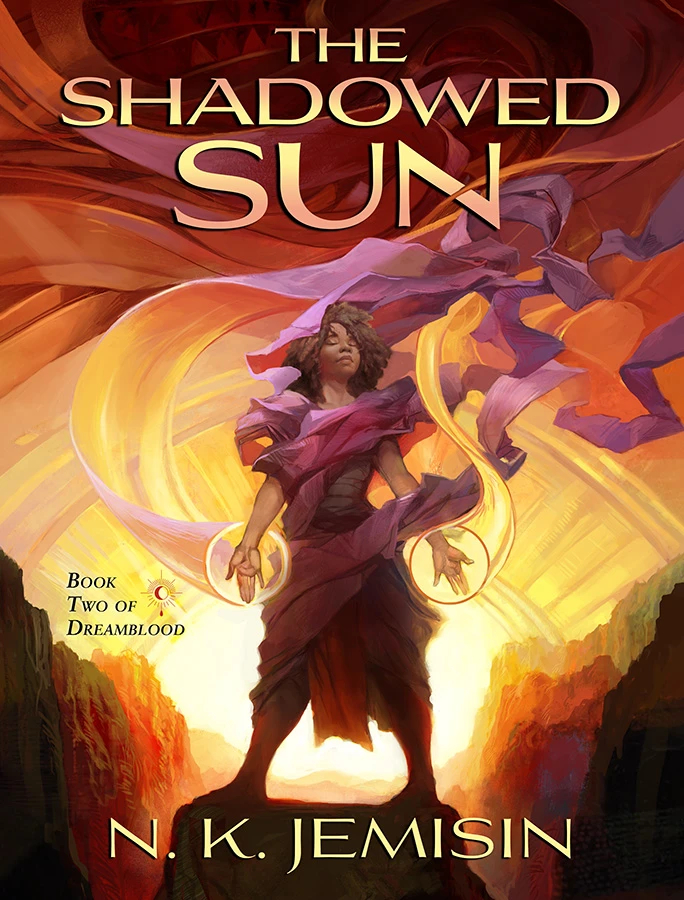
The Killing Moon (Dreamblood, #1) by N.K. Jemisin
Genres: Adult, Fantasy
Representation: Ancient Egyptian-inspired setting and cast, gay MC, asexual-coded MC
Goodreads
THE CITY BURNED BENEATH THE DREAMING MOON
In the ancient city-state of Gujaareh, peace is the only law. Upon its rooftops and among the shadows of its cobbled streets wait the Gatherers - the keepers of this peace. Priests of the dream-goddess, their duty is to harvest the magic of the sleeping mind and use it to heal, soothe...and kill those judged corrupt.
But when a conspiracy blooms within Gujaareh's great temple, the Gatherer Ehiru must question everything he knows. Someone, or something, is murdering innocent dreamers in the goddess's name, and Ehiru must now protect the woman he was sent to kill - or watch the city be devoured by war and forbidden magic.
I had to double-check I hadn’t already featured the Dreamblood duet on one of these lists, but apparently not! How on earth did I miss it?! Well, I can tell you about it now.
The Dreamblood magic system draws somewhat from the old idea of bodily humours, with special priests of the moon-goddess Hetawa gathering dream-humours from sleepers. There’s dreambile, dreamblood, dreamichor, and dreamseed, all of which are used for healing. This is already an incredibly cool premise, but it gets even better: the different dream-humours come from different kinds of dreams! And they’re good for healing different things! Dreambile comes from nightmares, and is used ‘for discouraging harmful growth and destroying unnecessary tissue in the body’, like tumours. Dreamblood is harvested from ‘the final dream that occurs at the moment of death’, and is used for bringing peace (possibly like a painkiller? It’s been a long time since I read the books, I don’t quite remember.) Dreamichor comes from ordinary dreams, the kind that are nonsensical, and the priests use it for repairing damage. But my favourite is definitely dreamseed, which a) comes from erotic dreams, which are sometimes specifically created by a sect of priests who specialise in causing/creating erotic dreams, and b) can be used to regrow lost limbs or heal genetic diseases. !!! (The official explanation is that these kinds of dreams are for ‘stimulating growth that ordinarily occurs only in the womb’, like the growth of entire limbs.)
I LOVE IT. Especially the fact that the kind of dreams which are most mocked/de-valued in our world (sex dreams) are the most valuable in this magic system!!!

Fair Haven by Wendy Palmer
Genres: Adult, Fantasy, Queer Protagonists
Representation: Genderqueer MC with ADHD, queer MC, major nonbinary autistic characters, minor trans character, minor F/F
Goodreads
Stronghold Fair Haven by the Sea is a beacon in a sometimes harsh world, open to all and deliberately, stubbornly kind. It also holds the honour and responsibility of hosting an atelier, a workshop for the rare and highly-prized magical engineers known as Mancers.
Hazel lives a comfortable, contented life in Stronghold Haven as a member of the team of elite bodyguards protecting the resident Mancer. But when another Mancer comes knocking on Haven's door to plead for refuge from the stronghold zhey've just escaped from, zhey bring a growing threat of invasion in zheir wake.
Ash is disruptive to Hazel's peaceful routine in more ways than just to his own astonishment, he's hopelessly attracted to the prickly, secretive Mancer.
This might be the start of something precious...or the end of everything he holds dear.
Explicit m/nb and m/m (different couple!) sex scenes
Mancy is a kind of engineering magic; mancers hear mancy as music, and are compelled to manifest that music by singing it into shape. It’s not just singing, though; mancers build things, physical objects out of all sorts of materials, and the mancy is what makes those objects work. Imagine a gadget that functions like an LED bulb, but if you open it up, there’s nothing in there, no reason it should light up. That’s what mancy creations are like; there’s no scientific reason the things they build should work like they do, because what’s powering them is magic.
Mancy isn’t a hobby: it’s a compulsion. Mancers who are unable to perform mancy will self-destruct, and/or lash out at the people around them; that’s why they have to live in places that keep ateliers (which are basically hardcore workshops, stocked with all the materials a mancer could possibly want). The almost holy obligation the rest of society has to mancers is a very important, plot-relevant part of the worldbuilding of the book.
Engineering magic is already a cool concept, but it gets weirder: mancers are all functionally autistic (though it’s not called that in-world) and non-binary. Since most mancers don’t come into their mancy until puberty or later, this raises REALLY interesting questions of what on earth the magic is DOING to them when it manifests!
There’s also the EXTREMELY plot-relevant issue of if and how mancers can work together on a mancy project, and how it would or could work.
Upcoming
Because I am a very lucky person, I get to read a lot of awesome books early. These next two haven’t been released yet, but I’m including them anyway! Don’t worry, there’ll be no spoilers.


The Unmagical Life of Briar Jones by Lex Croucher
Genres: Adult, Fantasy, Contemporary Fantasy, Queer Protagonists
Representation: Nonbinary MC, secondary Black character, secondary bisexual character, bi/pansexual love interest
Goodreads
Casey McQuiston meets The Secret History in this unmissable dark academia fantasy from New York Times bestselling author Lex Croucher following former childhood best friends who reunite at magical boarding school after years, only to find themselves enemies on opposite sides of the ugly secrets hidden within the gilded walls.
Welcome to the Temple School of Thaumaturgy ... and your newest dark academia obsession.
For as long as they can remember, Briar Jones dreamed of attending the Temple School of Thaumaturgy. Behind its looming ornate gates, the elite prep school—the place that has produced the most CEOs and Prime Ministers in British history—is whispered to be magical.
Briar's best friend, Sebastian Wolfe, never cared about Temple or believed in the rumors. He just wanted them to stay together forever.
When, at age 11, Seb gets an acceptance letter and Briar doesn't, their childhood friendship is shattered. Seb vanishes onto Temple's grounds and Briar resigns themself to a mundane life. But they can't completely forget their yearning for Temple, for the extraordinary, to be one of the chosen in the ivory tower.
Seven years later, a summer job advert a temp position sorting through the junk in Temple’s attics. Briar takes it. And they discover that quiet, sensitive Seb, the boy they once loved more than anything else in the world, has become a beautiful, arrogant villain feared by most of the school. And worse, the secrets Temple is hiding might not be so magical after all, but a dark conspiracy with implications that extend far beyond the gates.
The magic system Croucher has created is one of those that looks simple at first glance, but reveals itself to be genius the more you think about it. Wizards (they’re not called wizards in the book, but I am calling them that) basically make a big promise or oath to some nebulous Greater Power, and in return, they get the ability to do magic.
I want to be very clear here: they do not know what the Greater Power is. This isn’t a D&D type set-up where they know the name of the deity they’ve bargained with and have a nice clear contract laying out what they get for what they do. Some of them think it’s the Judaic God, but it could be anything! Possibly it’s the magic itself. (That’s my theory.)
The most interesting part, for me, is that in this system, wizards need to specialise quite quickly – in fact, most of them only really learn one single spell, which they master. It’s just too difficult to get really good with multiple spells, apparently.
Looks like a simple system, doesn’t it? But it interacts with the generational wealth and privilege of the Temple School of Thaumaturgy in freaking GENIUS ways – and with the history of political power within England, even as far back as the height of the British Empire. It’s absolutely horrifying – but utter genius.

Bodies of Magic by Freya Marske
Genres: Adult, Fantasy, Queer Protagonists
Representation: Nonbinary queer MC, autistic queer MC, MLM MCs
Published on: 15th September 2026
Goodreads
Grey’s Anatomy meets A Deadly Education in this dark academia fantasy from USA Today bestselling author Freya Marske.
At the Academie of the Grand Duchy of Sieuxerr, every mage with the healer’s gift has five years to master their power and to prepare for the infamous Grand Exam—a five-day trial whose results will determine their entire future.
The list of exam rules includes:
• You will perform five practical cases.
• Your exam group is chosen at random.
• You pass together, or fail together.It does not include:
• On the first day, your exam group will find a classmate's dead body in the exam hall.And as they will soon discover, this particular group all have something to hide... and all have a connection with the dead girl, a brilliant scholar who would have been first in their class.
Five scholars. Five secrets. Five days in which to solve a murder, pass the most important exam of their lives, and uncover a secret larger than all of their own combined. One with the potential to change the world.
Are you ready?
Let’s begin.
I mean, OBVIOUSLY healing magic is very, very cool. But that’s actually not what got Bodies of Magic a spot on my list. The thing I love about the magic in this setting is that it depends on location. By which I mean, mages who are born and raised in THIS area develop THIS kind of magic – but a few hundred miles away, the mages born and raised THERE develop THAT other kind of magic! And it’s not an ethnicity thing; if a family from country A up and move to country B, any mage children they have in country B will have country B’s magic. It doesn’t matter if their ancestors all had country A’s magic!
THIS IS SO FREAKING COOL TO ME! And what I love is that Marske really digs into it, exploring what the economic and international ramifications would be. The healing magic of Sieuxerr is, as you’d expect, incredibly valuable, the most sought-after in the world, and that means that lots of countries send immigrants there to hopefully have healer kids – and then go back to their home countries once those kids are trained up. Lots of people are Not Happy about it!
And of course – HEALING MAGIC. The healing magic itself is also excellent! But that, you’ll have to read the book to learn about.
That’s my 10 for 2026! My magical abilities list should be up in a few days.
Looking for more? You can find my earlier lists here;
Ten Ridiculously Cool Magic Systems!
Ten (More) Ridiculously Cool Magic Systems!
Ten (Even More) Ridiculously Cool Magic Systems!
Ten (Yet More) Ridiculously Cool Magic Systems!
Ten (Still More) Ridiculously Cool Magic Systems!
(The Return Of) Ten Ridiculously Cool Magic Systems!
And I’d love to know what some of YOUR favourite magic systems are!



There are 2 series and a standalone I need to read. You can probably guess which ones I’m referring to from this post.
Hmm…no, I’m not sure, actually! Which ones?