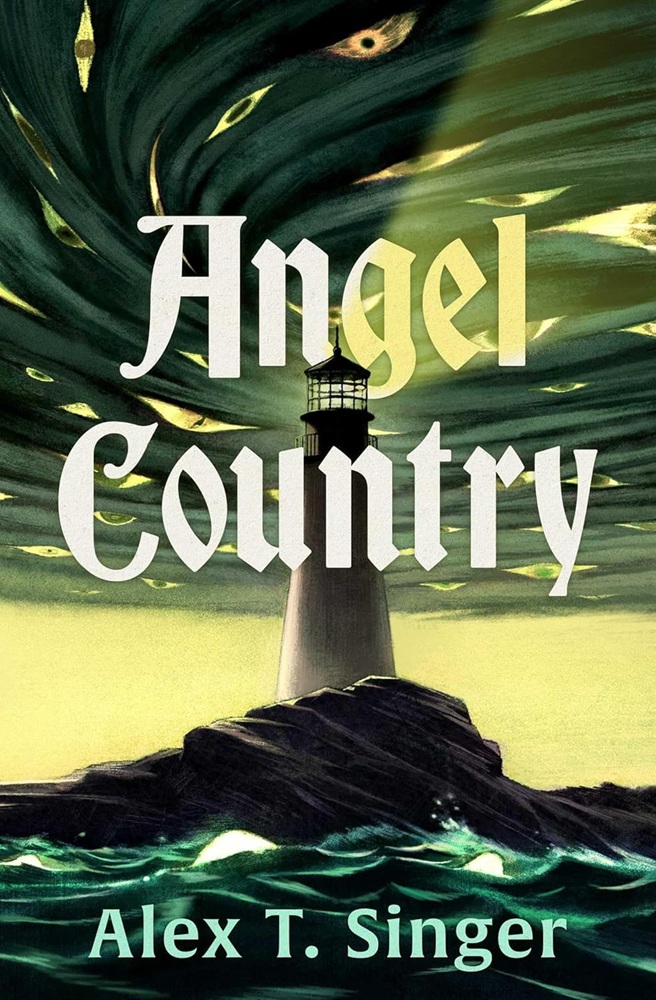
Angel Country by Alex T. Singer
Genres: Adult, Fantasy, Horror
Representation: Queer author, neurodivergent-coded MC, Native American love interest, secondary Black character, secondary trans (or something???) character
PoV: First-person, past-tense
Published on: 20th October 2026
ISBN: 1668216531
Goodreads
In an alternate early 1900s, a scientist hunts down her former research partner after he steals her life’s work before his greed reshapes the world in this darkly wondrous cosmic horror—perfect for fans of The Starving Saints and Ring Shout.
One morning in 1904, scientist Ada Franklin wakes up in her own grave. After clawing her way out, she discovers her lab abandoned and her research partner gone—along with her life’s work: a prototype designed to enable human-angel communication.
Angelic infestations have kept the original thirteen colonies from expanding for generations, but Manifest Destiny is a growing force in the new century. Whoever controls Ada’s invention may gain the power not only to communicate with angels, but to command them.
With no one else to trust, Ada resurrects her former lover, now monstrously altered by the entities they once studied. Together they pursue the man who betrayed her across a country warped by celestial horror, where angelic contact remakes both flesh and mind. But the closer Ada comes to reclaiming her work, the more she suspects humanity’s greed could prove more terrifying than the divine.
A fever dream mash-up of alternate history, dark fantasy, and eldritch horror, Angel Country delivers a morally complex tale that asks a chilling question: when faced with unimaginable power, who is truly the monster?
I received this book for free from the publisher via NetGalley in exchange for an honest review. This does not affect my opinion of the book or the content of my review.
Highlights
~‘biblically accurate’ angelic horror
~THAT IS TOO MANY EYES
~women who love science more than humanity
~(more than THEIR OWN humanity, even)
~no women rights = Women’s Wrongs
THIS BOOK IS GENIUS!
Not because it has an incredibly cool premise. (Though it does.) Not because it features one of the most awful-person-amazing-character protagonists I’ve ever come across. (Though it does!) Not even because the worldbuilding is endlessly fascinating. (Though it is!)
But the WRITING. The sheer, technical writing craft that went into Angel Country is MINDBLOWING!
See, Ada, our main character, is not well. She’s done…something to herself. Experiments, with angelic tissue. It’s having an effect on her mind. Sometimes she loses track of where she is or what’s going on. Sometimes she wakes up to find herself out on the marsh instead of in bed. Sometimes particular stimuli make her thoughts go very strange indeed.
And Alex T. Singer has caught all of this in the prose. Forget telling us that Ada’s not well; forget even showing us. Singer makes us experience it, with run-on sentences and spliced paragraphs and forgotten commas, with shifts in perspective and time. This is not a simple case of dual timelines; at one point, alternating paragraphs follow entirely separate scenes happening at different times, a fight-for-our-lives scene spliced into something much calmer. That example – my gods, the writing rhythm!!! The way the switches back and forth create this amazing strobing effect, ratcheting up the tension immensely, turning the pacing to 11 – you could play it like music, the bass is so clear; you can see it in your head like it’s been synced to a soundtrack. It’s AWESOME.
Thieves. Bastards. Con men. Oh what I would have done if they’d been in front of me in that moment. They deserved nothing as beautiful as an angel’s maw but I might have made an exception if I could have gutted them with my newfound strength oh I would have I digress.
You see what I mean? You see how in the above quote, how the run-on sentences make us feel Ada’s not-sanity? How the lack of commas makes it punch harder? This kind of thing is CONSTANT in Angel’s Country – not run-on sentences specifically, but this phenomenal awareness of and skill with writing rhythm, which Singer uses ruthlessly and masterfully to create whatever effect she wants a particular paragraph to have.
This is an author who understands EXACTLY what Ursula Le Guin said about writing rhythm, and it makes me so happy I could freaking cry.
“Men are snakes,” she said, emphatically.
“Didn’t you use to be one?” I managed to ask, with a ragged smile.
“Perhaps,” garbled the Keeper, the wrinkles of her face lifting into what I’d come to recognize as a smile. “All the more reason I would know!”
The book’s description calls it a ‘fever dream mash-up of alternate history, dark fantasy, and eldritch horror’, and that is extremely accurate. But it’s also a manifesto on Women’s Wrongs, on female rage, on women who are unapologetically mad scientists. Ada has spent her entire life being belittled and dismissed, even though she has an incredible mind, is light-years smarter than the men whose names end up on the results of her studies and experiments and proposals. This isn’t something the book lingers on – I would be bored if it did – but we see plenty of examples of it, and it’s obvious that enduring a lifetime of this is part of the reason Ada is so – well, so Ada. She has to fight tooth and nail to be allowed anywhere near the science she loves so much, and it is equal parts heartbreaking and infuriating and Singer makes you feel all of it.
Would you consider keeping just the first initial of your name–
Would you consider signing on as a significant other–
Would you consider
Consider
Which is not to say that Ada is likeable, even if her struggles in academia are easy to sympathise with. Ada is terrible. She has next to no social skills, has a hard time seeing people as people rather than tools or obstacles, and if there’s ever a moment where scientific inquiry and basic ethics are in conflict, she tosses ethics out the window. I read her as autistic – definitely not neurotypical – which might explain the poor social skills…
“Unbelievable,” she said. “So. How human are you, these days? Did you call me up here for a free meal?”
I stepped in very quickly at that supposition. “Oh, no. That is not one of the side effects. No angelic entity has been known to consume human flesh as sustenance.”
They both turned, staring. I realized very quickly that had not been what was on either of their minds.
Coralie threw up her hands. “I meant, did you expect me to do a food run. Jesus Christ, child.”
…but most of it is just Ada, and her overwhelming, overriding-everything obsession with angels. She is fascinated, she is driven, she loves angels and loves studying them, and it’s so intense and well-written that there’s no way for the reader not to end up feeling it too. It’s infectious. (Like all things angelic) Even as these ‘biblically accurate’* angels are gross and terrifying, Ada’s adoration for them sweeps you up – which creates this incredible effect, wherein you feel fondness and wonder alongside the ick and horror. It reinforces everything Singer does with the writing rhythm, so even the reader’s emotions start to mimic a Salvador Dalí painting, melting and strange and surreal. Magnificent!
I loved Ada’s passion; I loved that Singer made me feel it too. I loved that I was never in any doubt about the strength of Ada’s convictions and motives – that I never doubted that Ada would absolutely do the terrible things she’s done – and is doing – and will do – because her passion for angels and the study of them is unquestionable.
But gods, the terribleness of the terrible things she does! The gradual, dawning realisation of exactly what her prototype is!!! (I kept telling myself no, you’ve guessed wrong, it CAN’T be that, it just CAN’T. Even Ada wouldn’t do that. BUT FRIENDS, SHE DID.) If the story were only slightly different, she would be unambiguously the villain, and honestly the only reason she isn’t unambiguously the villain here is because someone else is worse.
And yet, I can’t help admiring her. For her passion, and her genius, sure, but also her…horrifying personal strength? To take just one example: due to the experiments she’s run on herself, over the course of the book Ada’s body starts shapeshifting, growing extra parts, and she bites them off to hide them. BITES
THEM
OFF.
Can you imagine the kind of determination of will it takes to be able to do that?! And she does it so casually. Her first-person narration barely even mentions the pain. Because the pain is unimportant. What matters are Ada’s goals, and anything required to accomplish those goals? She will do, without even hesitating.
I used my teeth to pry it off, and held my hand until the pain subsided, and the skin was much more pallid and unbroken. I swallowed the excess, knowing my altered body would do the rest. I did wish I could have logged it.
Ada, I say this with love, but WTF?!
Ada’s love for angels is far from her only effect on the writing of the book. Huge, game-changing revelations are dropped carelessly, dismissively, because to Ada they are all unimportant facts, are things she takes for granted even though we have been wondering about them for 300 pages. I loved that, loved how sneaky these mic-drops were, how much the way we learn about them showcases Ada’s self.
Just. My love for the writing here is endless. Every detail about the prose is deliberate and full of meaning; sometimes individual word choices gave me galaxy-brain moments! Even capital letters convey so much to the reader, in some scenes! And like I mentioned earlier, the shifts, sometimes mid-sentence, of perspective, especially around Blake.
“Ada,” he began, with a catch in your voice.
!!!
As should probably be clear by now (as is inherent, really, in any mention of ‘biblically accurate’ angels!) Angel Country is body-horror central. As the book goes on, we see more and more of what Ada’s changed body is capable of, with more and more extensive and dramatic shapeshifting, but Ada is not the only example. The lover mentioned in the book description, Blake, is in a state similar to Ada’s; worse, as they try to chase down the thief of the prototype, they encounter a whole lot of people who have been affected by its use, many of them warped in one way or another – growing extra eyes, or melting. Because exposure to angelic emanations is very bad for you! And animals are affected, too; at one point a poor horse grows gills, and there are many instances of ‘canonized’ birds. The angels themselves are very rubbery and slippery and shapeshifty, with nightmare fuel galore! So. Brace for that?
I watched the gooseflesh on my arms open to make way for tiny waving down feathers.
The worldbuilding never stops being fascinating. This is a North America where only a slice of the East Coast has been colonised; the rest is still squarely in the hands of the Native Americans, a state of affairs that no one expects to change in the foreseeable future. Angels seem to mainly come from the sea, which is why the coast is lined with bells – because bells keep them away. The connection between angels and music is so much fun to learn about, as we follow along with transcripts of Ada’s experiments and see her and others utilise her findings in real-time, pacifying or driving away angels to a limited degree with specific rhythms, songs, drumming. (THE ELEPHANTS!!!) And the way angels warp the animals around them! Especially human animals; humans exposed to too much Grace, especially long-term, become ‘canonized’ into Saints, deeply creepy eldritch beings who definitely can’t be considered human any more. Several Saints are vital to the plot – in fact, everything I’ve summarised here is hugely plot-relevant! There’s not a lot of extraneous detail – probably because there’s no extraneous words in this book, full stop. As I keep saying, the writing is too good, and too powerful, for that; every word is a bullet.
Which is especially clear in all the breathtaking visuals Singer gives us. Long before I was finished with Angel Country I was longing for someone to make it into a tv series, because this book is full of incredible, and often incredibly cinematic, visuals. The fight scenes (and there are several) are phenomenal; Ada pushing her shapeshifting abilities is often grotesque but also amazing; and of course the angels themselves, swarming on a beach or flooding into a city or flying in strange patterns! To say nothing of all the body-horror monstrosities; human civilians caught in the prototype’s effects, or animals turning strange under angelic exposure. Basically, if this was ever adapted into something live-action, I hope Guillermo del Toro is the one they call to direct it.
We hadn’t set the lanterns up that high, but up above, we saw a halo of light. The halo was made up of dozens of small bodies, all circling each other in increasingly elaborate concentric circles. Each of these bodies comprised at least six or seven wings, pearlescent white and dappled with gold. They beat furiously.
(The above quote is one of the tamest of my favourite visuals, because I refuse to spoil you for the properly breathcatching ones!)
And as if all that’s not enough? Angel Country is freaking FUNNY. I lost count of how many times I burst out laughing; at Ada’s Scientist Arrogance being disproven in hilarious ways; at the wryness of the narration; at the ridiculous images Singer comes up with at times. There’s a moment where a putti – a tiny angel – gets kicked like a football by a civilian who is just Done With This Shit, and I laughed until I cried. I had to go read it aloud to my partner, who also found it hysterical.
There’s even a quiet thread of queerness running through the background. Alex T. Singer is openly married to another woman, and has definitely brought what I can only call a queer sensibility to the book as a whole (if you know what that means then you know, and if you don’t know then I can’t explain) but there’s also the Keeper, a very plot-relevant Saint who was apparently a man when human and now uses she/her, and Ada’s parents seem to have been part of a bisexual polyamorous trio. It feels very of a piece with creating an alt-history where North America remains in the hands of its indigenous peoples, or casually drawing attention to the racism of the time period by making one of the important secondary characters, Cora, one of the first Black women to practice law.
“It’s big, Cora.”
“You don’t say. Bigger than the national conspiracy to keep us from the vote?”
Blake did pause to think about that one.
“About equal,” he concluded, “but there’s probably some crossover.”
Angel Country is not an easy book: it definitely requires Brain On reading. As well as Ada’s own narration, there are excerpts of other people’s lectures, case files from experiments, footnotes that track Ada’s mind coming apart. Sometimes we get other people’s memories. I already mentioned how different scenes are sometimes spliced together. It is often not immediately clear whether a new scene is taking place in the past or the present (ie, before or after Ada wakes up in a grave). Especially in the second half of the book, clues or revelations often have game-changing ripple effects on what we thought we knew, and those ripple effects are often retroactive, casting scenes or even chapters we’ve already read into a new light. So alas, this will not be a book for everyone; it isn’t straightforward enough to be mass-appeal, even aside from all the horror elements.
But my gods, this is a me-book. It will be on my Best of Year list come December, and it will be on my Best of Decade list come 2029, because Alex T. Singer is a genius. The sheer craft of Angel Country would have had me starry-eyed even if it hadn’t also featured so many of my very favourite things: genius women who are objectively terrible, men who love them anyway, shapeshifting, body-horror, ‘biblically accurate’ angels, Women’s Wrongs. I feel very strongly that this book was written for me specifically.
Now I need everyone to buy it so Alex T. Singer gets to write a gazillion more books!!!
*At this point, ‘biblically accurate angels’ is a term that has come to represent a recognised aesthetic inspired by ophanim angels specifically, but technically it is a misnomer, since the vast majority of angels in the bible seem to be indistinguishable from humans. If I remember correctly, the ophanim – the burning wheels covered in eyes type of angel – only show up in the bible one time! Anyway, that’s why I always put quotes around ‘biblically accurate’. I adore the aesthetic SO MUCH, though, whatever we call it!
Trigger warnings: View Spoiler »




Leave a Reply