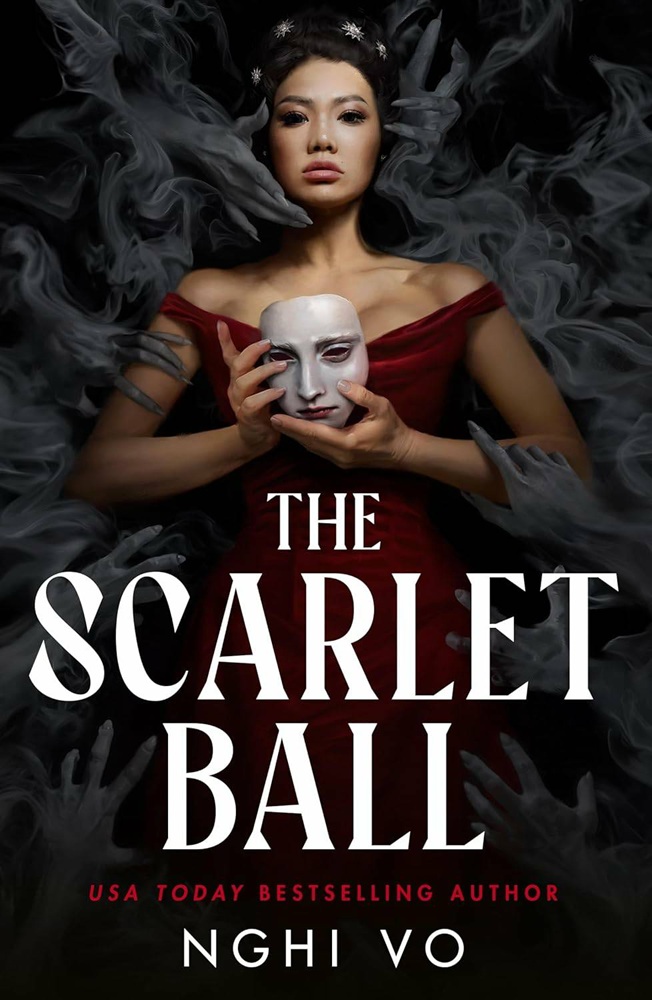
The Scarlet Ball by Nghi Vo
Genres: Adult, Fantasy, Historical Fantasy, Queer Protagonists
Representation: Biracial (Vietnamese and French) bisexual MC
PoV: First-person, past-tense
Published on: 6th October 2026
ISBN: 1250904978
Goodreads
From USA Today bestselling author Nghi Vo, this all-consuming tale of ballrooms and bloodshed weds The Gilded Age with the Gothic vision of Guillermo del Toro.
Pick a face, pick a fate.
Judith Ban, former convent girl, courtesan, and failed thief, is on the lookout for her next identity. The daughter of a Vietnamese adventuress and a French naval officer, she’s no stranger to risk, but she’s unprepared for the secrets of New York’s legendary Four Hundred, or for the women who build their power at the city’s heart through blood-soaked, gold-etched rituals of demonic marriage.
In exchange for enough wealth to outrun her past, Judith strikes a deal with the matriarch of the powerful Howard family: she will stand in for the missing Howard granddaughter, who was poised to make her debut when she disappeared. With Miss Iphigenia Marshall’s face stitched over her own, Judith is white, rich, and about to risk body and soul in the deadly games that determine which girls will find a match—and which will be devoured. If she can keep her wits and her life, her reward will be a husband with undreamt-of power who will be hers to command... so long as she can keep his infinite hungers fed. But to survive the season, Judith will have to seduce a storm in the shape of a man, before the night to which everything has been leading—the Scarlet Ball where the demons choose their brides.
A razor-sharp subversion of romance tropes and nightmare of manners, Vo's fusion of history and fantasy does for Edith Wharton what her acclaimed debut The Chosen and the Beautiful did for F. Scott Fitzgerald.
I received this book for free from the publisher via NetGalley in exchange for an honest review. This does not affect my opinion of the book or the content of my review.
Highlights
~nightmare of manners
~hedonism as defiance
~intoxicating prose
~more solidarity between humans and demons than poor and wealthy
~Nghi Vo’s best yet
Have you ever had truly excellent red velvet cake? I mean really excellent, not the bland stuff they serve at most coffee shops. The kind that’s so rich you have to take breaks between bites, or be overwhelmed; the kind with frosting so sinfully sweet each taste feels like you’re getting away with something. The kind you linger over, because you’ll mourn when it’s gone; that turns you into something predatory, hunting down every last crumb on the plate. The kind that would get a friend stabbed with your fork, if they tried to steal a piece.
That’s The Scarlet Ball.
If you’ve read and loved Nghi Vo before, you are not ready for this book: she has outdone herself a thousandfold. If you’ve never read a Nghi Vo book before, then this is the perfect place to start, the book that will leave you addicted to her decadent prose, her wild, beautiful magic, her heroines who revel in everything they are.
It emerged like wickedness from Pandora’s box, dark and eager to ruin the world.
Judith, Judith, Judith. Here is the protagonist I’ve been longing for, razor-sharp and ruthless with it, not just willing but able to dance with demons for her dreams. Morally-grey? Oh, in spades. She isn’t Nice, she isn’t Gentle, she is not any kind of Good Girl – she’s amoral at best, a starving tiger, wary and hungry and merciless, and I love her for all of it. I love how unabashed she is about her hunger, how untender she is with others as well as with herself, how unashamed she is of her everything. She makes me think of Lilith from Jewish folklore, that same kind of – elemental, feral freedom, the same sense of being untamed and untameable.
Which makes her such a perfect candidate for the Scarlet Ball, for the demon lords. Vo’s demons aren’t the Abrahamic kind; they’re elementals, forces of nature, natural disasters that have taken the form of men. (Been given those forms, even.) No wonder so many of the women who try for a demon husband fall; they’ve living in a world that stamps the wildness out of them, and you have to have more than a little wildness in you to be able to spar and dance and marry a wildfire, a mudslide, a flood.
(Except one of the many things Scarlet Ball does is explore the strength and power of these women, even if it’s not the strength or power we might think it is at first.)
But though she is wild, Judith is not fearless. Over and over again throughout the book, she is afraid, terrified, and that – makes her so much more vividly real than if she was contemptuous of the danger. She knows her own strength, in all senses of the word, and she knows what she’s capable of – which means she fully understands how completely outclassed she is by these wildfires and floods that look like men and want to eat her alive. That Judith is a long-time survivor enriches the whole scenario, because if she is afraid, we understand, after everything she’s been through – if she’s afraid, then we definitely should be. We can trust Judith to – accurately assess the situation she’s in, the threats to her, in a way we couldn’t if she had a more typical kind of confidence.
In so many ways, Scarlet Ball is a horror novel, and it can be difficult to decide whether the demons or New York’s ‘elite’ are the more monstrous. This is very clearly intentional. Judith is biracial – Vietnamese and French – and her poverty would put her at the bottom of the social hierarchy even if she were white; she is very, very aware of how disgusting the 1% are, and of how completely they would tear her apart if they realised she is not the mask she wears. Her terror of the demon lords is visceral, but at least they’re honest about what they are and what they want, and in a very real way they can’t help it. They’re not human and never will be. But the wealthy elite Judith’s infiltrated? What’s their excuse for the damage they do? This book is so full of beauty, an endless waterfall of wonders pouring into our laps, and I cannot express how much I love beautiful things being written with beautiful prose (which of course Vo’s always is) – but despite how much I loved it, Judith’s awareness of the context of all that beauty often had me wanting to spit. The shallow, meaningless things the wealthy spend their money on, when there are people starving and broken and dying a few hundred feet away! How dare they?
You feared a wildfire for its devastation, for the sudden and unthinking loss of life and property. You feared people that rich for their idle whims alone.
And that’s very far from all their monstrousness. Some of those overseeing the Balls seem eager for the new generation of would-be demons’ brides to fail and be slaughtered; at various points, other debutantes deliberately sabotage Judith, in moments and ways that could get her killed – that are clearly intended to get her killed! And they do so without knowing she’s a pretender; they do it while fully believing that she’s one of their own. Probably I am terribly naive, but I was stunned every time it happened. WHAT IS WRONG WITH ALL OF YOU?!
But of course, this is what these women have been reared and trained for, and it’s not even a metaphor, it’s just straight-up Patriarchy. All other women are competition; the only thing that matters is getting the best husband. It’s not like that’s an unfamiliar concept, alas.
(What would happen if the women banded together, instead? If they became allies instead of competitors? If they rejected the competition? Months after finishing this book, I’m still wondering about that.)
You can’t even blame these young women for trying to take out the competition. They’re not deluded or working from false information: gaining a demon husband IS power. Everyone who wins such a husband will have the power of a natural disaster at their beck and call – and we swiftly learn that these husbands worship their wives. A demon husband is never mad at you, never disagrees with you, will never divorce you or beat you or cheat on you; a woman with a demon husband is immune to almost all of the dangers married women faced at this point in history, in this part of the world. At first glance – at second and third glance, even – it looks like a feminist power-fantasy.
It was seen as wise for girls to starve a bit before the events. It kept us from throwing up out of nerves or needing to maneuver those fancy clothes overmuch in a powder room, but more than that, I think it kept us docile and woolly-headed, even when we were impressing bankers and industrialists rather than demons.
But it’s more complicated than that. Because the young women have been groomed for this from birth, because it’s their families that want these husbands, it’s the families, more than the wives, who will benefit. New York’s Four Hundred (or at least, the ones invited to participate in the Balls) offer up their daughters to monsters, sacrifice their sons to them, for more – more money, more power, more more more. That the demon husbands literally eat their wives, piece by piece? Well, that’s a cost these families can live with. Even if their daughters, sooner or later, can’t.
Girls like her balanced their wealth and reputation of their families on their heads. They were expected to bite their tongues and swallow the blood, and you saw in their perfected faces how they were prepared to do so all their lives.
None of which erases the fact that these women are not only victims. The opportunity to and process of winning a demon husband is a study in the kyriarchy, with multiple shifting forces and dynamics of power and privilege in play at any given moment. These women are sacrificial lambs, but they really will have power, power in the world and power over their husbands; in many ways having a demon husband is safer than having a mortal one! Which is one reason, of course, that all these mothers train and offer up their daughters: not only for the familial benefit, but because they want their daughters to have what they have. Especially in this time period, it’s not at all hard to see why mothers who do love their daughters would want this for them.
Nothing about this, or about the book as a whole, is reductive.
“At the White Ball, you chose to call down the demons. At the Rose Ball, the choice is ours. Be graceful, be lucky, be without fear in the face of the first things that made men afraid, and we will love you. Be otherwise, and be eaten.”
There’s so much more to the magic than the titular Scarlet Ball. For one thing, winning a demon husband takes far more than a single night at a single party; there are three capital-B Balls, the White and the Rose and the Scarlet, each of which anchors a different part of the – process, trials, and there’s a lot of work to do between them. But also…magic suffuses this setting. Vo has created a world that feels like a natural progression from the ones she’s shown us before; there are echoes here that speak of Siren Queen, or The Chosen and the Beautiful, or even City In Glass. It’s as though all of those were practice for Judith’s world – a world where for a few pennies a witch will let you see through the eyes of a pigeon and survey the city from the sky; where servants swap their memories of the household they worked at for their final paycheck; where a girl caught in amber can become your best friend. It’s an extravagance of wonder, of stunning strangeness and exquisite imagination, and I delighted in it endlessly, even when I probably should have been more horrified.
And obviously, there’s the mask Judith wears – the mask that has to be sewn on over her own face, every time she masquerades as Iphigenia. (Pun fully intended.) There are endless layers of symbolism to that mask and Judith’s wearing it; to the fact that she is so very good at wearing it, good enough to fool New York’s Four Hundred. I could talk about it as straight-washing (a brief line confirms Judith’s bisexuality, though queer readers will pick up on the signs long before it), or white-passing, or how perfectly it showcases that there is nothing special at all about being rich, no intrinsic difference between people who are poor and people who are not; anyone can become either, anyone can be either, the 1%’s insistence that they are special is a pathetic delusion. If it weren’t, there would be some quality of wealth Judith couldn’t mimic no matter what she wore, and there isn’t.
Walk like your spine is a sword, walk like you balance a feather on your head, that was what all those fraudster dance instructors say, but they were wrong. You walk like you’re on the way to the gallows, and the only thing left that matters is that you are beautiful as you do it.
This is a book about hunger; so many different kinds of it. There’s the hunger of New York’s wealthy for more, and the hunger of the demon lords for life, and most of all Judith’s hunger, her soul-starved hunger for beauty. There’s a substantial body of philosophy that says humans need beauty, that beauty feeds our souls like food feeds our bodies, and I couldn’t stop thinking about that throughout Scarlet Ball, because Judith’s hunger feels like a need, feels like something starved to the point of ferality, viciousness, ruthlessness. Without reading the book, it would be so easy to dismiss Judith as a gold-digger, as greedy, but instead – instead Vo uses her to not just argue, but prove that Judith’s hunger is real and valid and something we all share – a hunger we all deserve to feel sated.
Which makes the decadence, not just of imagery but of prose, into something very powerful. Like the works of Poppy Brite or Cassandra Khaw, when Vo takes the horrific, the terrible, and makes it beautiful, it breaks the fourth wall, brings the horror into us, makes us part of it. Is it not horrifying, the realisation that you find this awfulness beautiful, the realisation that you’re savouring every word and every drop of blood? Does it not make the reader into a kind of participant? Does it not make us, just a tiny little bit, monstrous?
But as well as that, Scarlet Ball’s approach to beauty is immensely subversive. Calvinist philosophy – which states that wealth and privilege is God-given and if you don’t have them you’re not meant to – is baked into the history of the USA and stains quite a lot of the modern West (brace yourself for a proper research rabbit-hole if you go look into it), and Scarlet Ball is a contemptuous, glorious middle-finger to it. I don’t know how to articulate the way that this book is a merciless refutation of that whole philosophy, the idea that the world doesn’t need to be beautiful, the poor don’t need beauty, that beauty itself is suspicious at best and no one should yearn for it. The idea that beauty cannot factor into economy. That hedonism is a bad thing. But all of that – all of that is here, in this book, and it whispers beneath the words, growing louder and louder until it’s nearly all you can hear, until it roars. There is a healthy kind of selfishness, and there is greed that is not greed, only the symptom of a famished soul. Living is for living. Existence without pleasure is evil. Everyone deserves better.
The more I followed Judith through the pages, the more convinced I became that her unapologetic hunger for beauty is a rebellion against the status quo of her time and mine. The narrative never punishes her for what could have so easily been demonised (hah) as greed; she is not struck down for straying from ‘her place’; her hunger is celebrated. When was the last time you saw a female main character treated that way? Especially a queer BIPOC one?
So, so many times, I’ve read stories where the heroine can only win by rejecting luxury and ease, or must do so to remain Good, and the messaging is unsubtle and pathetic, that there’s some kind of moral satisfaction in being poor, in struggling, in having your life be so damn hard. Scarlet Ball says that’s bullshit, that’s propaganda, that’s what the 1% want you to think, and fuck that. There’s no greatness to suffering. Poverty isn’t righteous. Miserable, grinding survival is only that, and wouldn’t you rather live? Wouldn’t you rather be wicked than ‘pure’?
Aren’t you so fucking hungry?
I had walked in the halls of palaces before, an invader, a thief, stealing glamour even if I wasn’t stealing the silverware. The memory of those places lived deep in my head, and now Sebastian was offering them back to me, something to play with, something to break if that was what I wanted.
We see the same subversion in the…I hesitate to call it a ‘romance’, and when you read the book I think you’ll understand why. It’s difficult to discuss without spoilers, but as much as I adored the dynamic between Judith and her storm – a powerful woman and the monster who kneels adoringly at her feet – I was never sure if Judith loved him in the romantic sense. Sebastian is a delight, a feral elemental, deadly as a hurricane with no understanding of humanity at all, see-sawing between endearingly sweet in his bafflement at human rules, and terrifyingly, destructively alien. But they match, is the thing; for all that Judith doesn’t have magic of her own, psychologically, she’s a perfect match for him. Her vivacity is the equal of his, her rage the mirror to the threat of him, her wildness the twin of his frenzy, and she is as hungry to be worshipped as he is to worship her. Whether you call it a romance or not, it is without question one of the most compelling dances I’ve seen two characters do around each other in a long time, and the tension! Is less ‘will they won’t they’, and more ‘is Judith going to SURVIVE this?!’ Their relationship had me constantly breathless, at the edge of my seat, hypnotised and panicking and never, never sure that Judith was safe.
(Because she isn’t.)
as much as I wanted him, I wanted power over him or something like him even more. That power would be mine like he could be mine.
And Mielle! Oh, Mielle! Mielle is the handmaiden Mrs Howard…acquires for Judith, and long before it was stated outright, Judith’s feelings for and about Mielle were what convinced me that there was no way this woman was straight. (Called it.) Mielle is magic – literally, because she’s not human, is something like the demon lords, and she is one of the highlights of the book, dryly hilarious and coolly wry, all still water at the surface and oceanic depths beneath. I don’t know how to talk about her but I can’t NOT mention her. She is so important – not just because she’s fun, but because of how Judith treats her, because of the bond they weave, because for all Mielle’s unhumanity her presence helps Judith hold on to her own. The other debutantes see Judith as competition, but Mielle becomes an ally, and there’s something about that – about how the not-demon is more human than the actual humans who are going through what Judith is going through; about how there can never be any trusting the rich, siding with the wealthy, depending on them; about how you can only and always trust the others who are trapped like you are trapped, no matter how different you seem to be. About how human and not-demon have more in common than poor and rich.
(I think the wealthy are the true monsters. They’re the ones who summon the demon lords in the first place, after all. Without them there would be no demons to fear!)
her glitter was not a kind thing. It wasn’t the sparkle of paste or even of gemstones. It was the glitter at the edge of a rough butcher’s cleaver, where the nicks will throw back the light and it would cut the moment she touched you.
Scarlet Ball is gilded, intoxicating, deliriously resplendent, all dark silks and bloody jewels, hedonistic to a degree that feels indecent – and revelling in every moment of it. It is a fantasy spun out of nightmares, a storming fantasia of velvet, a midnight incandescence. It is unabashed, unapologetic, desire unrestrained. It’s a magnum opus on hedonism as defiance, not just against Calvinism or the 1% but against entropy itself; this is a book about demanding the right to live instead of just survive – no, not demanding it, but taking it. It’s about living without apology, living gloriously, deliciously, decadently. Nothing about it is nice, but everything of it is exquisite, even the blood, even the terror.
(Maybe especially those.)
They spun madly, gorgeously, fireworks if fireworks knew they were alive and therefore could die.
This is Nghi Vo’s best book yet. Forget the best of year list; it’s going on my Best of the Decade list, come 2029. I’ve spent months working on this review, typing through fibro flares and migraines, bleeding my heart out onto the keyboard, and haven’t come close to doing this book justice; I’m not sure anyone could. The only way to understand how utterly perfect it is is to read it for yourself.
If you read only one book this year, let it be this one.


Leave a Reply