Some books I was majorly looking forward to turned out to be disappointments this month, sigh. Also I ran into what feels like a truly ridiculous amount of wonky prose.

The Undead Complex (The Undetectables, #2) by Courtney Smyth
Genres: Adult, Fantasy, Queer Protagonists, Urban Fantasy
Representation: Sapphic MC with fibromyalgia, major brown sapphic character, major bisexual character, major gay character, minor nonbinary characters, minor disability
PoV: Third-person, past-tense; multiple PoVs
ISBN: 1803364815
Goodreads
A witty, witchy fantasy murder mystery packed with ancient magic and fiendish puzzles. Mallory, Diana, Cornelia and Theodore are hired to solve a murder on a TV shoot by the victim herself. Perfect for fans of supernatural mysteries and cosy crime by authors such as Ben Aaronovitch, Josiah Bancroft and Tammie Painter.
Five months after the events of The Undetectables, business is booming – but finding cases that call for magical forensic investigators is not. So when Diana’s ex, Taylor, asks them to solve a murder – her own – Diana, Mallory and Cornelia can’t say no.
Called to investigate the set of Undead Complex, Diana re-enters the world of TV-show prop making – even in death, the show must go on. Even the appearance of a genuine-article Francine Leon dollhouse can't make up for the fact she's being pulled down a path of crime-solving she maybe doesn't want to walk forever.
Meanwhile, Theodore's coming apart at the seams – literally – in the aftermath of their last case, and Mallory is running out of ways to help him. Especially as he seems to be keeping secrets from her.
As the clues – and the bodies – keep piling up, each one making less and less sense, The Undetectables find themselves in a new race against the clock to find out what, exactly, the killer is up to – before they strike again...
My second attempt at reading this, and it didn’t go much better than the first time. 26% – that is further in than my first try. But I still ended up bored into a nap.
I’m still kind of baffled – I enjoyed the first book in this series so much! And in Undead Complex, the story shifts to the set of a new paranormal tv show, and we’re following as the characters create and wear special effects make-up and masks and things, which is an art form I am fascinated by! But it just…all feels very dry, and VERY contrived. There’s been five or six months since the events of the previous book, and no progress has been made on any of the Discussions People Definitely Need To Have, which is something that drives me nuts – I don’t understand why authors don’t have much smaller timeskips so it makes sense that conversations like that haven’t happened yet. Over five/six months, this kind of thing just feels extremely contrived.
It probably doesn’t help that, although she’s still a POV character, Mallory is no longer the main POV character, and the switch was surprisingly unappealing to me. But even when we were in Mallory’s head, everything still felt…wiffly-waffly. Like things were being dragged out for no reason – why not confront the person? Why not sit down for The Talk? Etc. It’s not so much miscommunication as it is lack of communication, which is even more annoying than miscommunication as a trope, imo. You’re supposed to be best friends! You have a company together! You live in the same house! TALK TO EACH OTHER!
I may skip over this one and try book three? Because maybe the problem is just this book specifically. But I am not feeling all that hopeful about it.
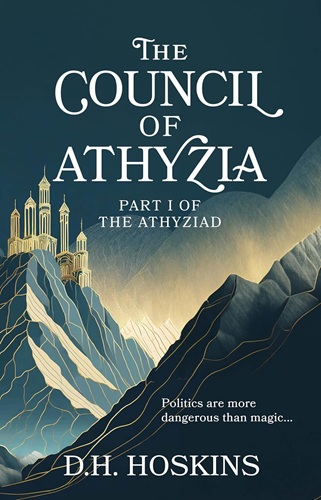
The Council of Athyzia (The Athyziad, #1) by D.H. Hoskins
Genres: Adult, Fantasy
PoV: Third-person, past-tense; multiple PoVs
ISBN: 9798989936007
Goodreads
The Osseomancer is finally vanquished, but the work has only just begun.
For a quarter-century, the dark wizard and his undead hordes raged across Jenor, leaving all in terror. Only the combined forces of men, dwarves, and elves, united by their desperation, were able to defeat him and his horrific magic.
Now, the world is battered and broken. Much needs to be rebuilt. And without a common foe, how long can all remain united?
Hoping to maintain such unity, the mage Snorri and his aide Nauveena invite all to a council at the magic academy Athyzia. Nauveena expects such a council to be easy, especially compared to years of war. But soon enough, she learns that politics are more difficult than magic… and more dangerous.
Nauveena assists Snorri in presiding over the council, but soon finds herself bartering votes and forging alliances to protect an already-fragile world. How the council votes will reshape everything, and possibly not for the better...
The Council of Athyzia weaves together some of the most beloved tropes of fantasy — wizards and witches, elves and dwarves, magic and war, good and evil — into an exciting new context familiar to modern readers and fans of political dramas and history. Here, a debate is as exciting as a sword fight, and a vote is as tense as a pitched battle.
Love the idea and enjoyed a lot of the worldlbuilding…but the prose itself is very simple, not as descriptive as I was hoping, and I couldn’t believe the naivete of our pov character and her wizard mentor. The mentor, Snorri (is his name supposed to be a joke re snoring, or is he named after Snorri Sturluson?) is the one who’s arranged the council and convinced everyone to come, but he is unbelievably idealistic about it. I say ‘unbelievable’ in the literal sense: I do not believe in this character at all. All his experience of the world, interacting with the heads of so many kingdoms, and he doesn’t understand politics are a thing? How does the Academy of Mages, where the council is taking place, govern themselves, that he doesn’t grasp voting blocs or all the behind-closed-doors scheming/intriguing that goes into powerful people making important decisions? How did he get all these people here in the first place – did he just ask nicely?
And why, when the council disagreed over who should have voting rights, did everyone abruptly decide they’d all let Snorri decide the issue? By himself? All these monarchs and mages not used to bowing their heads to anyone, fighting about it, suddenly meekIy deciding one person can choose for everyone as long as it’s THIS one? At that point why not just make him emperor, it would be faster!
All the beasts and birds on this entire continent only require one vote, huh? That is shared with the centaurs? That doesn’t seem ridiculous?
There’s a lot of info-dumping, which I think is a necessity with this set-up so I don’t really hold it against the book, but it still wasn’t great to read.
I hated everybody gossiping about one king being very obviously cuckolded – I hate when people think this is funny, and our pov character finding it entertaining made me a) dislike her immensely and b) convinced me all these people were morons, because no one is concerned about this affecting the council. OKAY. There’s no way this is going to blow up in your faces, and there’s no way you should all be savvy enough to realise that. SURE.
I just couldn’t believe in almost any of these characters being as intelligent or worldly as they needed to be to fulfil their roles. Literally one guy on the council – the one very obviously being set up as The Bad Guy – seems to have any brains, or behave in a way that makes sense for his character. Everyone else has random personality switches when it’s convenient.
GAH.
Adore the idea, but very frustrating execution.

Tantrum by Rachel Eve Moulton
Genres: Adult, Horror
PoV: First-person, present-tense
ISBN: 0593854616
Goodreads
In this electric horror novel from the author of The Insatiable Volt Sisters, an exhausted mother thinks her newborn might be a monster. She’s right.
Thea’s third pregnancy was her easiest. She wasn’t consumed with anxiety about the baby. She wasn’t convinced it was going to be born green, or have a third eye, or have tentacles sprouting from its torso. Thea was fine. Her baby would be fine.
But when the nurses handed Lucia to her, Thea just knew. Her baby girl was a monster. Not only was Lucia born with a full set of teeth and a devilish glint in her eye, but she’s always hungry. Indiscriminately so. One day Lucia pointed at her baby brother, looked Thea dead in the eye and said, “I eat.”
Thea doesn’t know whether to be terrified or proud of her rapacious baby girl. And as Lucia starts growing faster and talking more, dark memories bubble to the surface--flashes from Thea’s childhood that won’t release their hooks from her heart. Lucia wants to eat the world. Thea might just let her.
Crackling with originality and dark humor, Rachel Eve Moulton’s Tantrum is a provocative exploration of familial debt, duty, and the darker side of motherhood.
I tapped out when the protagonist, who has been terrified of her three-month-old since she was born but shared her fears with no one…decides NOT to tell her husband (the baby’s dad!) OR her doula (WHO SHE CALLS SPECIFICALLY TO TELL HER ABOUT IT) when the three-month-old twists the head off a chicken.
Ma’am. Ma’am. I get not bringing it up before now, when there was nothing specific you could point to that would justify your fears. But she just KILLED A CHICKEN. Which, besides being deeply creepy, you acknowledge she should not have the bodily control/dexterity to physically accomplish. This is a big obvious thing you can point to! And you just…tell no one. Your husband (the baby’s dad, I reiterate!) is appropriately concerned when you come in with you and the baby covered in blood…and you flat-out lie to him about it. WHY??? Separate from the why: I’m not convinced you have the right to keep this from him, actually??? Because this is his kid too??? It’s not like he’s MIA or indifferent, he is right there asking you what’s going on, worried!
At that point, you can deal with your demon baby yourself, clearly you wouldn’t accept help if an angel came down from on high to bequeath it to you.
Sorry-not-sorry, I’m not interested in reading about protagonists this abominably stupid.

We Call Them Witches by India-Rose Bower
Genres: Horror, Queer Protagonists, YA, Post-Apocalyptic
Representation: Sapphic MC, secondary nonbinary character
PoV: First-person, present-tense
ISBN: 0241755581
Goodreads
PRE-ORDER WE CALL THEM WITCHES NOW, THE HORROR STEEPED IN PAGAN FOLKLORE AND A SAPPHIC ROMANCE SET IN A POST-APOCOLYPTIC WORLD FULL OF HUNGRY ELDRITCH CREATURES . . .
--Most people have been devoured by the eldritch creatures, but Sara and her family have been fighting for survival, armed with their knowledge of folklore and pagan rituals - the only weapon that seems to work against these monsters.
And then a young woman, Parsley, comes out of nowhere into Sara's life. Found in their garden, they have no idea where she is from.
Sara and Parsley begin to fall in love, but disaster strikes when Sara’s brother Noah is taken by the creatures.They set out to find him, across a landscape of merciless terror, haunted by death.
But can Parsley truly be trusted in a world where humanity is as scarse as humans themselves?
I received this book for free from the publisher via NetGalley in exchange for an honest review. This does not affect my opinion of the book or the content of my review.
Boring and nonsensical. Why are the monsters called witches? More importantly, how has this huge family survived this long while still playing happy families like everything’s fine? What’s with the deadnaming of the elder sibling? Why is nothing HAPPENING?
Nooooooooooo thank you!

Song of Spores by Bogi Takács
Genres: Adult, Queer Protagonists, Sci Fi
Representation: Jewish bigender genderfluid MC, nonbinary MC, Black MC, elderly MC with prosthetic legs
PoV: Third-person, past-tense; multiple PoVs
ISBN: B0FZ6BXM8M
Goodreads
Hugo Award winner Bogi Takács spins a tale of adventure, mystery, and political intrigue in space. Plus sentient fungus!
Three experienced counterintelligence operatives from Alliance Treaty Enforcement are on a mission to find the source of shapeshifting infiltrators within Alliance space. Will the gruff Ereni commander, the Chasidic Jewish shapeshifter, and the cynical insectoid grandma be able to work together? Or will their differences drive them apart before they can reach their goal?
Not to mention dealing with the sentient spaceship and symbiotic pilot, who only signed on to provide transportation, not to be eaten by giant space fungus. Are they even on the right side of history when everything comes crashing down?
Can the galaxy possibly survive? This is weird space opera at its finest!
I received this book for free from the publisher via NetGalley in exchange for an honest review. This does not affect my opinion of the book or the content of my review.
I love the premise of this, the worldbuilding is WONDERFUL, and I really like most of the main cast (and suspect the ones I don’t adore yet would grow on me if I kept reading).
My issue is the prose, especially the dialogue. Quite often, there are sentences that sound jarring or clunky; the writing rhythm stops and starts a lot. The lack of contractions in the dialogue makes all the conversations sound very forced, unnatural, even among characters who are supposed to be close or friendly.
But that would be more trouble than that was worth.
The above is a pretty excellent example of what I mean by clunky phrasing – it’s not wrong, not grammatically incorrect or anything like that, but it makes me twitch because using ‘that’ instead of ‘it’ makes the sentence ping as odd.
Before this, Hlaz-mlan only felt fear and anger, but now, she was also positively vindictive.
I just think this is a really awkward way of saying what you mean. ‘Positively vindictive’ isn’t great, but the ‘also’ makes it worse, as does the comma after ‘now’.
These walls were grown, bent into shape in the time of her great-grandparents, carefully preserved and periodically reglazed. This was the first time someone would lash at the walls violently, cause destruction.
I included the first sentence for context, but the second one…eesh. Again, really clunky phrasing. ‘lash at the walls violently’?
Mlhlh-af sounded like he was molting. It was definitely not the season for that nor his turn so soon after another molting.
‘so soon after his previous molt’ would have been infinitely better.
“I could have jumped us out–” Mawu restarted.
‘Restarted’? In context, the character Mawu is saying something they’ve already said/been trying to argue, but why would you phrase it like that?
If you don’t have any problems with these quotes, then I hope you pick up this book, because it’s really great, and if the prose weren’t making me twitch I’d probably love it dearly! Alas, it IS making me twitch, so I’m going to stop at 23%.

The Divine Gardener's Handbook: Or What To Do If Your Girlfriend Accidentally Turns Off the Sun by Eli Snow
Genres: Adult, Queer Protagonists, Science Fantasy
Representation: F/F
Published on: 18th August 2026
ISBN: 1250395194
Goodreads
Perfect for fans of Tamsyn Muir and Rebecca Thorne, this joyful debut follows a gardener fighting to secure her dream job in the Divine Gardens—manipulating God, antagonizing her attractive rival, and running afoul of a brewing rebellion along the way.
Cyprin grows perfect apples.
No other worker tends the orchards like she can. Sick of living in a Jenga-esque megacity where she’s never alone (there’s always a rat), Cyprin dreams of a job in the Divine Gardens, tending to the plants overseen by God.
Her only way in is winning an annual flower pageant—one that’s been dominated by the Divine Gardens’ head gardener for five years an insufferable woman with an undeniable affinity for plants. When Cyprin plays dirty (criminally dirty) and wins, she jumps headfirst into life in the gardens and her rivalry with the head gardener, who she just can’t stop thinking about.
Pranks, backstabbing, and a lot of heated glaring unite them, until they’re both drawn into a plot to take down God—who’s really just some guy with a great garden. As they spiral through layers of the city’s history and underground rebel group, Cyprin and her rival will find they understand each other like no one else does, even if there can only be one head gardener in the end.
But rise or fall, at least Cyprin will always have the rats.
A chaotically queer exploration of love, ambition, and toxic work culture, The Divine Gardener's Handbook is a romp of a science fantasy that will leave you gasping for more.
I received this book for free from the publisher via NetGalley in exchange for an honest review. This does not affect my opinion of the book or the content of my review.
The prose is too clunky for me, and too often there were images that I couldn’t make any sense of. Please bear in mind that I’m quoting from the advanced reader copy, so there’s no telling what might change between what I read and the final version. Typos and things are often caught and removed before a book’s release day.
The bioluminescent mushroomy glow of a headlamp
What does ‘mushroomy’ mean? You’ve already used ‘bioluminescent’, which makes ‘mushroomy’ a separate descriptor – this phrasing does not imply bioluminescent mushrooms, which would make sense. So if we’re not talking about bioluminescent mushrooms, how is a glow ‘mushroomy’?
When Cyprin pictures the Gardens being full of carbon-copies of this person she doesn’t like, we get this line
Cyprin pictured them as little marshmallows she would pop in her month one by one until she was sick.
I have no idea what this means, and I say that as someone comfortable with how Tumblr warps language.
Purcell gasped and stepped back, winding herself on the wall.
Don’t know what this means either. Is it winding like knocked the wind out of her? Or winding like twisting? Neither makes sense to me.
Purcell edged closer, her fingertips on the tools in her pockets, ready to quick-draw her pliers gunslinger-style in case he tried any plant-god nonsense like in the stories where he became a golden shower and harassed some poor girl.
Hilarious image, I love it, but the chunk of sentence after the last comma is way too long. Needs more commas or rephrasing.
Her home needed mood lighting, the way a good soap opera does.
That ‘does’ pings as wrong to me. Shouldn’t it be ‘did’?
Amanda let herself in and started nosing around the apartment, the way only a person who’d known Purcell from childhood could get away with doing.
Awkward phrasing. Just removing the ‘doing’ at the end would help a lot.
“Right. I’m not in the mood for games.” Cyprin stood up and brushed the crinkles out of her knees, reading to leave.
“Me too, but no one seems to ever let me off the board.”
That is an incredible comeback, especially given who’s saying it! But shouldn’t it be ‘me neither’, not ‘me two’?
the spirit of blood and rubies distilled
Except we’re not talking about a liquid, so this makes no sense?
petals so lush and hydrated they sparkled like velvet in the sun.
Velvet doesn’t sparkle.
He sounded like he was trying to be jokey and put her at ease, but the words rubbed salt into all Cyprin’s psychological wounds.
Awkward phrasing.
Then the day recommenced stifling.
I don’t think stifling is a verb, so I’m not sure what’s going on here.
This is all without going into how Cyprin’s reasoning for a) taking part in the flower show and b) her strategy for winning make no sense. Her reasoning is ridiculous, to put it mildly. And the jumps in reasoning from point A to point Q happen constantly, like Purcell’s reasoning for not telling anyone she can talk to plants because someday she will Fail At Life. What??? I need you to explain how we got from one thing to the other!
This reads like something trying to be bonkers for the sake of it rather than something that is, naturally and objectively, bonkers. The jokes either make no sense or are very weak (like the attempt at poking fun at Purcell because…she’s using manure as fertiliser? How exactly is that funny? She’s a gardener, it’s a very basic thing for a gardener to do, isn’t it? Calling it poo rather than fertiliser doesn’t make it funny). It’s entirely possible than there will be shocking revelations about the worldbuilding later, but from what I read there’s nothing too unusual about the setting if this isn’t your first SFF novel, so the attempts at Being Weird felt very forced, not justified by the premise or the characters.
Really disappointed, but this one’s definitely not for me.

The Color of Time by Millie Abecassis
Genres: Adult, Queer Protagonists, Science Fantasy
Representation: F/F
PoV: Second-person, past-tense
Published on: 19th May 2026
ISBN: 1970458062
Goodreads
A science-fantasy retelling of Charles Perrault’s fairy tale “Peau d'Âne,”
The Color of Time
blends the whimsy of classic fairy tales with the sapphic romance of Fable for the End of the World and the large-scale politics of The Mercy of Gods.
Princess Cyrelle has always been faithful and true to her family, country, and Goddess. But now her brother, King Elias of Cicia, has asked for—no, commanded—her hand in marriage.Desperate to avoid this incestuous union, Cyrelle requests a series of increasingly impossible gifts and petitions the Goddess for a sign to sway her resolute brother’s proposal. As Elias persists undeterred, Cyrelle must risk everything to escape the only life she’s ever known.
Soon, she becomes Green Scales, hiding and struggling to survive on her own, far across the galaxy. But Phau isn’t the peaceful refuge Cyrelle had hoped for, and when the leader of its burgeoning rebel faction recognizes the runaway princess, she is forced to choose between safety and freedom. With the fate of two kingdoms on the line and nowhere left to run, Cyrelle must decide what it means to be true to herself, to her people, and to her heart.
I received this book for free from the publisher via NetGalley in exchange for an honest review. This does not affect my opinion of the book or the content of my review.
If you’re retelling Donkeyskin, the moment the father (or brother, in this version) announces he wants to marry his daughter (or sister, here) cannot be flat. It needs to be an atom bomb. Consider Robin Mckinley’s Deerskin, another retelling of the some fairytale: there, that moment is like the aftermath of a bomb going off, you can all but hear your ears ringing from the impact, the shock. The protagonist and reader are both left reeling. In Color of Time, that revelation is almost clinical, and I’m sorry, I’m not committing to finishing a book that so badly fumbles something the entire story hinges on.

Selkie by Nataly Gruender
Genres: Adult, Fantasy
Representation: Queer MC?
PoV: Third-person, past-tense
ISBN: 153876539X
Goodreads
From the author of Medusa comes another beautiful and emotional story, this one featuring a selkie, a mythological creature who can turn from a seal into a human.
Seven years ago, Quinn finally dared to transform from a seal into a human and took her first steps on land. As a selkie, she is both a daughter of land and sea. But when a human stole her pelt, he stole her freedom as well, forcing Quinn to become his wife and bear his children. As legend tells, capturing a selkie will bring you luck, and she became a coveted prize.
Constrained to a life that was no longer her own, Quinn longed for nothing more than to find her pelt and seize her freedom. Then one day, her eldest daughter hands Quinn her pelt and without a second thought, Quinn snatches it and escapes to the sea. But she's no longer used to swimming and doesn't know where her herd has gone. And after an almost disastrous encounter with her former husband, leaving her severely injured, Quinn doesn't even have the strength to go searching.
Instead, she finds herself taking shelter on a nearby island with a lighthouse and three lighthouse keepers. Quinn doesn't trust humans anymore and wants to stay hidden from the keepers. But she can't survive on her own either. Can she learn to trust these humans and shed her hatred of all humankind? Or will she give into her fears and accept the monstrous fate that others have bestowed upon her?
Not willing to say this is bad, but I really dislike the prose. It’s not poor phrasing or nonsensical lines, nothing objectively wrong. I just find it really blunt and plain, very heavy-handed with the telling-not-showing, and the beginning felt very rushed. I skipped to the final few chapters and the day was saved by a couple of magic things that from context no one knew were possible until they happened, which I never like.
I will say that the rapist-and-kidnapper, aka the protagonist’s ‘husband’, was exactly the kind of person I wanted to see torn apart by killer whales, so I can’t fault the characterisation there!

The Mountain God Sleeps On Its Back by Sam Farren
Genres: Adult, Fantasy, Queer Protagonists
Representation: Lesbian MC
PoV: Third-person, past-tense
ISBN: B09QZY3TFR
Goodreads
The Mark of the Gods runs from Laslin’s palm to her heart. It is the only true part of her; her body is a mortal shell, destined to change like all the gods before her. She follows their legacy, two hundred years since the last god brought peace to the continent, answering what few prayers remain.
Eight years after leaving the mountains she once called home, Laslin finds the beginnings of purpose in a woman named Avery. The rules she’d followed and etched for herself begin to break, and she realises she does not have to be defined by her divinity alone.
Once committed to her godhood and now in love with a mortal, Laslin must reconcile the changes creeping across her skin with the truths awaiting her beyond cliffs rearing over the Empty Ocean.
Beautiful premise, can’t stand the prose. Kind of awkward, kind of over-written.
The fungus of the forest, closer to the gods than most living creatures, lit the way with the soft, unearthly glow of their white caps.
Beautiful image, love the idea that fungus as a lifeform is especially close to the gods, but if you’re using ‘their’ to refer to the fungus, shouldn’t it be fungi?
As a god, her only destination was the places people lived. The world was hers to traverse, and she followed the rise of the sun, only remiss in her duty when a maze of trees and knee-deep undergrowth sprung like a trap.
I don’t think ‘traverse’ and ‘duty’ go well together – I think the connotation of ‘traverse’ is more ‘wander’ than it is travelling-because-duty – and knee-deep undergrowth being the only thing that ever stops you… I don’t know, the phrasing is just so awkward and over-elaborate.
Laslin placed a hand on Thorn’s face, promising the forest wouldn’t ensnare them for much longer. Not with the mushrooms leading the way. Like all Valainian Bloodscales, Thorn was a large, sturdy creature, built for steep mountain paths and crumbling cliffsides.
Creeping ivy tangled around his legs and tail, and the trees pressed close together. He hissed with frustration each time the soft earth yielded beneath his feet; it was a good thing he couldn’t breathe fire.
This is so jarring to me. Going from the mushroom mention to the description of Thorn seems too abrupt; I’d want Thorn’s description to be its own paragraph. And then why is there a paragraph break after ‘cliffsides’? What do you mean, there’s ivy around his legs and tail ‘and the trees pressed close together’? Are the trees a part of him? If they are, that’s not clear at all; if they’re not, why are you talking about the trees now? He hisses with every footstep but I thought you were standing still in this moment, so why are we talking about that?
This is all from the first two pages, and it has me climbing the walls. Nope nope nope.

Toward Eternity by Anton Hur
Genres: Adult, Queer Protagonists, Sci Fi
Representation: Assorted East Asian cast, gay MC
PoV: First-person, past-tense; multiple PoVs
ISBN: 0063344505
Goodreads
Negotiating the terrain of Kazuo Ishiguro’s Klara and the Sun and Emily St. John Mandel’s Sea of Tranquility, a brilliant, haunting speculative novel from a #1 New York Times bestselling translator that sets out to answer the question: What does it mean to be human in a world where technology is quickly catching up to biology?
In a near-future world, a new technological therapy is quickly eradicating cancer. The body’s cells are entirely replaced with nanites—robot or android cells which not only cure those afflicted but leaves them virtually immortal.
Literary researcher Yonghun teaches an AI how to understand poetry and creates a living, thinking machine he names Panit, meaning Beloved, in honor of his husband. When Yonghun—himself a recipient of nanotherapy—mysteriously vanishes into thin air and then just as suddenly reappears, the event raises disturbing questions. What happened to Yonghun, and though he’s returned, is he really himself anymore?
When Dr. Beeko, the scientist who holds the patent to the nanotherapy technology, learns of Panit, he transfers its consciousness from the machine into an android body, giving it freedom and life. As Yonghun, Panit, and other nano humans thrive—and begin to replicate—their development will lead them to a crossroads and a choice with existential consequences.
Exploring the nature of intelligence and the unexpected consequences of progress, the meaning of personhood and life, and what we really have to fear from technology and the future, Toward Eternity is a gorgeous, thought-provoking novel that challenges the notion of what makes us human—and how love survives even the end of that humanity.
I really hate the narrator! I think he will not be narrating the whole book – it’s divided into parts and I’m pretty sure each one has a different narrator – but wow, so much no-thank you! The first-person writing is very blunt, the character is a pretentious, arrogant, hates-everybody kind of person, and I can’t stand ‘listening’ to him. When he acknowledged that plants ‘have other names, but I preferred to call them by their scientific designations’, I tapped out. How do you stand living inside your own head, sir?
Protagonists/narrators do not at all have to be nice, but if they’re not sympathetic then they’d better be interesting, and this guy is instead low-key nasty and high-key annoying. GOODBYE.
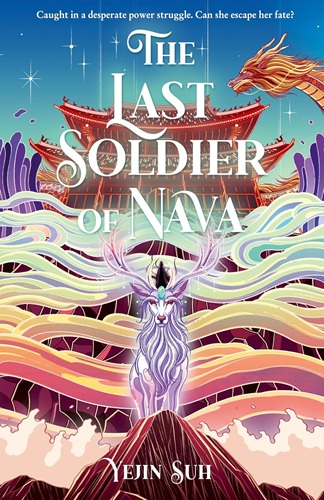
The Last Soldier of Nava by Yejin Suh
Genres: Adult, Fantasy, Queer Protagonists
Representation: Korean-inspired setting and cast, F/F
PoV: Third-person, past-tense
ISBN: 0008683409
Goodreads
In this Korean mythology inspired sapphic fantasy, a young woman with shadow magic is awakened after a thousand years to heal her nation and her own troubled memory, even as she falls for the sister of a saint she killed in her past life.
According to legend, the Soldier drowned entire kingdoms in darkness.
Yet, the Soldier was only a girl, robbed of her will and raised as a weapon for her power-hungry father. When she awakens years later, freedom takes the form of a hidden life and a new name: Shadow.
As war brews and magical dead zones devour the natural world, Shadow is captured and pulled back into court life by her immortal father’s new prodigy, Scarlet, a diabolical woman obsessed with her sister’s murder. A murder Shadow herself committed in a past life.
Shadow’s control over darkness holds the key to restoring the balance of their world, but a serpentine court hides greed, corruption, and her father’s new plot to resurrect his fading magic.
If she’s to survive and save her nation, Shadow will have to hide her past and rely on the woman who captured her—even as they unwind the legends that brought them together and face their growing attraction.
The prose is very awkward, and there are images that don’t make sense to me.
blood ran hot in the pocket of her mouth
It’s not objectively wrong, but I’m surprised by how much I hate describing a mouth as a pocket.
vision muddled as an eroding river
…this is really confusing. Do rivers erode? I mean, they erode OTHER THINGS, but do rivers erode? Riverbanks can erode. ???
‘Can you stand?’ echoed a voice suddenly.
For context, this is happening underground, so I think this is supposed to mean that the voice is all echoey because of the space around them. But this seems a really incorrect way of phrasing it?
she’d only wanted to feel the beat of the sun against her
I’ve heard people talk about the sun beating down, but the beat of the sun against you?
She turned and plunged into the crowd without hesitation, a cold sense of control settling into her.
‘a cold sense of control’ is very awkward phrasing for that.
Crow looked fight-ready and sharp.
Fight-ready?
She would meet the Moonbearer on her own terms; or not at all.
Why use a semi-colon for that? Why not a dash or an ellipsis?
The house was shot through with light and humid air clambering through the back.
The house was shot through with humid air clambering through the back? That doesn’t make sense…
Some patches of the dirt had been disturbed where Sae might have pulled vegetables up, but otherwise remained intact.
The patches of dirt remained intact? Even though they didn’t, because they’d been disturbed?
They would eat at the low table – Sae, slowly, and her, rapidly, as if it would all disappear – and retire to bed.
‘as if it would all disappear before she could finish/eat her fill/WHATEVER’. ‘eating rapidly as if it would all disappear’ isn’t a finished sentence/point.

So Sang the Riverman by Alixander Florian Dietrich
Genres: Adult, Fantasy, Horror, Queer Protagonists
Representation: Queer MCs
PoV: Third-person, past-tense; dual PoVs
ISBN: B0CPC5W87C
Goodreads
In the very beginning, onto the first naked shores of an exuberant becoming, the sea begot two sons: one life, the other death; one heedless in desire and the other a martyr to his obsession. For the sake of all creation, they should never have crossed paths. But what is unleashed cannot be subdued, what is destroyed cannot be restored, and nascent humanity will pay the price for what was taken from the grave of Decay, for scarcely shall be remembered those final days of springtime upon the earth.
Listen, I love purple prose, okay? I seek it out on purpose. One-star reviews complaining about purple prose are my catnip, just like homophobes complaining that something is too queer.
But the prose in So Sang the Riverman is so overwrought that I genuinely can’t understand most of it. Which is a huge pity, because what I did understand was fascinating, and there are occasional lines and images that are gorgeous.
I’m gonna do my thing and list a bunch of quotes now, so you can decide for yourself whether this prose is Too Much for you or not.
The field I must have grazed upon will come to pasture soon, and its teeth shall scrape my nakedness; first swollen, lacquered, mulled by heat. The hours’ climb is steady and sure. I have seen the sunlight crest just now.
I genuinely don’t understand.
Was not so much reliant on him that he could allow such high hopes to drop him so far upon snapping?
That should be ‘that he could not allow’, if I’m understanding this right, which I’m not at all sure I am.
The beach coated him as he lay upon it, weaving an algae sheath to cover him. In that way he cocooned himself, and under the gentle starlight, willed himself to stillness.
The issue with this bit is, a) the ‘he’ is a supernatural being, and b) the ocean seems to be another supernatural being, who is also his mother. So leaving it ambiguous as to who exactly is making the cocoon is maddening, because it could be either or neither of them. What is actually happening here?
Dreams circled like fish beneath brine on the water
The fish are in the water, but beneath the brine? I assumed I just didn’t know properly what brine was, and went to look it up, but, uh, no. You do get brine pools within other waters, but they’re at the bottom of the water, so fish couldn’t be under them. And to be honest, I’m not at all convinced that ‘brine’ isn’t used in this sentence to refer to salty water in general, in which case the fish are where? Below…the salt water? In the ocean? What???
My flock needs attending.”
I’ve never heard it said this way before. Is this a typo? If it’s not then I don’t know what’s being said here.
Low above the shore, the cries of seabirds faded, the beating of their wings become indistinguishable from the great font of motion that was Fervor’s earth to walk.
What?
Further into the sky, a silence awaited him. Unknown to an entire world of endless feeding, it seemed as desolate now as it had the day before.
I think this is trying to say that the whole world is constantly loud because everything’s constantly eating? And so the silence is unnatural? Or something?
There could only be a handful of awakenings more alarming than this: not earth where he lay but as blinding a sky, as potent its resonance of bird screech and wind.
What???
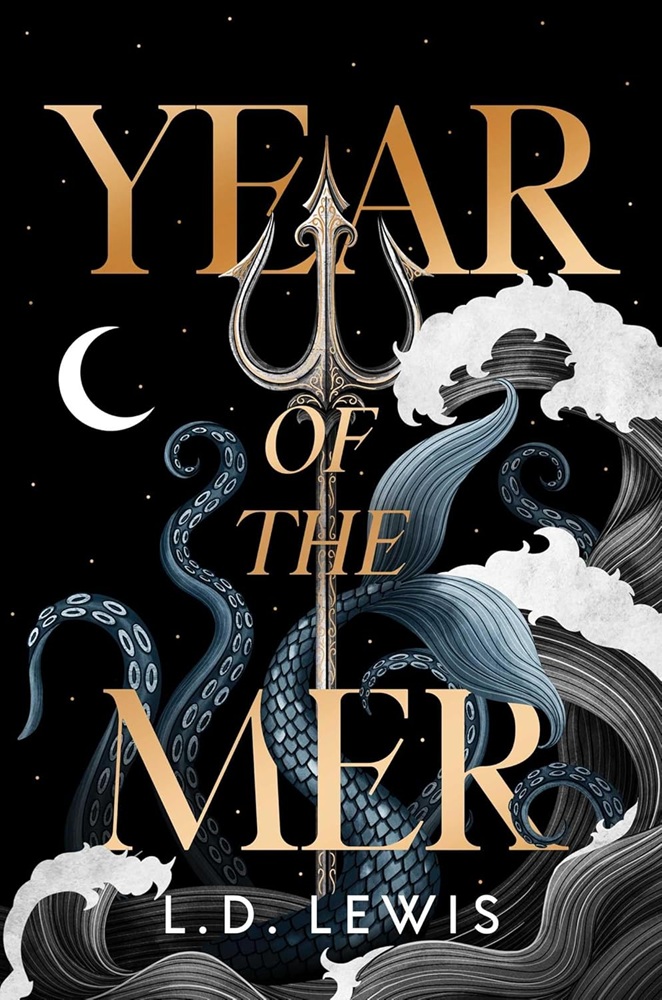
Year of the Mer by L.D. Lewis
Genres: Adult, Fantasy, Queer Protagonists
Representation: Biracial Black sapphic MC, Black sapphic MC, F/F
PoV: Third-person, past-tense; dual PoVs
Published on: 7th April 2026
ISBN: 1668060965
Goodreads
A dark, bloody epic fantasy reimagining of The Little Mermaid that goes far beyond the fairytale to explore family legacy, war, and what we will sacrifice for vengeance—the perfect read for fans of The Priory of the Orange Tree and Circe.
The fairytale mermaid Arielle might have gotten her happily-ever-after, but her granddaughter Yemi is having a much harder time. Her father, the king of Ixia, was assassinated years ago, her mother is slowly dying of a poisoned wound, and she faces whispers and slights from her own people. Yemi has been raised as the shield of the kingdom and is soon to inherit the throne, but she cannot shake her fury at how Ixia has treated her family after all they’ve sacrificed. Only her patient mother and steadfast personal bodyguard (and fiancée), Nova, help Yemi rein in that fury...most of the time.
When the kingdom’s discontented rumblings reach a fever pitch, a coup erupts and Yemi’s throne is usurped, stripping her of her family and forcing her into exile. Now, only one being has the power to help her: Ursla.
Like her grandmother before her, Yemi is tempted by a deal with the sea-witch. With powerful and ancient magic behind her, Yemi could avenge her family, take back her throne, and protect the love of her life. But she should know more than anyone that there is always a price. As much as Yemi wants vengeance, Ursla has been waiting a very, very long time for her own—and it may take more fortune than Yemi possesses to keep her from losing everything all over again.
I received this book for free from the publisher via NetGalley in exchange for an honest review. This does not affect my opinion of the book or the content of my review.
I really wanted to DNF midway through the first chapter, but after the (longer) second chapter, I’m tapping out.
One thing is purely my own fault, though: for some reason, I assumed that Yemaya, the granddaughter of Arielle, was a mermaid and at least the first chunk of the book was going to take place underwater. No idea why I thought that, and that was completely incorrect; Yemaya is bipedal and lives on land. Don’t know if she gains a mermaid tail later.
Things I didn’t like that did not come from me making dumb assumptions: the worldbuilding is interesting but deeply odd. Cars and (landline) phones and cameras exist, but, while guns exist, they’re not any kind of widespread. On the one hand, I like the wish-fulfilment of this, but on the other hand, I’m struggling to make it make sense. The setting feels hugely messy because of this; we have characters saying ‘yikes’, and radio, and they sail wooden ships. It doesn’t feel cohesive, just really confusing.
There are also things like – once a monarch is crowned, no one outside their inner household ever sees their face again. They always wear a mask, even within the palace. When they host feasts, they don’t eat, because the mask can’t come off. This…is a completely unbelievable way to run a monarchy. a) hosting feasts is a huge diplomatic thing and if you don’t eat at said feast you’re sending a very bad message to the guests you presumably want to think well of you, and b) more importantly, how can anyone trust a monarch they can’t see?! What noble or ambassador or businessman can EVER be sure they’re talking to the actual monarch and not a body-double? How can you make treaties or sign deals or ANYTHING?
I assumed that living like this would mean the monarchs regularly, you know, go about incognito, because no one will recognise them without the mask, but from Yemaya’s thoughts that’s not it, she really will be wearing the mask for the rest of her life once she becomes queen.
Yemaya is going to be marrying another woman. Very cool! But I’m baffled that this has apparently made no difference to the religious and political schisms that are unhappy because Yemaya has Mer blood. If Yemaya adopts, or her wife acts as surrogate, won’t the next heir be Mer-blood free? Or will Yemaya be pregnant and give birth (in which case the baby would have Mer blood)? Maybe this is clarified later in the book.
Yemaya and Nova – her bodyguard and wife-to-be – are not the kind of characters I like reading about. Yemaya hates being a royal, doesn’t want to be queen, and other than interacting with the military has no interest in the role. She’s horrifically rude/tasteless at an important dinner just because she’s bored. She drags her feet at everything. I know why this is a popular character type, but to be honest I’m incredibly bored of it. If you’ve been raised from birth to all this responsibility, shouldn’t you be inured to it by now? Shouldn’t you be at least tolerable at playing nice with nobles and whatever? How have you not learned manners yet? Nova is hyper-competent, but also very…blase about everything? The book goes on and on about how she never leaves Yemaya’s side…and then almost immediately she wanders off, leaving Nova unguarded, because they’re on a military ship so the whole military is supposedly guarding her. But…there’s no military guard on Nova’s door? You wandered off with no one to replace you? What??? It’s a lot of stuff like that.
Then there’s the prose, which is full of really odd or awkward phrasing. Occasionally I genuinely didn’t understand what was being said. Examples below. (Usual caveats apply: I read an advanced reader copy, there’s no telling what’ll change between what I read and the book in stores on release day.)
scents of tobacco and hearth and of bergamot someone was wearing poorly.
‘someone was wearing poorly’ sounds very awkwardly phrased to my ear.
When frustrated by a bunch of military leaders, Yemaya thinks
You need these people, she calmed herself. If no one else.
I really can’t figure out what this means – I get that she’s reminding herself that these people are important, but what does the ‘if no one else’ refer to? She can’t actually believe it doesn’t matter what the rest of the military thinks of her? Or the civilian populace? Or the nobility? Or – you get it.
“We’ll prepare the final report for the generals by arrival tomorrow.”
Very odd phrasing, possibly a typo?
Night had fully descended, and all was dark but what the moon graced.
‘It was dark except where it wasn’t.’ Okay, snark aside: does this not mean it’s a well-lit night?
But what else is there ever to do at sea but callous your hands and trade make-believe?
That ‘ever’ is jarring.
Of a painting of a dead man, the book says
The Bear King stood in immortal silence,
I think I understand what this means, but ‘immortal silence’ is deeply weird phrasing.
Roughly half of [the nation] hated the throne, but was just too depleted to fight about it anymore.
‘Depleted’ seems an odd way to say that?
The present military force was by default deputized into the Qorrea’s protection,
Qorrea is the equivalent of princess in this setting. From context, this line is supposed to mean that while the Qorrea is with the military, the military is supposed to protect her. But in that case it should be ‘deputized to the Qorrea’s protection’, not ‘into’. ‘Into’ makes it sound like the Qorrea is protecting the military.
allowing her mind to wander to the soft, wet mischief to be made in the nooks and crannies of the late Bear King’s ship, should she ever catch his daughter in the proper mood.
This is where I wanted to DNF. ‘soft, wet mischief’? If I had a paper copy of this book this is where it would be defenestrated. Definitely in the top ten grossest ways I’ve ever heard sex described, thank you not at all!!!
“We know her future is coming fast. And she is loved with us.”
This is a military commander saying they know the Qorrea will take the throne soon, and it’s fine because the military likes her. But ‘loved with us’ doesn’t make sense there. ‘Loved by us’, maybe? I’d have gone with ‘And among us, she is loved’ personally.
And the truth of anything was that any word spoken by anyone had the potential to be a lie.
Don’t disagree with the statement, but very awkward phrasing.
When speaking of a landmark,
They shielded the palace atop the cliffs from naval attack and marked minutes to the city’s docks.
I think I understand what’s meant here, but ‘marked minutes’ feels incomplete. ‘and marked that viewers were minutes from the city’s docks’, maybe, something like that.
“I’m fine. Not thrilled to get back to the Rock of course, but…” She shrugged, which was its own end to the sentence.
‘which was its own end to the sentence’ sounds horrible to me.
Nova’s dark brown eyes warmed like amber in the sunlight as she inspected Yemi for lies.
‘inspected Yemi for lies’?
Speaking of the country’s population,
Most of the people had at some point earned their livelihoods from these waters.
‘these waters’ meaning the sea. This line has been driving me bonkers because Ixia, this nation, is not an island – and even if it WAS, surely it would have to be a TINY island for most of the population to be involved with the sea? Imagine saying of Ireland, ‘most of the people had at some point earned their livelihoods from the sea’. It would be nonsensical. And Ixia isn’t an island, from comments in the second chapter it seems to have a land border with another country. So how does this work? Is Ixia a tiny strip running along the coast, just a few miles wide? I’m baffled and I can’t drop it.
the blinding, impossible shine of his spear
‘shine of his spear’ just sounds wrong.
Nova, who was giving her a yikes look
Hate that super-modern note, don’t like it at all.
The palace itself was a sprawling compound in the shape of interlocking squares built from pale stone, adorned with ornate porticos and laced with intricate gardens that told the story of bored royals with green thumbs going back centuries. In the summer, the stone became highly reflective as it warmed, making it seem like the walls were made of forest.
The first sentence is way too long; the second is confusing. If the stone walls are pale, how do they look like a forest? It’s at the top of a mountain, what are they reflecting? The forest is below them.
“What do you think is the slowest we’ve ever walked?”
“Does standing still count?”
There’s a lot of banter like this, which strikes me as very modern and also really stupid. You’re supposed to be the next queen-and-consort! Why do you sound like moody teenagers?
The Qorrea has apparently returned with the rest of Her Majesty’s navy from an exercise we’ve been told was “exploratory of the roots of our famished seas.” Good news, you think, Max?
What on earth does ‘exploratory of the roots of our famished seas’ mean?
“I’m ridiculous?” Van nearly shrieked.
This is the second-in-command of Nova’s spy network. And it’s kind of emblematic of the book: being funny takes precedence over things making sense. It’s funnier to have a histrionic second-in-command than it is to have, you know, a really good one who isn’t an idiot.
“You’d be…amicable to a dissolution of the monarchy?” [random stuff here]
“If you tell someone they’re a god from birth, indoctrinate them, steep them in that reality, give them immeasurable power and influence, and then suddenly tell them they’re not because you’ve changed your mind, thereby fucking up their entire reality, how well do you expect that should go?”
I don’t understand this as a response to the question. And there’s a lot of moments like this, where something is said that, to me, doesn’t match up to what they’re responding to. I don’t know if it’s genuinely bad writing, or if I’m being Very Autistic, but it’s exhausting. In this example, Yemi/Yemaya is the one speaking, and she doesn’t believe she’s a god, so what is she talking about?
Two chapters in, and I’m out.

Tentacle by Rita Indiana, Achy Obejas
Genres: Adult, Queer Protagonists, Sci Fi
Representation: Black trans MC
PoV: Third-person, past-tense; multiple PoVs
ISBN: 1911508350
Goodreads
Plucked from her life on the streets of post-apocalyptic Santo Domingo, young maid Acilde Figueroa finds herself at the heart of a Santería prophecy: only she can travel back in time and save the ocean – and humanity – from disaster. But first she must become the man she always was – with the help of a sacred anemone. Tentacle is an electric novel with a big appetite and a brave vision, plunging headfirst into questions of climate change, technology, Yoruba ritual, queer politics, poverty, sex, colonialism and contemporary art. Bursting with punk energy and lyricism, it’s a restless, addictive trip: The Tempest meets the telenovela.
I have no critique of this one, it’s just not a me-book. It’s written in the dirty realism style, which I hate, but that’s purely a matter of taste, not an objective flaw or anything. If you LIKE dirty realism, then I can say that this is incredibly interesting with very multi-faceted, wtf-oddball characters and I can see it being REALLY EPIC for the right reader!
It’s just that, alas, I’m not that reader.

The Killing Spell by Shay Kauwe
Genres: Adult, Fantasy, Urban Fantasy
Representation: Hawaiian MC
PoV: First-person, past-tense
Published on: 14th April 2026
ISBN: 1668053292
Goodreads
In this spellbinding fantasy debut set in a future where language magic reigns, a young Hawaiian woman must solve a murder to clear her name.
Kea Petrova is dealing with more than her fair share of trouble.
At just twenty-five years old, she’s the youngest of five Hawaiian clan leaders living on the Homestead in outer Los Angeles. Nearly 200 years ago, when a catastrophic flood submerged the Hawaiian islands and unleashed magic into the world, these clans forged a treaty with the city, establishing a new Hawaiian homeland. But that treaty is about to expire.
Kea struggles to keep her small clan afloat, scraping together rent each month through odd jobs and selling her own crafted Hawaiian language spells. While her talent for language magic is her saving grace, she feels like a shadow of those who came before her. Just when she thinks things can’t get any more complicated, the murder of Angelo Reyes—LA’s most prominent Filipino activist—turns her world upside-down.
Angelo was killed by a death spell—something that, due to the properties of each school of language magic, can only exist in Hawaiian. With independent spellsmithing being technically illegal, Kea quickly becomes the prime suspect, known for her spellwork on the Homestead. To clear her name, she must unravel the mystery behind Angelo’s murder and confront LA’s most powerful (and dangerous) players, each wielding their own type of magic. The clock is ticking—can Kea save herself, her clan, and the Homestead before it’s too late?
I received this book for free from the publisher via NetGalley in exchange for an honest review. This does not affect my opinion of the book or the content of my review.
27% in, and I’m out. I spent a week feeling guilty for not enjoying it, made myself read another chapter, and am convinced that I just don’t care where this is going. Absolutely no part of this is interesting or fun for me.
It’s not objectively bad! But the language magic doesn’t make this feel any different from your typical urban fantasy. The prose and vibe/feel of it all is very generic; the first-person narration isn’t very descriptive or beautiful, it’s plain and blunt and weighted heavily towards telling-not-showing; the worldbuilding is very minimal and simple (there is no obvious connection between each language and the kind of magic it’s best suited to, for example, and no attempt at explaining the connection); Kea is the kind of heroine we’ve seen a thousand times before, with nothing about her personality or interests standing out in any way. The only unique thing is the magic, and in practice it might as well be any magic-words magic system. (I think some of this is my own unfamiliarity with Hawaiian, and the author’s inability to really make me comprehend how the language works and what it feels like? Because in terms of reading experience, the book is basically just telling me spells as they come up, there’s nothing for me to feel or appreciate or put together on my own. The only comparison I can think of is something like Suzette Haden Elgin’s Native Tongue trilogy, which did a much better job at making me understand, at least emotionally, a language I don’t speak.)
Kea is inexplicably responsible for her entire clan despite there being older family members available. I hate this trope/setup and am extremely tired of it. Her family is very poor, and she is the sole breadwinner, which is portrayed as believably stressful and awful. What confuses me is that the kids in the house seem unaware of the family’s situation? The book opens with one child getting all the family chickens killed by breaking the ward that protects them – for the dozenth time, after many previous warnings. The kid is unrepentant, and when Kea yells at him, Kea is the one her grandmother says has to apologise. Even though the kid is objectively in the wrong, said horrible things to Kea, and has gotten the family’s protein source killed. What even. I hated that scene so much!
(They never make the kid apologise, even. WHAT.)(He sort of apologises for saying he wanted Kea to be the one who died, but he doesn’t apologise for, you know, getting the chickens killed. Despite knowing full well he wasn’t allowed to break the ward he did.)
Casual worldbuilding details make no sense – at one point we learn that wards only work if the people within the wards want everyone inside to be safe. The whole of LA is warded, and a whole lot of the plot revolves around this. But if the ward needs the people inside it to be unified, why on earth does the Board and the rest of the city government not work so much harder at preventing…I can’t think of the word, dis-unity? There all these factions, all these political feuds, clans who hate each other, voting blocs; shouldn’t it all be weakening the ward? Is it possible to have something as big as a city be the kind of unified the ward requires? One way or another, this doesn’t work.
I was hoping for something that stood out, that was different and unique and beautiful. This doesn’t seem to be that. It’s your typical urban fantasy with a scrappy underdog forced to investigate things. The language magic is really unclear to me, and there’s no sense of wonder. There’s potential for the way magic is tied to culture and heritage in this setting to be something really powerful and meaningful, but for me it was falling flat. It’s perfectly fine, but it’s not what I was here for.

The Gods Must Burn by T.R. Moore
Genres: Adult, Fantasy, Queer Protagonists
Representation: 'Copper' bisexual MC
PoV: Third-person, present-tense
Published on: 24th February 2026
ISBN: 1837866015
Goodreads
A disgraced war hero is transformed into the Wolf God, protector of the Forest God, and must earn her trust in this healing dark fantasy for fans of The Wolf and the Woodsman and Princess Mononoke
War hero Basuin doesn't know what to believe in anymore. All Basuin knows is life as an army captain and the pain, loss, and disgrace it has brought him. Demoted and humiliated by his legion commander, he is led into the forest for one more mission: capture a god.
But when his commander uses innocent wolf pups as bait, Basuin dies saving them. The Wolf God, impressed by his sacrifice, deifies Basuin to protect the forest and its beautiful, sharp-tongued god from the legion's deforestation.
To the Forest God, Basuin is nothing more than one of the men sent to burn her forest down. Betrayed by humans too many times, she rejects him, working alone to protect the spirits of the forest as her home disappears around her. To save the god he is growing to love, Basuin must untangle the feelings between them.
Otherwise, they'll burn together.
I received this book for free from the publisher via NetGalley in exchange for an honest review. This does not affect my opinion of the book or the content of my review.
I did not even make it to our protagonist becoming a god. I tapped out just before it was about to happen, when he ‘died’ or whatever.
The prose is…really bad. Besides the fact that every simile uses ‘like’ (which starts to create an awful effect after the fifth or sixth in a row!) there are a lot of lines, especially images, that are extremely confusing; a lot of times things are poorly worded, misleadingly phrased. Quotes to illustrate my points below! Insert the usual caveat here that I read an advanced reading copy, so possibly all of these will be rewritten and fixed before release day.
An ache shatters through his spine, breaking bones on its way through.
His bones are not literally breaking, but even so I think ‘ache’ and ‘shatters’ don’t go together at all?
Basuin had never seen a color as brilliantly red until he saw the remnants of his squadron laid out and screaming for help, rubies spilled across the ice.
This is a great example of the kinds of confusing images we get a lot of in this book. Are the ‘rubies’ – the blood drops? – the ones screaming? Are the ‘remnants’ blood, or are there corpses present? (From the next paragraph, there are in fact corpses.)
orange rays cast the waters in gold like an illuminated script only the nuns and their habits know the mastery of.
Awkward phrasing, and what do you mean the nuns’ HABITS know how to illuminate scripts? Their CLOTHES are masters of illumination?! (Habits are an item of clothing some kinds of nuns wear.)
Unlike him, she’s already stripped out of her shirt, wearing nothing but a black band that runs tight around her chest and shows off the muscles rippling through her shoulders and arms.
…So she’s naked? She’s ‘wearing nothing but’ the band around her chest. (From this, and the fact that no one ever had their trousers described in the parts I read, only their shirts, I decided to envision everyone as wearing no pants. It made the reading experience much more bearable.)
But he feels it–familiar, but inexplicable. From a memory.
‘familiar but inexplicable’ is awful phrasing, but actually fair, because he’s sensing what he thinks are gods. I can accept divine energies or whatever being deeply strange. But what does that ‘from a memory’ mean???
The only home Basuin knows anymore is war–and the smell of it isn’t just the burn of the hearth and food that cooks over a flame.
…What? After a LOT of staring at this, I decided the author probably means the smell of fire/smoke no longer suggests ‘home’ to Basuin, but wow, that was not clear.
His heart-bone, the trunk of his tree, is reinforced with militant commands and strengthened by break after break after break where his body had to regrow bone and heal again, organs reincarnating themselves after his blood painted every border that Grimmalia ever thought they had.
‘heart-bone’ refers to the central pillar of the ribcage, but it’s also a metaphor/symbol for Basuin’s…faith? Sense of self, possibly? But because it’s a bone AND a metaphor, the ‘break after break’ etc is really weird – Basuin was in war, does he mean his ribs were literally being broken? And wtf is ‘organs REINCARNATING themselves’?! NO.
He reaches so far, stretches so far that it aches his muscles and he feels his joints lock up.
It whats his muscles? I don’t know that that’s grammatically wrong, but it sounds awful.
The book trades speed for worldbuilding, and unfortunately that’s a real problem. I appreciated that the action described in the blurb – Basuin becoming a god – happened so soon, but it happened before I understood ANYTHING about how this world worked. The queen outlawed the gods, which I took to mean outlawed their WORSHIP – but maybe the gods had actual bodies at one point and were murdered after the queen outlawed them? Which is it? THIS IS KIND OF CRITICAL. We know god-talkers exist, or existed, people whose prayers the gods talked back to. But are you born a god-talker, or can you become one? AGAIN, CRUCIAL.
Because the villain’s actions rely heavily on these facts. He doesn’t believe in the gods – but he’s searching for a divine artefact. If the gods had actual bodies people could see and murder, how can he not believe the gods existed? If he doesn’t believe in gods, how can he be looking for this artefact, at least without coming up with another explanation for its origins? He wants Basuin because he wants a god-talker – but Basuin ISN’T one, so? He says Basuin has to help him in order to protect the gods, implicitly threatening them – so gods WERE real and you’re threatening to murder the local ones??? So you DO believe??? WHICH IS IT???
He sets a tree on fire – IN A FOREST – to make the gods respond to him. Uh, do you have any reason to think the gods will care about this? The wolf-cubs he’s about to kill; again, he means to do it to make the gods pay attention to him. But nothing in what we’ve learned of the worldbuilding up to this point gives us any reason to expect this to work? Why would the gods care? WHICH god do you think will care? It’s implied the gods were gods of specific places, so do you even have reason to believe there ARE gods here, in this new land you’ve just landed on? The villain’s reasoning is incoherent, he just does over-the-top evil things Because Plot, I guess, and it’s maddening.
The godstone Basuin wears under his clothes grows heavy, then hums, then grows hot, in the space of a couple of minutes (when nothing obviously magical is happening in the vicinity). Does this mean anything? Are godstones magical? Who knows; the text draws attention to the stone being weird but Basuin doesn’t react, so I can’t tell.
Etc. It’s all like this. And what I’ve seen of reviews from people who DID finish reading this book does not incentivise me at all to push on – even if I didn’t find the prose unacceptable, which I absolutely do.
One star because I can’t rate higher when I genuinely can’t understand a good bit of the prose.
Any of these on your radar?




“Low above the shore” makes no sense. If you’re at the shore you are as low as you can go without going underwater or underground. How can you be low and above something?? Blah!
I read Song of Spores. It’s one of those “quirky people on a space adventure” stories but I liked it more than most because of the autistic, trans and Jewish characters.
BLAH INDEED! I seriously couldn’t understand almost anything that book was saying!
I really liked the rep in Song of Spores! Just didn’t like the prose, alas. But that was clearly a ‘this is not to my taste’ thing, rather than ‘this prose is ACTIVELY BAD’. Like the other one XD
I liked Toward Eternity enough that I’d rec it to people who are looking for something it specifically offers, but I’m not going out of my way to sing its praises. For what its worth, it does shift characters almost every chapter, and once it leaves I don’t think it ever returns to them. Wouldn’t solve the need to get through an insanely painful first section though
I saw from the table of contents that it would swap PoVs! I would have skipped ahead, maybe, if the prose had been more my flavour, but it wasn’t. C’est la vie!
I am INTENSELY interested in your review of Children of Time that just went up, btw, but I haven’t finished the book yet and don’t want to check out your thoughts till I have XD
“(From this, and the fact that no one ever had their trousers described in the parts I read, only their shirts, I decided to envision everyone as wearing no pants. It made the reading experience much more bearable.)”
This gave me a laugh. It reminded me of Diana Wynne Jones’ passage on elves fading into the West–have you read The Tough Guide to Fantasyland?
I have! I absolutely adore it! Should be mandatory reading, imo XD
Yes!!