16 DNFs this month, exactly the same as in April! Mostly arcs; a lot of books I was really excited for, that alas, did not meet my (admittedly super-picky) standards. But as usual, it’s not that they were all BAD; there were several that were clearly objectively good, just not for me.
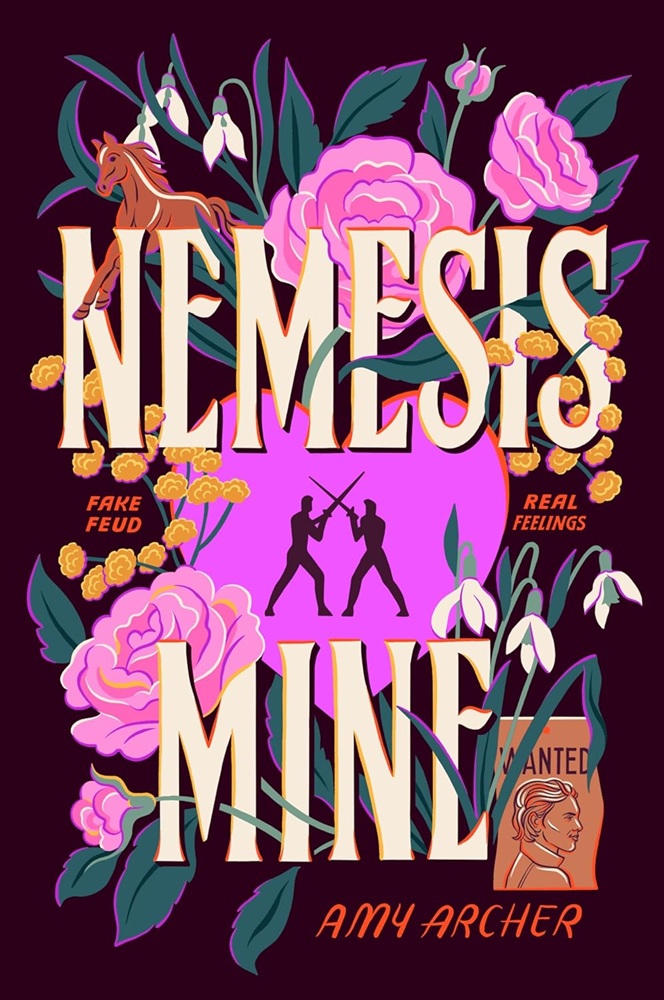

Nemesis Mine by Amy Archer
Genres: Adult, Fantasy, Romantic Fantasy, Queer Protagonists
Representation: M/M
PoV: Third-person, past-tense
Published on: 9th June 2026
ISBN: 0063459418
Goodreads
A not-so-evil villain strikes a deal with a not-quite-perfect hero to fake a feud, boost their reputations . . . and try not to fall in love in the process—in this hilarious, tender, sexy, and outrageously fun romp that blends the humor of Assistant to the Villain with the unforgettable romance of Red, White, & Royal Blue and the cozy fantasy vibes of Legends & Lattes.
Fake nemeses. It’s a dastardly plan that can’t go wrong… until love crashes the act.
Nobody is more surprised than Cyrus to learn that he’s no longer considered the greatest villain in the land of Athaca. Sure, he’s lying about the fact that his magical power is making flowers grow. And maybe lately he’s spent more time embroidering pillowcases than tormenting the locals. But that doesn’t mean he’s ready to be yesterday’s evil news.
Enter the hero Maximillian: the realm’s golden boy, complete with a blinding smile, chiseled abs, and an infuriating habit of spreading hope and joy. (Gross.) If Cyrus wants to be taken seriously, he’ll have to take this guy down.
But Maximillian isn’t quite as perfect as he seems. When he proposes a scheme to fake an epic rivalry and increase their fame, Cyrus can’t resist. Stage the battles, soak up the spotlight, share the spoils—it’s a villainously good marketing plan.
There’s just one hitch. Pretending to hate your nemesis becomes a lot harder when you start falling for them instead.
Nemesis Mine is a wickedly funny, steamy, and big-hearted rom-com set in a cozy fantasy world, featuring:
- An irreverent take on a fantasy kingdom for fans of Shrek and The Princess Bride
- Enemies to reluctant allies to lovers (M/M)
- A twist on fake hating/fake dating
- Black cat/golden retriever energy
- Dagger to the throat moments
- Falling for the villain
- “Touch him and you die”
I received this book for free from the publisher via NetGalley in exchange for an honest review. This does not affect my opinion of the book or the content of my review.
The tl;dr version: this isn’t quite my flavour of humour, and that’s okay.
The long version: there are objectively weird rules for likeable villains. Murdering people is fine, as long as it’s not too gory, but rape will make readers blanch. We’ll handwave putting a village to the torch, but killing a pet-shaped animal is inexcusable. Etc. It’s very strange. I mean, I feel this way too; I’ll give a pass to burning down a village, and throw a book out the window if the villain I like (or am supposed to like) hurts an animal. I just don’t know why I feel this way, because when you stop and think about it, it’s ridiculous.
I think it’s a combination of factors. One is that, for some reason, fictional murder doesn’t feel very real to us unless it’s written/shown in very intense ways; this usually necessitates it being the murder of a character we know and care about. If it’s an NPC, and it’s not a very gory murder, then it just doesn’t land emotionally. I don’t know if we’re desensitised, or if we just don’t think of NPCs as ‘real’ and therefore don’t care about them getting hurt?
The other factor is the unreality or glamour (which I mean in the old-school sense of the word) of villains in general. I don’t quite know how to articulate this, but I expect most readers understand exactly what I mean, even if they can’t articulate it either. Villains, especially ones written so that we’re meant to like them, kind of…stand above or outside of normal societal standards? Partly, I think, because they don’t feel real to us; most of us (happily) do not know people who would burn a village, or order it burned, so it doesn’t feel real to us. Not really.
Whereas smaller evils – like sexual assault, or hurting an animal – those things feel real, I guess because they’re more common? Or easier to wrap our heads around the existence of? I continue to not articulate this well but again, I suspect most readers know what I mean.
Now: the difficulty with writing a likeable, small-scale villain? Is that if you turn the dial too far down on the villainy, you are left with ONLY small evils. Smaller than sexual assault or harm to animals. Pettier things. Everyday things that we are all very familiar with. That feel real to us, and which we viscerally dislike.
In other words, if you bring a character down from the unreal heights of villainy, what you are left with is an asshole.
This, imo, is the problem with Nemesis Mine: in trying to keep things light and/or cozy, the author didn’t want the villain (the protagonist) to be an ACTUAL villain. He does not have the glamour of an actual villain, because he is engaging in mundane, everyday awfulness which I have no trouble feeling as real. Petty stuff. Which means that he’s…just an asshole.
Which is what he comes across as, to me. Not funny, and not villainous, but petty and mean and pathetic. I hold him in contempt, and he does not interest me at all. Stealing toys from small children? Really? Lying on roofs spitting seeds at people? Are you serious? Why would I want to read about this character? This kind of person is boring. I am rolling my eyes at his antics and not grinning while I do it.
If you want to see light-hearted villainy done correctly, check out Apparently, Sir Cameron Needs To Die by Greer Stothers. That’s a perfect example of a not-truly-evil villain, who is not toned down so far that they’re just pathetic.
Nemesis Mine missed the spot for me, so. DNF.


Canon by Paige Lewis
Genres: Adult, Queer Protagonists, Speculative Fiction
Representation: Nonbinary MC
PoV: Third/second-person, past-tense
ISBN: 9798217059379
Goodreads
“A scorchingly brilliant, wildly funny, and deeply moving epic.” —John Green, #1 globally bestselling author of The Fault in Our Stars
Two unlikely heroes embark on quests to win God’s favor in this outrageously entertaining, profoundly heartfelt novel that announces an ingenious new voice in the tradition of Chain-Gang All-Stars, No One Is Talking About This, and Martyr!
Yara can’t comprehend why God has chosen them to slay Dominic, the ruthless leader of the army of Bad Guys. Cast out by their family and reeling from a destructive relationship, Yara has never felt weaker—but with nothing left to lose, they strike a deal. Abandoning their solitary days of embroidery and obsessive cleaning, Yara reluctantly embarks on a perilous odyssey designed to prepare them for the daunting mission ahead.
Meanwhile, Adrena, a disillusioned prophet with a terrifying secret power, is determined to become the hero of this story. Desperately seeking the glory of God’s approval and the promise of heaven, where she hopes to reunite with her beloved mother, Adrena must first persuade Harpo, the leader of the Good Guys, that her plan is God’s will.
As their journeys unfold in a series of unforgettable adventures, Yara and Adrena are propelled toward each other and transformative revelations about life, death, and destiny in this intensely captivating, irreverent epic from a singularly brilliant new voice in fiction.
I received this book for free from the publisher via NetGalley in exchange for an honest review. This does not affect my opinion of the book or the content of my review.
Weirdest DNF review ever: I love the zaniness of this and am so happy it exists (and is doing so well with other early readers) but alas, I just can’t click with it. I’ve tried four times now and keep bouncing off it. I’m really disappointed in myself, especially because it’s clear to me that it’s an objectively great book. I WANT to love it!
I think maybe it’s the semi-modern-ness of it? Is just not to my taste? Sigh.
I will happily try anything else Lewis writes, in the hopes that I will be less picky next time. And I will be recommending this to plenty of people that I think will love it as it should be loved. I have no actual critique for this book; there’s nothing I can point to and say ‘I think this was done poorly’. I love everything about it, I just don’t enjoy READING it, if that makes any sense?
So. I refuse to take stars off. It’s objectively awesome and I hope everyone else adores it!

Endless Blue Beneath (Daughters of Atlantea #1) by Shannon K. English
Genres: Adult, Fantasy, Queer Protagonists
Representation: F/F
PoV: First-person, present-tense
Published on: 9th June 2026
ISBN: 0316592889
Goodreads
A young mermaid is forced to choose between her old life above the waves and her new life below them in this eerie, romantic queer fantasy duology from debut author Shannon K. English.
Eppie has never quite understood why the world hates her—all she did was kiss a girl. Must that mean she suffers isolation, with whispers and glares following her at every turn? She tries to focus on her duty to her family, but options are limited for a woman alone, and life in the seaside village of Hwenfirth is agonizingly mundane.
One day, as Eppie walks along the beach, she spies someone drowning in the shallows. Without thinking, she runs to rescue the poor soul—but when she gets up close, instead of a sputtering victim she finds an inhuman creature smiling up at her with rows of sharp, white teeth that snap closed on her arm and drag her beneath the waves.
When Eppie awakes in a deep ocean cave, she finds her own body has changed: she can breathe underwater, her skin is turning scaly, her teeth have been replaced by fangs, and she is suddenly ravenous for human flesh.She has become a dreaded creature of the ocean—a mermaid.
Things aren’t all bad, though. The mermaid colony is mesmerizing and Eppie’s new sisters are fiercely loyal. And when Eppie meets Marie, a stunningly beautiful mermaid with a past as shadowed as her glossy, raven-black scales, she finds she no longer needs to resist the desires that were denied to her on land.
But the mermaid hunters are coming, and Eppie must decide whether to protect the new, monstrous family she’s found or leave it all behind for a chance to live above the waves once again.
I received this book for free from the publisher via NetGalley in exchange for an honest review. This does not affect my opinion of the book or the content of my review.
This is one of those times when a great deal of strange marketing decisions have been made by the publisher, giving a fairly misleading impression of the book. In this case, Endless Blue Beneath is a much darker story than it sounds like; English has written an impressively complex, pretty screwed-up arc for her protagonist Eppie, one that really digs into how Eppie has been kidnapped, and transformed into something not-human against her will. It’s painful and traumatic and awful, pretty body-horror at points; she’s treated like something between a toy and a slave and livestock, forcibly shapeshifted, and then to cap it all, she’s mind-controlled into being happy about all of it.
UM.
Not at all the story I was expecting from the official description!
The worldbuilding is great: mermaid colonies are led by and revolve around whale-sized giant mermaids who are the mothers to most members of the colony. This is hands-down my favourite detail of this book! Mermaids don’t have hair or breasts; instead of hair they have tendrils similar to a sea anemone’s. They can communicate telepathically with members of their own colony, and speak aloud in a language made up of clicks and whistles like dolphins. And we eventually get long-lost Atlantis, too, which I was not expecting but did not at all disapprove of. There’s conflict surrounding ‘land-born’ mermaids like Eppie, ones who started out human, especially since the transformation doesn’t ‘take’ with everyone, and those who are left in-between occupy a pretty miserable niche in their colonies.
Bonus: mermaids REALLY love eating humans, human men specifically. At one heartbreaking point, Eppie comes very close to eating her little brother.
My problem was not with any of that: I just really struggled with the prose. Endless Blue Beneath is written in first-person present-tense, which almost never works for me and didn’t here. There wasn’t as much description as I wanted (which seems an extra shame because Eppie visits multiple biomes that I really wanted tons of lavish detail about) though in fairness we get lots of physical description of the mermaids, which was delightful (and I adore the author’s design of her mermaids). And I thought things felt rushed, like everything was constantly moving too fast – though I think some readers are going to appreciate that there is always something happening; for example, we meet our first mermaid in chapter two, so it really doesn’t take long for the story to get going.
None of the characters felt very fleshed-out to me, including Eppie. I don’t know if it would have helped if we’d seen her as a human for longer, because I think the real issue was that she simply didn’t have a lot of personality – she’s a lesbian and ostracised for it, and that’s…basically it. No hobbies, no passions, no friends, nothing to really define her. Her baby brother has more of a personality and he’s barely on-page. The rest of the cast is the same: they’re each defined by one trait, maybe two. This mermaid is the ‘mean’ one, this one badly wants kids of her own, etc. By the time I was 30% into the book, I still didn’t care about any of the characters – I thought Eppie’s situation was horrific and wanted it resolved because of that, but not because I didn’t want bad things happening to her specifically, you know?
I skipped to read the last few chapters and…don’t feel that I missed out. Some of it is objectively very cool, but between the prose and the personality-less characters, I don’t regret skipping the majority of the book.
I do think Endless Blue Beneath could appeal to a lot of vampire fans, because Eppie’s transformation, and adjustment afterwards, very much echoes a lot of darker vampire stories. The scene where Eppie smells/tastes human blood for the first time being a prime example!
But yeah. This could have been awesome, and I think a lot of readers will love it (the other early reviews I’ve seen have been glowing). But it didn’t work for me, alas.


The Dragon Has Some Complaints by John Wiswell
Genres: Adult, Fantasy
Representation: Major queer character, major trans character
PoV: Third-person, past-tense
Published on: 14th July 2026
ISBN: 0756420504
Goodreads
In this heartfelt and humorous fantasy, a dragon whose three heads bear rather…different personalities finds family in the most unexpected of places.
From the Nebula-winning author of Someone You Can Build a Nest In!
Garrodigh was once a four-headed dragon, among the most powerful in Kardoša. After an unfortunate incident, he now has three heads, one stump, and a daily whirlwind of internal bickering. Centerhead wants to rain death upon all humanity, Bottomhead is like a feral cat, and Upperhead is under the delicate delusion that he is, in fact, human.
When a nearby battle goes awry, Garrodigh sneaks into an elite dragon rider academy, pretending to be tame to get free food and a warm bed. Lucky for him, rider Rania Albright is desperate enough for a dragon of her own that she overlooks his eccentricities.
As Garrodigh recovers under Rania’s care, all three heads start to turn, for the first time, in the same direction. Each wants to protect her from the invaders who killed their fourth head—the same invaders who seek to conquer Kardoša. When the academy comes under attack, can this wild dragon and his wilder rider save their homeland together?
This cozy fantasy intertwines epic battles with loving friendships, sharing an utterly unique perspective on what it means to be a ‘monster.’
I received this book for free from the publisher via NetGalley in exchange for an honest review. This does not affect my opinion of the book or the content of my review.
I love this and I’m happy it exists – but I don’t want to finish it.
It’s genuinely bizarre; on paper, I love everything about this premise. The characters are fantastic, and it’s wonderfully easy to read. But every time I set the book down, I don’t want to pick it up again. After months of struggling, I made it to 51% of the way through, and despite being in the middle of what should be a very tense and exciting part of the story… I don’t want to keep reading.
I don’t know why. There’s nothing I can point to and say ‘I hate it’. (I mean, except introducing that one character as a trans man, with zero explanation. Can dragons tell someone is trans just by looking???) The set-up of the three heads is adorable and funny. I want to be Rania’s new bestie. The worldbuilding isn’t super complicated, but there’s lots of cool bits and pieces in it, like the dragon goddess of the sky and how flight works for dragons. The whole arc of Garrodigh recovering as much as he (they?) can and learning how to get the most out of their disabled body is really heart-warming and poignant. I love the pro-immigration storyline/philosophy. There are a decent number of mysterious mysteries I should want answered, like how the airships keep teleporting into place, what happened to fourthhead, what’s out on the secret island, why can none of the dragon-rider dragons talk when the wild ones can, etc.
And laying it out like that makes me want to try picking it up again, giving it yet another go, but the fact is that for whatever reason, I just don’t enjoy reading this one.
So to be clear: I love this book. If it sounds good to you, you should DEFINITELY try it. It’s cute and lovely and full of Feels, with lots to say (and yet doesn’t come across as preachy). I recommend it to absolutely everybody.
Just not me, I guess!
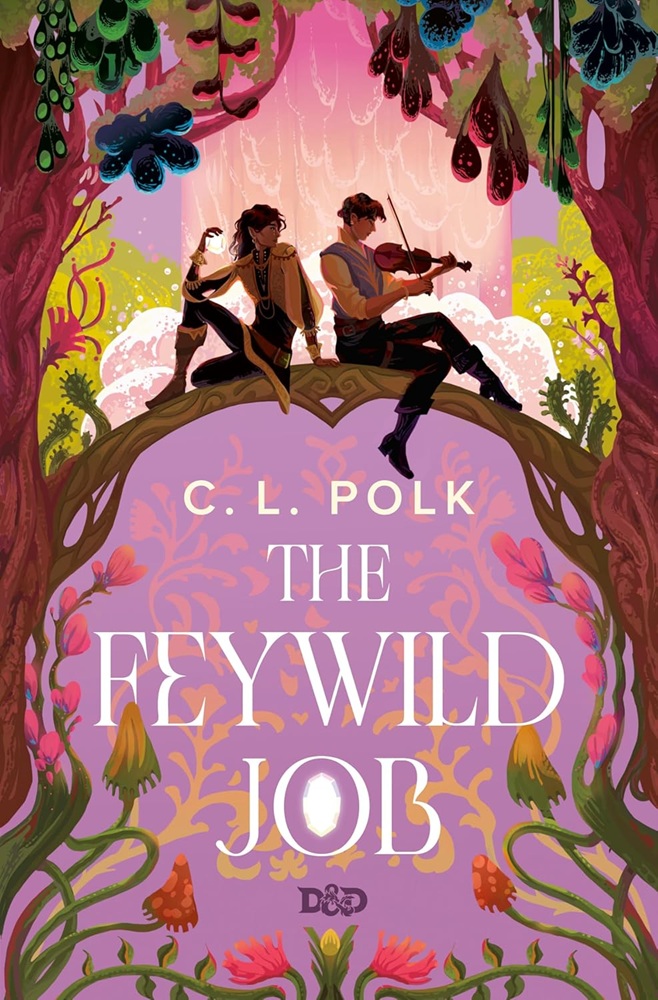
The Feywild Job (Dungeons & Dragons) by C.L. Polk
Genres: Adult, Fantasy, Queer Protagonists
Representation: Nonbinary MC, queer MC
PoV: Third-person, present-tense; dual PoVs
Published on: 30th June 2026
ISBN: 0593599802
Goodreads
Sparks fly when bitter exes are forced to team up for an elaborate Feywild heist, in this cozy fantasy romance by the bestselling author of the Kingston Cycle and Even Though I Knew the End.
Saeldian has sworn never to fall in love. That oath isn’t just a personal promise, but rather a magical pact, granting them powerful abilities. The only catch? They must never give their heart away—a deal that Saeldian is perfectly content with. They’ve seen firsthand how messy love can get.
Saeldian prefers their no-strings-attached life as a con artist, pulling off heists and leaving a trail of broken hearts behind them. But when a grift goes horribly wrong, they catch the eye of a mysterious patron with a job offer they can’t refuse.
The mission? Steal a gem called “The Kiss of Enduring Love” and return it to the Feywild. Simple enough, until Saeldian discovers their ex-partner, Kell—a charming bard—is part of the team.
The last time Saeldian saw Kell, things hardly ended on good terms. A kiss became a betrayal, leaving Kell hurt and confused for almost a decade. But Kell can’t just walk away—not when this job might finally be his ticket back to the Feywild.
Forced to work together again, their adventure takes them from high-society parties to Feywild couple’s therapy. But as Saeldian and Kell rekindle their chemistry, they realize the gem is much more than a fey bauble, and their simple heist has summoned powerful enemies. . . .
I received this book for free from the publisher via NetGalley in exchange for an honest review. This does not affect my opinion of the book or the content of my review.
There’s nothing at all wrong with this book, it’s just not for me. As a major fan of Polk’s Midnight Bargain and Witchmark trilogy, this just wasn’t what I was hoping for. I thought that it being written by Polk could overcome my vague dislike of the D&D aesthetic, but alas, it didn’t. Which is not an objective flaw by any means.
If you DO like the D&D aesthetic, if you’re into heists and lovers-to-enemies-to-lovers again, you’ll probably love this! It’s not for me specifically, but that doesn’t make it a bad book. (And I’m still going to pounce on anything not-D&D that Polk writes in the future!)

BOOM goes the Bride (Brides of Nap City Book 1) by Valiant Evermech
Genres: Adult, Queer Protagonists, Science Fantasy
Representation: F/F
PoV: Third-person, past-tense; dual PoVs
Published on: 1st June 2026
ISBN: 1069718815
Goodreads
A pulpy lesbian romance between an elven thief from another world and a corporate princess whose company is built on her clones. 300,000 and counting, and the woman they're made from wishes they didn't exist. Danger, spice, and everything not-nice.
When the twice-dead thief Nil steals a magical dagger from one of the world's angriest trillionaires, the last thing she expects is to fall in love with his daughter Sook, the so-called Mother of a Million Clones. But the heart wants what the heart wants, and in this case the heart wants to be chased, shot at, and possibly exploded.
Til death do us part is gonna need a bit of an extension...
I received this book for free from the publisher via Book Sirens in exchange for an honest review. This does not affect my opinion of the book or the content of my review.
I’m not willing to say this is actively bad, but it was too overwritten for my taste. Which is a real shame because I think the setting and characters are fantastic! A bit bleaker than I like my fictional worlds, but I would have happily devoured this if it wasn’t taking three paragraphs to over-explain things to me. I would call it borderline info-dumpy; in trying to establish this world and these characters to the reader, we’re very bluntly Told Not Shown a lot, and I found it fairly clumsy. Possibly this would have smoothed out the further we got into the book, when the author doesn’t have to explain as much of the worldbuilding to us any more.
Some examples taken from my arc – obviously, these could all be very different in the final version of the book published on release day, or even be cut from it entirely!
she oozed to ground level, as awake as a doorknob.
For context, the ‘she’ is, you know, barely awake. But still, ‘awake as a doorknob’ seems like a very awkward simile to me.
She let him and sat in the rig, wordless and thoughtless. Her brain pounded. Her mind ran. Her feelings ran like sludge, pooling in an empty void inside her chest like an old swimming pool draining to reveal nothing but trash and dead rats.
This just seems really overwritten to me.
The clones smiled prettily, all thin and trim and plump.
I don’t think you can be thin and trim and plump simultaneously. ‘Trim’ could be interpreted in a few ways, I guess, but ‘thin’ and ‘plump’ are opposites.
The levcar hummed out of the launch bay into a spilling pool of golden light. An aura of pure ostentatiousness. The result of millions of lamps that shone at a trademarked wavelength of the visible spectrum, resulting in a golden color no one could copy. No one could use, and no one would ever see outside of Kingdom Keep. The largest arcology in existence. A two-kilometer-tall uneven stack of coins wide enough to fit a stadium and more. And it did. Shopping malls, amusement parks, regular parks. Restaurants, grocery stores, theatres and gyms, all glowing the aquamarine gold of cloning tanks. Tens of thousands lining the vast interior, from floor to cloud level, infant to adult in bubbling emerald vats. Generation after generation of Sooks gestated over months in transparent wombs marred only by the occasional spray of graffiti, quickly cleaned by genetically-engineered snails.
Overwritten, over-described in a clumsy way. Choppy sentences. ‘a spilling pool of golden light’ sounds very wonky (how does a pool of light spill?), ‘No one could use, and no one would ever see outside of Kingdom Keep’ doesn’t make sense to me (if they can’t see out of it, they must be inside it. But they can’t be inside it, because no one can use it. So…what???)
I admit the idea of graffiti-eating snails delights me.
a tall glass tower with an asymmetrical hook-shape.
I’ve stared at this for ages and asked a few other people what they thought, and none of us can make sense of it. Isn’t a hook-shape asymmetrical by default? How can a hook be symmetrical? And if it cannot, then why specify that it’s asymmetrical?
Her target today was a relic of her universe. A demonic dagger used for ceremonial sacrifices. A useful tool for those who knew the right names. Names that went untold, yet let themselves be known. Shadows of shadows, fleshy suns, and the stench of death. Killing someone with a kitchen knife could still call their attention, but the right tool in the right place made a summons that could not be ignored. To say in a more modern way, a regular sacrifice was calling the customer service line. This knife offered the party’s direct extension.
Overwritten, overcomplicated sentences in the attempt to sound fancy and grand. The direct extension metaphor is excellent, though.
I think a good editor could have turned this into something dazzling. As it is, it’s not BAD, but it’s not GREAT, and I am not pushing through my daily migraine for anything less than great.

Radiant Star by Ann Leckie
Genres: Adult, Queer Protagonists, Sci Fi
Representation: Multiple nonbinary MCs
PoV: Third-person, past-tense; multiple PoVs
ISBN: B0FH6YZHB1
Goodreads
Ann Leckie returns to the world of the Imperial Radch in this standalone.
The Temporal Location of the Radiant Star has always been a source of both conflict and hope for the people of Ooioiaa. However, the imperial Radch see it only as an inconvenience, an antiquated religious site soon to be absorbed into their own, superior culture. But local politics is complicated, and the Radch have made one last concession: One last man will be allowed to join the mummified bodies in the temporal location to become a "living saint".
But this one decision will ripple out to affect every part of the city. Amidst a slowly worsening food shortage, riots, and a communication blackout from the rest of the Radch Empire, a religious savant will entertain visions of his own sainthood, a socialite will discover zer comfortable life upended, and a young man sold into servitude will find unlikely escape.
Friends, I started using this as an insomnia cure just a few chapters in. I pushed through to 53%, because it’s ANN LECKIE, but the fact is I was bored to tears. I do not care about any of these characters, I do not care about their politics, I do not care about their society drama, I do not care about their religion, and I do not care about their BLEAK little ice-planet. (What is sci fi’s obsession with ice planets??? I hate them and they seem to be everywhere.)
Appreciated all the non-binary rep, but it doesn’t stop the story from boring my socks off.

The Keepers by Sarah Goehrke
Genres: Adult, Fantasy
PoV: Third-person, past-tense; multiple PoVs
Published on: 16th June 2026
ISBN: 1965790119
Goodreads
Sanverra lies at the heart of the Cardinal Lands, dynamic realms ruled by lines of great queens. While magic is very real, witchery is challenged, for witches bow to no queen, they hold loyalty to no crown. The queens may accept advice or healing from their local Covens of the Grounded, but they and their subjects are well aware witches do not offer their services without a price.
Aleris, adopted into the ambitious Orcharder family as a second daughter, is raised to hide the magic she was born with-until she no longer can. When she finally embraces her own witchery, she changes more fates than her own.Queen Daphne of Sanverra's word on any matter is final-until she is nearly silenced forever. When she lives through her own death, she begins to understand how much she doesn't know about the witches of her world.Greater than any Coven of the Grounded, though, is the otherworldly Coven of the Keepers, whose magic turns the very Wheel of the Year. These witches take sacrificed moments from the world to do so, adhering to only one truth: The Wheel must turn.
I received this book for free from the author in exchange for an honest review. This does not affect my opinion of the book or the content of my review.
This was pitched to me as ‘matriarchal Game of Thrones‘, but the problem is that GRR Martin is actually excellent at prose and this is not. It’s not appallingly bad, the writing I mean, but it’s – blunt and choppy and unpolished, often awkwardly phrased or jarring in rhythm. And every single character is…basic. Obvious. Of course Cora is evil. Of course the boyfriend is evil. Of course the witch-sister is idealistic and lovely. None of these characters feel complicated enough to be real people. The time-skips (time-skims?) had me grinding my teeth, they were just so clunky and hand-wavey. The dialogue is ridiculous, it all sounds very forced and overly formal, even in conversations taking place between family members. And personally, I’m really tired of ‘persecute the witches!’ storylines; it’s so incredible done at this point, I don’t know how you could make it interesting. (I wouldn’t have picked this book up if I’d known we were going to be dealing with a growing movement of witch-hunters.)
Not for me, and the writing isn’t at a level that can do justice to what the story wants to be.

The Bloodweaver (The Weaver Saga Book 1) by C. N. Kuster
Genres: Adult, Fantasy, Queer Protagonists
Representation: Sapphic MC
PoV: Third-person, past-tense; multiple PoVs
Published on: 23rd June 2026
ISBN: 9798347018529
Goodreads
A divisive magic. A shattered family. A brewing war.
In a world where some can manipulate life with a single touch, siblings fight on rival sides, forced to reckon with the choices that led them there.
Three generations ago, ancient and mysterious beings introduced the world to the arcane art of Bloodweaving, which allows its practitioners to manipulate life with merely a touch. Now, Bloodweavers must hide in plain sight or risk being hunted by violent regime soldiers known as Breakers, who will stop at nothing to eradicate weaving once and for all.
Though his family’s vineyard has flourished thanks to Bloodweaving, Kerick DeLuvena has kept his powers a secret from everyone, including his beloved fellow triplets, Mel and Emiel. When a squad of Breakers arrives on the day of Emiel’s wedding, Kerick weaves himself a new face and flees to protect his family, setting out in search of the Ravel, a secret society of Bloodweavers who stand on the precipice of an uprising.
Meanwhile, Mel’s girlfriend is identified as a Bloodweaver and arrested. Devastated by so much loss, Mel hatches a plan to get captured in the same raid, hoping to protect her love at all costs, even if it means allying herself with the Breakers’ ruthless commander and serving the very force that tore her family apart.
As the consequences of the siblings’ diverging paths ripple across a divided and hostile world, both must eventually face the same Is Bloodweaving a miracle—or a curse?
The gripping debut of the Weaver Saga is perfect for fans of V.E. Schwab, Andrea Stewart, and Fonda Lee.
I received this book for free from the publisher via NetGalley in exchange for an honest review. This does not affect my opinion of the book or the content of my review.
DNFing this one baffles me, because Bloodweaver is kind of excellent? The prose is mostly lovely? The magic is really interesting? I don’t love any of the characters, but they all feel satisfyingly multi-faceted? Even in just 25% of the book (the point at which I set this down) the plot took SO MANY turns I didn’t see coming???
And yet it’s grating on me. It’s something about the prose, something I can’t put my finger on, that keeps making me wince and twitch. I think it’s…over-written? To the point that the pacing is snail-slow: it takes forever for anything to happen, and when things are happening time just streeeeetches so the scene lasts so many more pages than it needs. We get lovely description, but of things we really don’t need. And sometimes the phrasing is just wonky – quotes taken from my advanced reader copy, so they may be edited or removed entirely from the final version of the book.
They’d spent so many afternoons here, bathing in the shade of their own little sanctuary where the world melted away. Responsibilities waited, commitments deferred, pressures abated.
That second sentence just doesn’t make sense to me. I know what it’s meant to mean, but the actual phrasing doesn’t make sense to me. ‘commitments deferred’ = perfect sense. But ‘responsibilities waited’ makes it sound like, you know, the responsibilities are WAITING, expectant, impatient, making you anxious. And are the pressures ACTUALLY abated, or just ignored or turned low for a few hours?
He’d grown–for the first time in his life–a full beard, reddish-brown hair covering his upper lip and jaw. The longest, an Oren-reminiscent goatee at his chin, needed to be dealt with at the earliest possible moment.
The longest what? The longest beard? The longest hair? The longest upper lip or jaw? You mean the longest BIT of the beard, I think, but that’s not what you said.
It’s like – slightly odd phrasing, sentences that don’t quite make sense on a line level. It’s extra jarring because most of the prose is quite lovely – not A+ level, but at least a B, maybe a B+. But that makes these little jolts stand out all the more by contrast, you see? And my weird prose sensitivity can’t take it.
If you have no idea why these quotes bother me, then I think you should give this book a try, because without this issue with the prose this is a pretty great book! And so if you have a saner taste in prose than I do, you should have a good time with Bloodweaver.
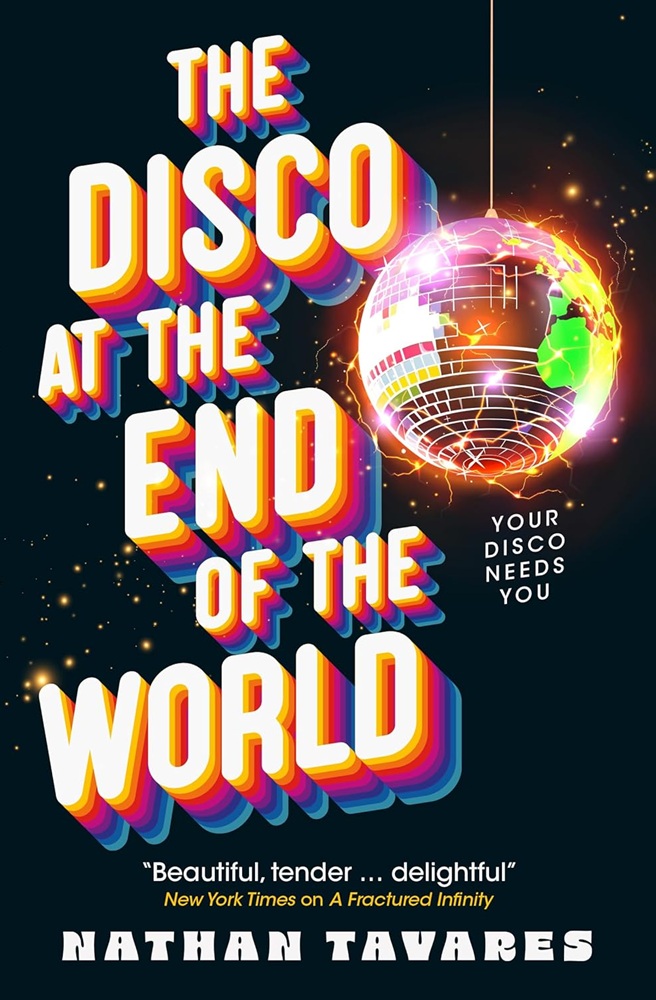
The Disco at the End of the World by Nathan Tavares
Genres: Adult, Queer Protagonists, Sci Fi
Representation: Biracial gay MC, major Black trans character
PoV: First-person, present-tense
Published on: 2nd June 2026
ISBN: 9781835414200
Goodreads
An alternate 1970s science fiction romance blending first contact and queer counterculture in the Los Angeles disco scene, perfect for readers of Vajra Chandraseker and Victor Manibo.
In 1977 - a world in which America launched its space program shortly after WWII - Mitch Ward followed Flynn, the lost love of his youth, into the US Space Guard. Now, he’s stuck on a backwater moon base with his only friend, Gloria, watching every shuttle in the hope Flynn will be on it.
After an inexplicable encounter with a strange, euphoric being, Mitch and Gloria find themselves dishonorably discharged, and stuck in a USA rapidly sliding into fascism with no plans and no future. There’s nothing for it but to move to Los Angeles to chase their dreams, and find their people in the discos of the city.
But when Flynn crashes back into their lives, claiming to be the host for an emissary of a utopian civilization approaching Earth, he offers Mitch the power to protect himself and friends across the queer community, so they never have to live in the shadows or face oppression again.
With the world on the brink of cataclysm, and Mitch and his friends being squeezed out of every space, it’s down to this community of disco-loving outcasts to stand up for what is beautiful and right.
I received this book for free from the publisher via NetGalley in exchange for an honest review. This does not affect my opinion of the book or the content of my review.
Despite clinging on with my fingernails all the way to 41%, I did not make it to the aliens. The majority of this seems to be ‘what if Reagan went even more overtly evil after the US landed on the moon early?’ Which – wasn’t what I was here for, and I was depressed and bored.
(Yes, fine, we glimpsed an alien when they were still on the moon. But it was a glimpse, it lasted less than a page, the characters didn’t know it was an alien, I’m not counting that.)
The book’s not badly written – the main character has a distinctive voice, which is something I very much require from first-person, and the prose isn’t pretty in the way I prefer but there’s nothing at all wrong with it. It’s just…I signed up for aliens, and what I got instead was a slog through a surprisingly dull moon-base, and then the dull, grinding misery of fascism. The MC and his bestie are part of an underground…defiance-movement, rather than resistance-movement, though that was shifting into more active resistance (and fascist pushback) at the point I stopped reading. And I just don’t want to read this, read queer people being oppressed, even if it’s meant to be about survival in the face of oppression, and taking joy where you find it, joy as defiance, etc. Those are all big important things, but as a general rule of thumb they’re not what I want to read about – I don’t get anything out of these kinds of stories. I wouldn’t have picked this book up if I’d realised that this is far less about the aliens than the description makes it sound.
If I have one critique that is not down to personal taste, it’s that I felt like Disco did a lot of telling-not-showing. It seemed like a lot of events, and the passing of time, was just summarised for us, rather than us actually experiencing them on-page. Things like the disco nights, but also the shift to resisting the cops, and helping qbipoc people in need – we weren’t really seeing it, just getting told about it. It felt hand-wavey and info-dumpy, and a weird choice since the rest of the writing, when we’re experiencing things as they happen, is very immediate and vivid and excellent.

Phoning Faust by Sophie Mutiara Nova, Sophie Whittemore
Genres: Adult, Fantasy, Horror, Queer Protagonists
Representation: Biracial Indonesian demisexual MC
PoV: First-person, present-tense
Published on: 2nd June 2026
ISBN: 1648908926
Goodreads
Queer mixed Indonesian college student Dian Faust attempts to call the suicide hotline only to dial the wrong number, her finger slipping and typing in six three times (the mark of the Devil). The mysterious voice on the other end of the line is revealed to be a charming scam caller named Memphis with a penchant for chattiness, trapped in a dingy bus stop bathroom, wanting to learn a concerning amount about the lonely Dian’s life.
But this scam caller is more than just a Mr. Robot hacker wannabe—a sinister presence lurks in the pixels on Dian’s laptop screen in the shadows of her apartment. The Devil themself has come to collect Dian’s soul, and “Memphis” is actually Mephistopheles—Hell’s foremost golden-tongued agent and notorious liar.
In this loose retelling of Goethe’s Faust, will Dian save her soul before time runs out—or will she fall prey to the renowned storytelling deception of the infamous Mephistopheles?
I received this book for free from the publisher via a publicist in exchange for an honest review. This does not affect my opinion of the book or the content of my review.
On a line level, this is fine, but the story itself is very choppy – things keep happening out of nowhere – and it’s reading much more like a paranormal romance than the horror I thought I was getting. Memphis is intensely flirtatious and Dian is very struck by how pretty and cool she is, and Memphis is swiftly doing the whole ‘I would fight the Devil to protect you’ thing, calling Dian ‘mine’ and all the rest of it. Not at all what I signed up for.
Dian is a pretty great example of a queer millennial with reasonable trauma, but I can’t get over her just Not Reacting when Satan – not Memphis but Memphis’ boss – appears in her apartment, tells her Memphis is going to deliver Dian to him by sunrise, and then vanishes again. Not only does Dian brush past the obviously supernatural nature of that appearance/disappearance, she STILL opens the door to Memphis to let her into the apartment. WHAT.
Not the story I thought this was, and not for me at all.

Queenswood by Kathleen Schwab
Genres: Adult, Fantasy, Queer Protagonists
Representation: Bisexual MC (with ADHD?)
PoV: Third-person, past-tense; multiple PoVs
Published on: 16th June 2026
ISBN: B0FVPG9V7F
Goodreads
Queenswood is a lush, lyrical historical fantasy debut that transports readers to twelfth-century Ireland.
In twelfth-century Ireland, girls go missing—fleeing arranged marriages, carried off by outlaws, abducted by faeries. Rhiannon, treasured daughter of nobility, believes herself secure, shielded by her parents’ stone manor and friendship with the king. But as her beauty grows and suitors jostle for her dowry, she watches her father’s tenants wrung dry in order to supply the banquet for her older sister’s wedding, and realizes the marriage market is a game she does not want to win. A convent offers a life of books and learning, although it means turning her back on mortal men for good.
Angus, Crown Prince of Faerie, grew up in the Queenswood, the enchanted old-growth forest that feeds all the woodlands of Earth and Faerie. Even once he comes of age, Angus much prefers roaming the wilds over the High Court than the responsibility of choosing a bride. But when he sees his mother fading—and the Queenswood dropping its leaves in mourning—he knows he cannot put it off any longer. He must do his duty as the prince and journey to the human world to find a maiden who can become the next Queen of Faerie.
Set in an Ireland still reeling from the Norman invasions, Queenswood combines a deep and immersive historical world with folkloric fantasy adventure.
I received this book for free from the author in exchange for an honest review. This does not affect my opinion of the book or the content of my review.
I made it to 35% of the way through the ebook, because I want so badly to like it. But I do not: I am terribly bored and don’t care about any of these characters.
Occasionally other PoVs pop up briefly, but the bulk of the book is divided between Rhianon, a young human noblewoman, and Aengus, the crown prince of the Fae, and to be blunt, Rhiannon’s chapters drag on and on, while Aengus’ are rushed and info-dumpy. The Fae are basically humans with magic, not strange or alien in the least, which is something I find incredibly boring. And I’m trying not to grind my teeth at them being called Sidhe, which is not the Irish term – this being set in post-Normandy Ireland.
(Actually, that’s a whole other issue – for historical fantasy set in Ireland, nothing about this feels Irish. I actually forgot this was meant to be taking place in Ireland. Speaking as someone half-Irish who was born and raised there…no Irish terminology, no distinctly Irish culture – even the character names weren’t recognisably Irish! Whaaaat?)
The big love-story between Aengus’ parents makes no sense: they broke all the rules to marry each other… so that they could live and rule in separate courts and only meet 4 times a year??? They could have seen more of each other if they hadn’t married! (Any woman who marries the High King becomes High Queen of the Queenswood and lives apart from him and his court, except for the festivals when both courts party together.) Like, a huge amount of the plot rests on this – because Aengus’ dad ignored the seer and married Aengus’ mother instead of who he should have, Aengus must now deal with the repercussions. I thus require the love-story to make sense!
We’re watching Rhiannon grow up from a young child to an adult, and it takes forever, wherein almost nothing actually happens. Aengus has an almost entirely off-screen romance with a male faerie we barely see, and otherwise…does nothing, really. Everything we learn about the Otherworld is just – dropped on us like a stone, very bluntly. It sucks the wonder out of all of it.
Nothing I’ve seen in other early reviews makes me want to push on through my boredom. No thank you!

Bromantasy by Máire Roche
Genres: Adult, Fantasy, Cosy Fantasy, Romantic Fantasy, Queer Protagonists
Representation: M/M
PoV: Third-person, past-tense
ISBN: 9798217180714
Goodreads
Two heroes. One brain cell.
BROMANTASY is a cozy, queer fantasy about the mortifying ordeal of being known by your totally platonic best friend and the epic quest that might force you to confront the truth.
Fellas, is it gay to kiss your bff while on a quest through the forest you’re unqualified for?
Juniper O'Reilly is good at only two things: demolishing a pint of mead and finding the perfect skincare routine. Everything else—taking care of the farm, bartering for goods, any sort of manual labor—falls to Juniper’s best friend, the absurdly capable, endlessly patient Mo Elmthorn.
But when Juniper accidentally volunteers them both for a quest to kill a fearsome monster, he knows he’s finally gotten in over his head. Juniper hates camping, he hates the dark, and there’s no way all these foraged mushrooms are going to sit well in his stomach. One thing he doesn’t hate? How good Mo’s thighs look in his questing pants—he doesn’t have time to think about that, though, with a monster to hunt and their futures on the line.
But monsters come in all shapes and sizes. When Juniper and Mo realize that the terrifying beast they’ve sworn to kill is just a scared little girl torn from their family, they’re off to find not only the true villain of the story, but maybe even a happy ending.
The characters don’t feel their age, and they don’t act with each other as if they’ve been living together for a decade. I think this one’s just not for me.

Witch Queen Rising by Savannah Stephens
Genres: Adult, Fantasy, Urban Fantasy
Representation: Black cast
PoV: Third-person, past-tense
ISBN: 0593955218
Goodreads
Phine was born of the Bayou; now the Tick Witch has come home.
Presided over by their Prime, New Orleans witch clans have hidden in plain sight for centuries. With her unique power, Seraphine Barreau should have been the witches crowning jewel, instead she was their shameful secret, shunned for her syphoning ability and forced to flee the city. When the former Prime dies, the mantle unexpectedly passes to Phine, and the Tick Witch is summoned home.
Dragged back into the simmering tension of New Orleans' supernatural underbelly, Phine attempts to sort through the shattered pieces of her past, while maintaining the truce between the blood-thirsty Vampires, the reality altering Sidhe, and the Shifters, led by her former lover.
When the source of their magic is cursed by a parasitic blight, witchkin, living and dead, turn on Phine. As war with the Vampires spills blood onto the streets of New Orleans, Phine allies herself with the terrifying Queen of Nightmares and heads into the depths of the bayous to find answers. Together, these two magical abominations will make people rue the day they crossed the Tick Witch.
Phine is fabulous: the worldbuilding is not. Which is not to say it’s BAD, because it isn’t, but it’s…the kind of uncomplicated worldbuilding we usually get in Urban Fantasy. New Orleans is divided between two magical factions, and leadership of the city is supposed to go back and forth between them, which I like much better than a magical monarchy, but is…incredibly basic? You’re telling me a city the size of New Orleans has only TWO factions? That all the kinds of magic there are can be contained in just two categories? That’s…pretty boring.
The opening is fantastic: dramatic and urgent, instantly gripping. But once we get to New Orleans (it doesn’t take long, Phine is teleported there by chapter two) there’s a LOT of info-dumping, explaining who people are and the relationships between them and how the magical community works. The prose that is not info-dumpy is great, when it’s describing a room or Phine is moving from one place to another. But whenever we’re introduced to a new bit of lore – it’s so awfully choppy and abrupt. Just doesn’t work for me.

Sailing the Golden Chersonese by Joyce Chng
Genres: Adult, Fantasy, Queer Protagonists
Representation: Indonesian-inspired setting and cast
PoV: First-person, past-tense
ISBN: 9798991866842
Goodreads
Adventure, magic and more…
Neo has been raised to be their father’s son, to succeed him as the captain of the pirate vessel Sri Matahari and to sail the seas of the Golden Chersonese raiding and having adventures. They thought this was all that they needed or wanted until the beautiful Maria sought their help on her quest for vengeance. Together, they will avenge wrongs, encounter Naks and other wonders and find a magic all their own.
The prose here keeps making me twitch. The rhythm/phrasing is often pretty wonky? Examples below.
By midday, Maria hung around like a bedraggled ghost. The ship floor was scrubbed but she was thorough.
This is talking about how the character Maria is exhausted, but she’s successfully scrubbed the deck. But ‘hung around’ seems really strange there, and what do you mean, ‘the floor was scrubbed BUT she was thorough’? That…doesn’t seem like a ‘but’ thing?
Her sails caught the wind full.
I do know what this is saying, but that ‘full’ is just ruining the sentence!
No thank you.

Semiosis (Semiosis Duology, #1) by Sue Burke
Genres: Adult, Sci Fi
ISBN: B071RXVGGB
Goodreads
In this character driven novel of first contact by debut author Sue Burke, human survival hinges on a bizarre alliance.
Only mutual communication can forge an alliance with the planet's sentient species and prove that mammals are more than tools.
Forced to land on a planet they aren't prepared for, human colonists rely on their limited resources to survive. The planet provides a lush but inexplicable landscape—trees offer edible, addictive fruit one day and poison the next, while the ruins of an alien race are found entwined in the roots of a strange plant. Conflicts between generations arise as they struggle to understand one another and grapple with an unknowable alien intellect.
The prose is lovely – it has a kind of silky quality to it, even though it’s not actually very descriptive? But a few things about this took me aback: for one, it’s not a novel, but a series of short stories/novellas following subsequent generations of the human settlers of Pax. Which does make sense – the story Burke is trying to tell, it’s much more believable that it would take generations to happen; trying to fit it into one human lifetime would be implausible.
The second thing that bothered me was how – horrifically dystopian the settlers became. Not over generations: the FIRST generation, in raising their children, and making rules for their descendants, were just AWFUL. It repulsed me (which to be fair, I’m sure was the intent), but I also didn’t find it believable at all, and then it culminated in a – fairly disturbing rape scene? Not disturbing in the usual sense, but in how…casual?…it was, and how much it felt like it was there for shock value.
Third thing was how the settlers named the plants and animals after ones on Earth. This is something that I always hate; when you say ‘bamboo’, I reflexively picture, you know, ACTUAL BAMBOO, not the alien plant you’ve named after it. The ‘lions’ here are – something shaped more like kangaroos, but if you say ‘lion’, it’s a real lion that I picture! GAH.
But the death knell was when we were suddenly just – presented with the alien POV with no fanfare, and there’s nothing alien about it at all. Sure, it’s concerned with roots and chlorophyll rather than all the things humans care about, but there’s zero attempt to make its perspective feel not-human. Burke’s not done ANYTHING with the writing to try and make it Other. This alien plant just reads like a nature-obsessed human. For me, that’s unforgivable, especially in a book that’s specifically about humans connecting with an alien intelligence! NOPE. Sia out!
Fingers crossed for fewer DNFs next month!


Thanks for sharing your DNFs!
I think I spent this whole month reading the first four and a half books of a competed litrpg I didn’t realize was written by the author of an ongoing litrpg I like.
I’ve really become a litrpg/indie fiction convert. It’s surprising given my first foray into the genre was so awful, but I guess I just needed to find stories I liked.
As always! I hope they help SOMEBODY, and they’re sometimes cathartic to write.
Good for you! I don’t think litrpg is for me, but a lot of people love it, so clearly there’s something to it :D Indie fiction in general, though, gets a HELLS’ YES from me! Even if it can be quite hard to find good stuff (because indie pubs often have no marketing budget), it’s worth it to find glorious stuff trad publishers are too cowardly to publish!
Your description of the difficulty of small-scale villainy is PERFECT, and it’s exactly why I pick up so little cozy fantasy. If a book dials the conflict down from “We must save the world!” to “We must navigate our interpersonal relationship!” it can be so much more stressful!
(Had a thought immediately after I hit “Reply”) I think Dorothy Parker’s Song of Perfect Propriety is a good encapsulation of why grandiose villainy (like piracy) is so captivating. It’s one of my favorite poems.
I don’t know it! Must go look it up. Thank you for the rec!
Thank you! And yes, exactly! I really think it’s to do with how familiar we are with the ‘evil’ – the more familiar it is, the more we know exactly what it feels like? It’s just – too immediate, too real!
Oh, how my heart sank when I saw The Dragon Has Some Complaints on this list! But what you said about it was encouraging, so I’m still very eager to read it.
I’ll be giving The Disco at the End of the World a pass, though. I want more escapism, not a slightly different slant of what we’re already dealing with.
I really think I’m the odd one out on Dragon Complaints – and I’m hoping I’ll come back to it in the future and love it. DEFINITELY not calling it a bad book!
Yeah :/ I’m starting to think Nathan Tavares’ debut was a one-off for me, since I haven’t enjoyed either of his books since then…
Ha, I loved Radiant Star but I suspect it might be because I read a lot of Dickens at a young age so that style gives me the nostalgic warm and fuzzies. Leckie’s been doing something with the Raadch books that Le Guin (who I think you’ve also mentioned not liking) used to do that I’ve always been a fan of; now that she’s established the setting she’s showing off by writing a bunch of novels from different genres in that setting with the sure knowledge that readers are so immersed in the world already that we can just do everything in it. She doesn’t need to explain the civil war or sentient ships or ancillaries, she can just tell a story. I particularly liked how Provenance was a YA coming of age story that felt exactly like the sort of thing the characters themselves would watch. So I recognized Radiant Star as a Dickensian critique of capitalism which meant I knew from the get go that there would be a happy ending no matter how bleak things got in the mean time. I particularly appreciated the way the story shows how each character thinks the events of the novel are about them, when in fact, what is happening is the result of a system wide failure that each of them was only tangentially involved with. In a Dickens novel, we gradually come to root for or at least empathize with characters as we see where their choices lead them, but the character you’re bonded with as the reader is actually the narrator. Charlie Jane Anders wrote somewhere once that an omnipotent narrator gives the reader the feeling of being carried along like a mouse in a pocket, and Dickens was the master of pocket mice, and Radiant Star also gave me cozy pocket feels. Whether it works probably comes down to how much you trust the narrator and how much appreciation you have for the humor that narrator uses to cut through how bleak, mundane and evil life in a society can be.
None of this is an argument saying you should like it though. Just trying to explain why it appealed to me so much. I also happening to have a brief respite from the daily migraines (thanks hormones) while I was listening to the audio so that certainly helped I’m sure. I hope yours give you a break soon.
I actually had no problems with the style – I’ve loved it in other cases, Dickins is one (though I’ve not read him since high school). It was just…these particular characters, this particular storyline, didn’t hold my interest. The themes, the ideas, they were fantastic! And the style was fun! Honestly I really struggle to put my finger on what the problem was.
I did love, as you say, how we saw that each character felt so much like the main character of their own story. I just…wish they’d been different characters??? Gah, I don’t know.
I’m glad you had a break from migraines! Hopefully they haven’t come back yet. And thank you! Mine have been a lot milder now I’m on new meds, thank goodness.