I am so enormously relieved to be getting back to a REASONABLE number of DNFs-per-month! Six is fine. Six is FINE.

Eat the Ones You Love by Sarah Maria Griffin
Genres: Adult, Horror, Queer Protagonists
Representation: Bisexual MC, sapphic love interest
ISBN: 1250910706
Goodreads
A twisted, tangled story about workplace love-affairs, and plants with a taste for human flesh
During a grocery run to her local shopping center, Shell Pine sees a ‘HELP NEEDED’ sign in a flower shop window. She’s just left her fiancé, lost her job, and moved home to her parents’ house. She has to make a change and bring some good into her life, so she goes inside and takes a chance. Shell realizes right away that flowers are just the good thing she's been looking for, as is Neve, the beautiful florist who wrote the sign asking for help. The thing is, Neve needs help more than Shell could possibly imagine.
An orchid growing out of sight in the heart of the mall is watching them closely. His name is Baby, and the beautiful florist belongs to him. He’s young, he’s hungry, and he’ll do just about anything to make sure he can keep growing big and strong. Nothing he eats – nobody he eats – can satisfy him, except the thing he most desires. Neve. He adores her and wants to consume her, and will stop at nothing to eat the one he loves.
This is a story about possession, and monstrosity, and working retail. It is about hunger and desire, and other terrible things that grow.
I received this book for free from the publisher via NetGalley in exchange for an honest review. This does not affect my opinion of the book or the content of my review.
The thing is that this is mind-numbing.
Baby, the monster plant that occasionally eats humans and hungers after Neve (the woman tending him) specifically, narrates the book – and the moments where he’s talking in first-person are deliciously creepy!
But the vast majority of the book is him telling us what’s happening in the heads of the humans, functionally third-person, and these people are SO GODS-DAMN BORING. Endlessly mundane, endlessly banal, endlessly dull. I could not give less of a fuck about Shell’s instagram, or all her petty anxieties, or the will-they-won’t-they energy suffusing their friend group! I am not here for all the reflections on how people have, or haven’t, changed since secondary school! When we straight-up had orchids growing out of someone’s face and QUESTIONS WERE NOT ASKED OR ANSWERED, I gave the fuck up. (Past the 50% mark, for the record. I almost DNFed so many times, but then we’d have a split second of really gorgeous creepiness and I’d push on…until I couldn’t take one more minute of it.) The ‘explanation’ Neve gives at that point is so vague no functioning human on the face of planet Earth would accept it, sorry – you’d RUN to the emergency room, you certainly wouldn’t keep hanging around the flower shop that presumably infected you!
And please don’t get me started on the baffling emails from Neve’s ex. I have no idea why they’re included, because they add absolutely nothing. Just pages and pages of her begging a friend to take her seriously but dancing around what exactly is going on, with even MORE pages of how much her life sucks and oh isn’t her inability to strike up a conversation with her coworkers so very WOEFUL. No, woman, it’s pathetic; if you want them to talk to, start talking!!! She doesn’t even have anxiety, she’s just deeply, deeply lame.
Baby is the only character that’s at all interesting, and for some reason the author decided not to focus on him? Inexplicable. Though the way his own opinions suddenly interject into the ‘third-person’ – abruptly reminding you of who’s doing the narrating – had the potential to be very cool, but like. Those moments – along with the ones of Baby being Deeply Creepy about eating people – are just…specks of glitter lost in the grey mud that is the rest of it. Those specks certainly aren’t enough to save this novel.
This book is grey, and I’m so confused by all the positive reviews – they seem like they’re talking about some other book, not the one I read. I needed so much more creepy. I needed the spotlight to be on the man-eating plant! Not the wishy-washy literary-fiction-y mundanity that I read SFF/H to get AWAY from!
This had so much potential – and Griffin is clearly capable of writing marvellous creepiness! So I don’t understand what went wrong here. I want to shake whoever completely failed to edit this; how did the agent or editor NOT address how drowned-out the horror was by the lit-fic nonsense???
Sigh.
I’m cautiously willing to try Griffin again, depending on what a future (or past? I think she’s written a few other things already) novel’s about. She can obviously write! But I need my spec fic to be so much more speculative than this, sorry-not-sorry.
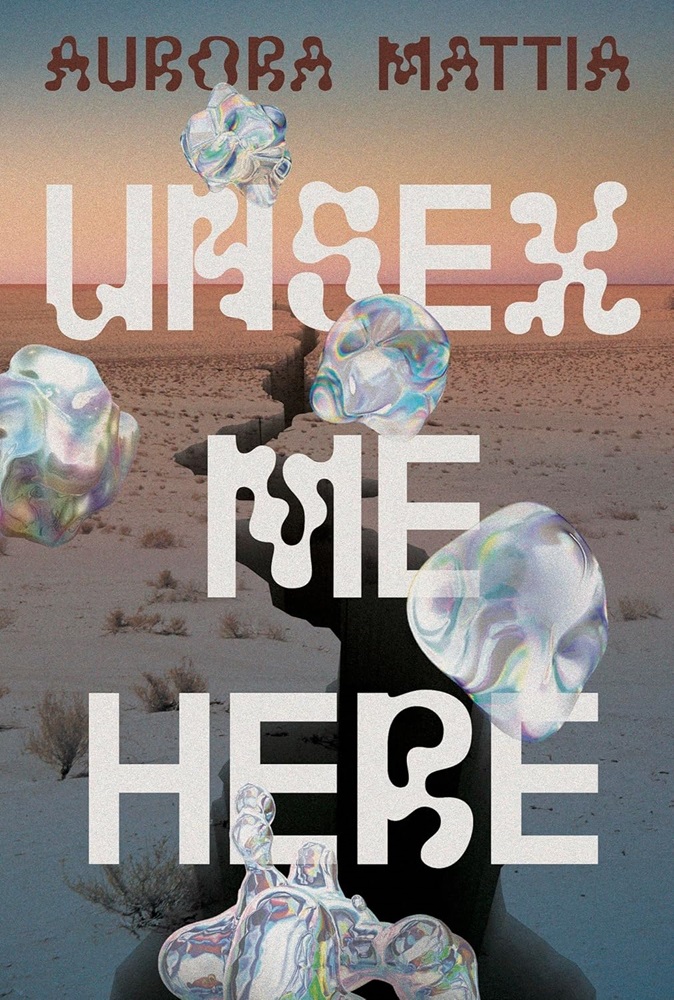
Unsex Me Here by Aurora Mattia
Genres: Adult, Queer Protagonists
Representation: Trans MCs
ISBN: 164362265X
Goodreads
Unsex Me Here is a prayer book tied together by the strings of a corset. Glamorous ramblers, haunted by the sense of another world drawing near, wander in and out of its inexplicable twilight. From a West Texas town with a supernatural past to a stalactite cavern in the birthplace of Aphrodite, from hotel rooms to gardens to the far horizon of a thought, they seek the source of the disturbance in their minds. Heartbreak is not so far from rapture; holy babble is another kind of gossip. Every pilgrimage is as dense with symbolism as it is refined by desire.
I loved Mattia’s debut novel The Fifth Wound, which was full of magical imagery and bejewelled prose. The writing in Unsex Me Here is still lovely (though probably too purple for most people – cowards!) but the simple issue is that this collection seems a lot less fantastical, which means that I’m bored.
So this isn’t me calling the book bad! It’s just not what I thought it would be, and therefore I’m not the right reader for it. Alas! I’ll still be paying attention to anything Mattia publishes in the future!
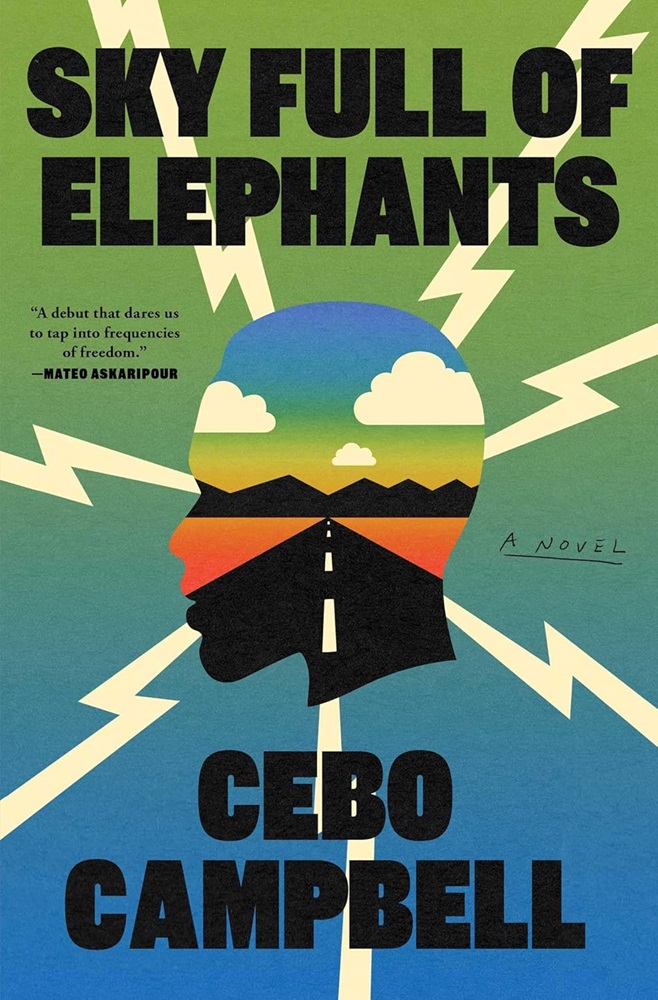
Sky Full of Elephants by Cebo Campbell
Genres: Adult, Speculative Fiction
Representation: Black cast, biracial MC
ISBN: 1668034948
Goodreads
In this exquisite speculative novel set in a world where white people no longer exist, college professor Charlie Brunton receives a call from his estranged daughter Sidney, setting off a chain of events as they journey across a truly “post-racial” America in search of answers.
One day, a cataclysmic event occurs: all of the white people in America walk into the nearest body of water. A year later, Charles Brunton is a Black man living in an entirely new world. Having served time in prison for a wrongful conviction, he’s now a professor of electric and solar power systems at Howard University when he receives a call from someone he wasn’t even sure existed: his daughter Sidney, a nineteen-year-old who watched her white mother and step-family drown themselves in the lake behind their house.
Traumatized by the event, and terrified of the outside world, Sidney has spent a year in isolation in Wisconsin. Desperate for help, she turns to the father she never met, a man she has always resented. Sidney and Charlie meet for the first time as they embark on a journey across America headed for Alabama, where Sidney believes she may still have some family left. But neither Sidney or Charlie is prepared for this new world and how they see themselves in it.
When they enter the Kingdom of Alabama, everything Charlie and Sidney thought they knew about themselves, and the world, will be turned upside down. Brimming with heart and humor, Cebo Campbell’s astonishing debut novel is about the power of community and connection, about healing and self-actualization, and a reckoning with what it means to be Black in America, in both their world and ours.
I made it to 53%, but I am just SO BORED.
I’m also, like. Side-eyeing the author quite a bit, because I think BIPOC would do just fine without us whites, actually? The society we see coming together in the first half of the book is refreshingly utopic in many ways, but there’s also all sorts of things that can’t be made or done now, and. Why??? You don’t need white people to make meds or run power stations, sir. That’s a really weird idea. Even if we run with the premise that no BIPOC were ever in charge of those things before all the white people died – which, racism is real and also terrible but I just don’t believe that for a second – what on earth would stop them picking up the instruction manuals afterwards? Or contacting people from all the many, many countries where white people were always a minority (radios are a thing! the satellites are presumably still up in space! pick up a phone!!!) and getting help or lessons from them? You’re telling me nobody was capable or interested??? I call bollocks.
(Also Canada and Mexico are right there and you’re not telling me ANYTHING about what things look like there, which is disappointing.)
Magical realism elements started showing up around the halfway mark, but the book is mostly about a dad escorting his (biracial with so much internalised racism) daughter to a place where there are allegedly some white survivors. The daughter gradually unlearning her internalised awfulness is objectively moving but not super interesting (she’s actually pretty unpleasant to read about, since she takes out this internalised racism on everybody else around her, constantly) and nothing else is really happening. I wanted to see so much more of this post-white world, but as I should have expected there was very little focus on that. Sigh!
I saw another review that said this read like it was written for white people, and…yeah, that kinda hits the nail on the head re the tone. It’s much more lecturing me and readers like me about (modern North American) racism, rather than a thought experiment or escapist wish-fulfilment thing for BIPOC readers. It’s not interesting, it’s very heavy-handed, and again, NOTHING WAS HAPPENING.
Calling it quits, doubt I’ll try this author again.
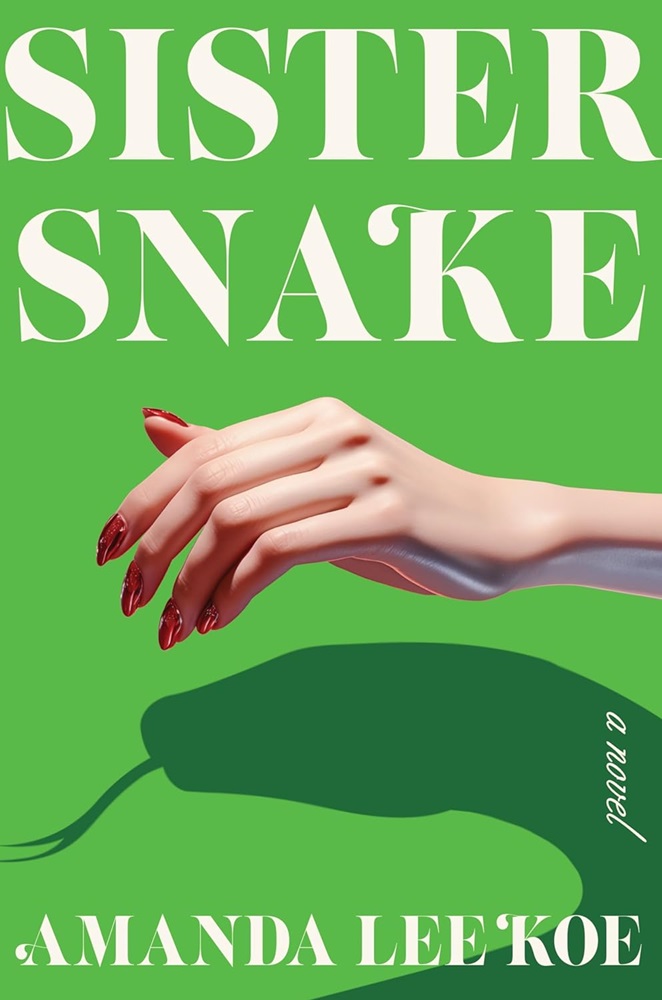
Sister Snake by Amanda Lee Koe
Genres: Adult, Fantasy, Queer Protagonists
Representation: Chinese pansexual MC, Chinese MC
ISBN: 0063355086
Goodreads
A glittering, bold, darkly funny novel about two sisters—one in New York, one in Singapore—who are bound by an ancient secret
Sisterhood is difficult for Su and Emerald. Su leads a sheltered, moneyed life as the picture-perfect wife of a conservative politician in Singapore. Emerald is a nihilistic sugar baby in New York, living from whim to whim and using her charms to make ends meet. But they share a once, they were snakes, basking under a full moon in Tang dynasty China.
A thousand years later, their mysterious history is the only thing still binding them together. When Emerald experiences a violent encounter in Central Park and Su boards the next flight to New York, the two reach a tenuous reconciliation for the first time in decades. Su convinces Emerald to move to Singapore so she can keep an eye on her—but she soon begins to worry that Emerald’s irrepressible behavior will out them both, in a sparkling, affluent city where everything runs like clockwork and any deviation from the norm is automatically suspect.
Razor-sharp, hilarious, and raw in emotion, Sister Snake explores chosen family, queerness, passing, and the struggle against conformity. Reimagining the Chinese folktale “The Legend of the White Snake,” this is a novel about being seen for who you are—and, ultimately, how to live free.
I received this book for free from the publisher via NetGalley in exchange for an honest review. This does not affect my opinion of the book or the content of my review.
My friends, I noped the fuck out when we got a snake-on-snake gangrape scene. Enough said.
(It’s also written in a very Literary Fiction style that is extremely boring, AND I can’t believe that an ancient magic snake decided to become human in order to…become the Singaporean version of a tradwife. WHAT. With bonus impossible!pregnancy, because OF COURSE.)
GOODBYE.

The Memory Hunters (The Consecrated Book 1) by Mia Tsai
Genres: Adult, Fantasy, Queer Protagonists
Representation: Sapphic brown MC, bisexual MC, secondary MLM character, secondary bisexual character
PoV: Third-person, past-tense; dual PoVs
Published on: 29th July 2025
ISBN: 1645662128
Goodreads
Inception meets Indiana Jones in this propulsive fungal science fantasy following a headstrong academic and her equally stubborn bodyguard as they unearth an ancient secret that rocks the foundations of their society—and challenges their unspoken love for one another.
Kiana Strade can dive deeper into blood memories than anyone alive. But instead of devoting her talents to the temple she’s meant to lead, Key wants to do research for the Museum of Human Memory. . . and to avoid the public eye.
Valerian IV's twin swords protect Key from murderous rivals and her own enthusiasm alike. Vale cares about Key as a friend—and maybe more—but most of all, she needs to keep her job so she can support her parents and siblings in the storm-torn south.
But when Key collects a memory that diverges from official history, only Vale sees the fallout. Key’s mentor suspiciously dismisses the finding; her powerful mother demands she stop research altogether. And Key, unusually affected by the memory, begins to lose moments, then minutes, then days.
As Vale becomes increasingly entangled in Key’s obsessive drive for answers, the women uncover a shattering discovery—and a devastating betrayal. Key and Vale can remain complicit, or they can jeopardize everything for the truth.
Either way, Key is becoming consumed by the past in more ways than one, and time is running out.
I received this book for free from the publisher via NetGalley in exchange for an honest review. This does not affect my opinion of the book or the content of my review.
I pushed and pushed with this one, all the way to 48%, but I was so bored.
The concept of memory-hunting is incredibly cool, but I wanted to see so much more of how it impacted the society that had developed after some kind of apocalypse scenario (there are a lot of references to the Decade of Storms, put it seemed to me that even before that the world wasn’t one we’d recognise. Possibly this is entirely a secondary-world setting and not meant to be a future version of our world? I wasn’t completely certain). Despite seeing inside the museum the main characters worked for, I don’t understand how this effects most people; there’s a religion that memory-diving is extremely important to, but by the halfway mark I still didn’t know much about it, even though one of our main characters is under pressure to become the next high priestess.
Plot-wise…gods, this dragged on! We start with Key and Vale out on an expedition looking for memories away from the city, and that was great, but the moment they returned home the pacing slowed down immensely to very little purpose. Key and Vale’s relationship, which seemed great when they were by themselves, either broke down or revealed itself to be much less great when they were back home. Key is from a wealthy family with a lot of privilege, whereas Vale comes from extreme poverty – and Key has been leaning on their friendship, on Vale’s desire to make Key happy, to avoid a lot of the duties Vale is responsible for enforcing. They get in an enormous amount of trouble for this – Vale loses her next paycheck, which is potentially devastating for the family back home who depend on it – and a) I thought the punishment was extreme and sudden when there was no mention of previous official warnings or anything, and b) …this was all Key’s fault and I never got the sense that she really understood why this was her fault. Yes, she blamed herself and did her best to make it up to Vale, but my impression was that she thought the rules were wrong, not that she’s been completely unfair to Vale.
None of the characters or their relationships ended up interesting me. Vale herself is the most intriguing character, but I quickly got tired of her constantly thinking she wasn’t up to the standards of everyone around her because of her background/poverty; she thinks she’s ugly, she takes everything said to her in the worst possible light even when that makes no sense, and she doesn’t seem to take pride in her skills as an elite Guardian. (She was top of her class in the academy! She can still wipe the floor with almost any other Guardian! I don’t get why she doesn’t appreciate that she’s really great at what she’s devoted her life to!) She’s physically attracted to Key but thinks this is terrible; her boyfriend, Jing, is…narcissistic is too strong a term, but he doesn’t care about her very much and makes that clear (I never understood why Vale keeps hoping he’ll eventually want to say ‘I love you’ and ‘be serious’ when he’s said multiple times that he doesn’t want to, and I disliked how pathetic she was about someone who clearly wasn’t worth her). Key thinks Jing doesn’t treat Vale well enough but doesn’t talk about it, because of course not.
(Jing is clearly in love with his Guardian, Cal, who is in love with him right back, but why would they talk about it like adults???)
Key’s mother is suffocating and controlling and doesn’t hesitate to throw her weight around; the head of the museum is clearly terrible and Key somehow doesn’t notice despite being the woman’s protege. Like. I don’t mind all these characters being unlikable, but who am I supposed to be interested in? Key? Key is passionate about memory-diving but I didn’t actually understand WHY; she’s very excited about a memory she finds at the start of the book, but we don’t know enough about the world to get why it’s important (or at least, I didn’t). I kept waiting for Key to explain to the reader what this memory could mean, to hear her babble (out loud or in internal monologue) like someone talking about their special interest, and it never happened. And yes, Key is attracted to Vale physically, but doesn’t treat her very well (even after they get punished, she still tries to emotionally blackmail Vale into letting her, Key, out of necessary memory-hunter medical treatment!) so I’m not interested in the sapphic pining, thanks.
By the halfway mark, yes, it’s clear that the museum at least is built on some kind of conspiracy to hide truths about the past, and quite possibly the whole tradition of memory-hunting (including the religion I mentioned earlier, of which Key’s mother is the current high priestess). But since I had no hint as to what the hidden truths might be, or why they mattered, I really don’t care. Is this setting even a dystopia? I haven’t seen enough of it to be sure. The dodgiest things I’m aware of are a) memory-hunters needing occasional short-term memory wipes to be able to function, and b) memory-hunters being hunted for their blood, hence why they need Guardians. Okay? Neither of those things make it clear to me that this society is fucked-up and I should want all its secrets exposed.
Prose-wise, I kept twitching at awkward sentences and clunky images, neither of which I remember from Tsai’s debut Bitter Medicine.
telling herself things like validation or personal desire were as distant as the roll of thunder from ten miles away.
…so validation or personal desire are ten miles away? Okay.
She herself was possessed of as many curves as a fence and was leaner than a weasel.
This just sounds really odd to me. ‘Flat as a board’, I get; ‘flat as a fence’…I mean, fences can curve? I think you mean that what the fence is made of – boards, iron bars, whatever – are not curvy. It’s just awkward.
only person Jing puts above himself is Cal.” She was wrong, but Vale figured she didn’t want to know that Jing preferred lying on his back in bed.
I’m still not sure what it means. Is it a sex joke? Vale is usually on top when she and Jing have sex?
“Because you treat me like a friend, not an asset.”
[…]
“As a friend. Not like a friend.”
Am I just being dumb? I don’t get it. I think what is meant here is ‘I treat you like a friend because you are my friend’, but the distinction between ‘as a friend’ and ‘like a friend’…don’t they mean the same thing? What???
48% and I’m bored, don’t care where the story is going, and have no interest in any of the characters, never mind Key and Vale someday getting together. I give up!
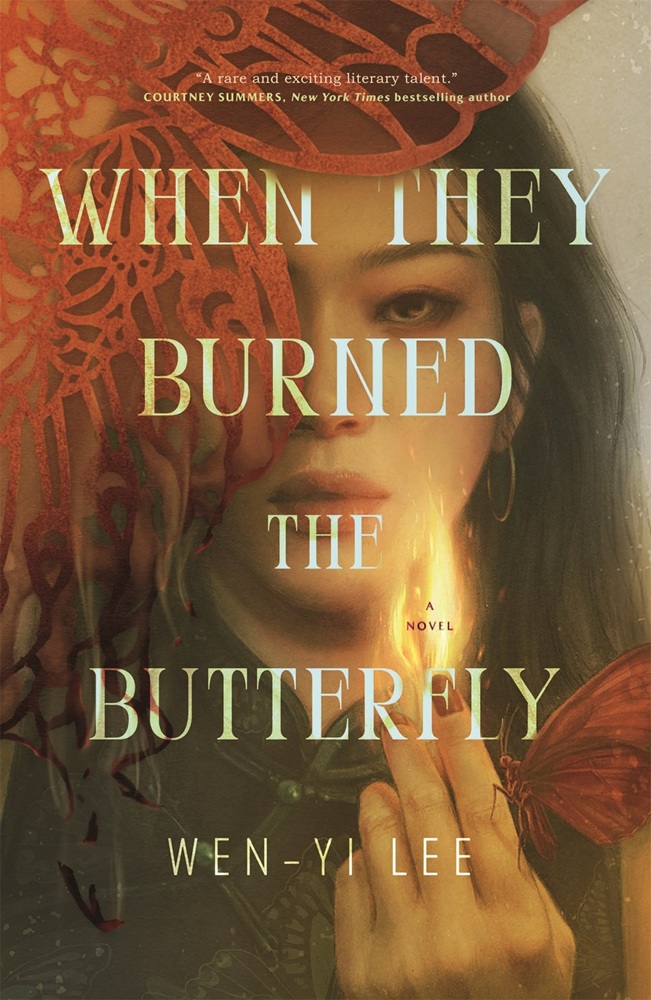
When They Burned the Butterfly: A Novel by Wen-yi Lee
Genres: Adult, Fantasy, Historical Fantasy, Queer Protagonists
Representation: Sapphic Singaporean MC, F/F, minor trans character
PoV: Third-person, past-tense
Published on: 21st October 2025
ISBN: 1250369460
Goodreads
A fierce, glamorous sapphic fantasy reimagining the secret societies of postcolonial Singapore, for fans of Jade City, Silvia Moreno-Garcia, and the feverish intensity of RF Kuang’s Poppy War trilogy.
Singapore, 1972: Newly independent, a city of immigrants grappling for power in a fast-modernizing world. Here, gangsters are the last conduits of the gods their ancestors brought with them, and the back alleys where they fight are the last place where magic has not been assimilated and legislated away.
Loner schoolgirl Adeline Siow has never needed more company than the flame she can summon at her fingertips. But when her mother dies in a house fire with a butterfly seared onto her skin and Adeline hunts down a girl she saw in a back-alley barfight—a girl with a butterfly tattoo–she discovers she’s far from alone.
Ang Tian is a Red Butterfly: one of a gang of girls who came from nothing, sworn to a fire goddess and empowered to wreak vengeance on the men that abuse and underestimate them. Adeline’s mother led a double life as their elusive patron, Madam Butterfly. Now that she’s dead, Adeline’s bloodline is the sole thing sustaining the goddess. Between her search for her mother’s killer and the gang’s succession crisis, Adeline becomes quickly entangled with the girls’ dangerous world, and even more so with the charismatic Tian.But no home lasts long around here. Ambitious and paranoid neighbor gangs hunt at the edges of Butterfly territory, and bodies are turning up in the red light district suffused with a strange new magic. Adeline may have found her place for once, but with the streets changing by the day, it may take everything she is to keep it.
I received this book for free from the publisher via NetGalley in exchange for an honest review. This does not affect my opinion of the book or the content of my review.
I was so freaking hyped for this, but I can’t stand the prose.
Don’t get me wrong: I love the main character. She is, as other reviewers have said, a bitch, and you know what? It’s great. Give me more unlikable heroines, characters who DGAF about being Nice, who have sharp edges and sharper tongues and will burn the fucking world down for spite. Adeline is *chef’s kiss*
The premise, though, seemed to be very simplistic as the book went on – various criminal gangs draw power from different gods and spirits, granting them different kinds of magical abilities. I was hoping for a lot more on the nature of this connection, what makes a god, where these beings come from – and I especially thought we’d get it because Adeline’s connection to the Butterfly goddess is unique. Possibly it showed up later in the book than I got, but the way it was all framed very much made it feel like we weren’t going to get any explorations into that. Which was disappointing.
But the main problem is the prose. Bear in mind, I seem to ‘hear’ prose in a way the vast majority of readers don’t, so when I have an issue with prose rhythm, it’s almost always something that doesn’t affect others. The fact that Lee’s writing seemed unbearably jerky to me – stopping-and-starting, establishing a rhythm only to immediately break it, using word order that doesn’t sound CorrectTM (to me, I emphasise!) – does not mean it will to you! If you’ve never been bothered by prose rhythm before, you very likely do not need to worry about it bothering you in When They Burned the Butterfly. (I am envious.)
For me, it made When They Burned the Butterfly a chore; every time I set it down, I had zero desire to pick it up again. The dialogue in particular rang very false to me, and while there were occasionally really beautiful lines of prose, such as Adeline’s first moments of Sapphic Awakening–
And she had another something whose articulation was formless on Adeline’s teeth, tart and vivid enough to strike the nerves in her gums, something essential she was gnawing at that wasn’t yet solid enough to spit out. But it turned Adeline’s throat dry and scraped her insides with a terrifying hunger.
–there were a lot more that jarred, where the writing felt ‘out of tune’ and the phrasing was confusingly clunky.
The street constantly smelled sweet of burning chrysanthemums.
The author’s meaning comes through perfectly! But that either ought to be ‘sweetly’ (and possibly it is meant to be and this is just a typo that will be corrected before release day – I read an advanced reader copy, and they do have errors sometimes) or it needs rephrasing.
There had been cholera outbreaks recently, but it didn’t seem to have gripped the actual place in any sense of urgency.
‘There had been cholera outbreaks recently, but you wouldn’t guess it from the atmosphere of the street.’ Or something. ‘it didn’t seem to have gripped the actual place in any sense of urgency’ is just such an awkward way of saying what is meant here.
At least, a shop was a generous name.
‘Calling it a shop was being generous.’
Tragedy could fuel revenge with the right conditions to move it along.
I know what you mean, but! This is not the best phrasing!
which also meant they knew exactly where he would be on days of the week.
…so they knew where he’d be every day, then?
If you’re raising an eyebrow at me right now, with no idea why these quotes bother me, then congrats, you will probably enjoy the prose just fine and can completely ignore my critique there! Again, I am jealous of you.
I should also note that I skipped ahead to read the ending, hoping it would be interesting enough that I’d want to finish the book to find out how we got to it. Instead, I found a wishy-washy, not-an-actual-ending ending, the kind that annoys me immensely. Especially when it’s trying to be gritty, which this definitely was. (The author gets points for doing a thing very few authors are brave enough to do, but it’s a tragic thing that I don’t actually enjoy and which is definitely going to upset a lot of readers.) The epilogue is one long info-dump type summary of events that should have been an entire second book.
(That being said, Tor has had a habit recently of marketing books as standalones – Kerstin Hall’s Asunder, Sandymancer by David Edison, etc – that the authors did not intend as standalones, and I do wonder if that’s part of the issue here? Does Lee intend for there to be a sequel? One set after the events of the epilogue??? Or maybe wanted there to be one but Tor only bought one book, so she wrote the epilogue to…? Try and resolve things? But even if so, the epilogue did not leave me feeling like Adeline’s story was finished. Gah, I don’t know. Whatever the authorial intent, the reading experience was not satisfying, and whether that was Lee’s fault or Tor’s doesn’t make a practical difference, in the end.)
So…yeah. Sigh. DNF. Lots of other early reviewers have loved this, and I would like When They Burned the Butterfly to do well because I want to see more characters like Adeline! But I won’t be finishing this one.
Did you DNF anything this month???




Leave a Reply