September was a really rough month, and it’s possible that had an effect on my patience and/or ability to enjoy reading, so please take these with a bigger pinch of salt than usual!
In other words: we hit a new record for number of DNFs in a month! YAY! Not. Gah!
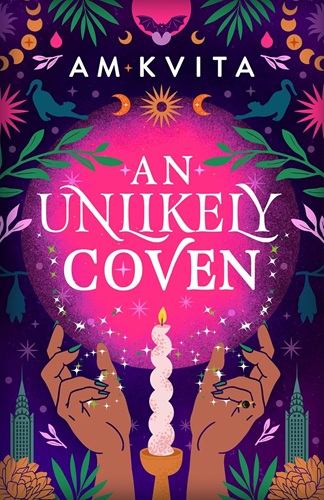
Genres: Adult, Fantasy, Queer Protagonists, Urban Fantasy
Representation: Brown biracial sapphic MC
Published on: 28th October 2025
ISBN: 0356527522
Goodreads

The outcast daughter of a powerful family of witches returns home to New York City and is immediately embroiled in a supernatural power struggle in this wickedly funny fantasy debut from AM Kvita.
After seven long years, Joan Greenwood is finally returning home.
Unfortunately, her family totally forgot about it.
The outcast daughter of a powerful witch family, Joan’s homecoming is lukewarm at best, but soon turns disastrous when news hits that someone has created a spell that can turn an ordinary human into a powerful witch, threatening the balance of the magical world and the Greenwoods' place at the top of it.
When her best friend confesses that he has secretly, accidentally, saved this human-turned-witch from an uncertain fate, Joan is thrust headfirst into a desperate race to undo the spell before it does permanent damage to its unwilling host.
Soon, Joan finds herself drawn deeper into the heart of the city’s magic, into an uncertain alliance with a (very attractive) family rival, and far beyond the limits of everything she thought her own magic capable of.
Welcome home, Joan Greenwood.
I received this book for free from the publisher via NetGalley in exchange for an honest review. This does not affect my opinion of the book or the content of my review.
I’m not sure this is bad, as such – but it’s like it was written specifically to annoy me. It’s a checklist of my pet peeves, full of little things that probably won’t bother anyone else – that some readers may even be looking for! – but that needle me. I did force myself to read to 20%, but it was such a relief when I decided I wasn’t going to read more than that.
The worldbuilding is, imo, particularly lame. Urban fantasy usually doesn’t have extensive or especially unique worldbuilding, and I wasn’t expecting that – but Unlikely Coven was still a letdown in that department. The magical community is literally just called the ‘magic world’ by all and sundry (even Cassandra Clare came up with ‘the Shadow World’ or ‘Downworld’!); vampires live in groups called packs (I honestly can’t believe how much this bothered me); the crest/logo of the ruling witch family is ‘a coffin with a scythe in the background, wrapped in ivy’. (In a world with vampires, how is that the symbol of a WITCH family?) But the objectively worst part is that there is no way to discern the difference between humans, witches, and vampires. Members of the magical community can’t see or sense that another person is also magical, never mind what species they might be. This is both something that annoys me whenever it comes up, and something that breaks the entire plot.
See, a human has been turned into a witch! How do we know this? Well, witnesses saw someone at a magic market use magic! …Okay. How did they know this person wasn’t born a witch? Do humans and witches look different? Do magical folk have the witchy equivalent of gaydar? Was there anything about the magic this person was using that was Clearly Not Witch-Magic?
No?
THEN WHY DIDN’T THE WITNESSES ASSUME THIS PERSON WAS A WITCH? What POSSIBLE reason did they have to jump to ‘omg that person was born human!!!’ ? Everything hinges on this!!! If there’s no way to tell, the WITNESSES can’t tell, there are no rumours, THE ENTIRE PLOT DOESN’T HAPPEN.
Cue me screaming into a pillow in frustration.
The prose is also…just a few degrees ‘off’. It reminds me of the uncanny valley effect: it’s SO CLOSE to being perfectly normal that it’s more distracting than if it were full-on bad. I found myself staring at certain sentences, saying them over and over in my head, trying to figure out why they bothered me so much. Take this example
A smile flickered across Grace’s lips before she crushed it like an ant.
Unlikely Coven is written in third-person, from the perspective of Joan, our mc. So in this line, Joan is observing Grace from the outside – there’s no magical/psychic telepathy or empathy going on here. So all Joan actually sees is that Grace is smiling, then suddenly not-smiling. Which makes me ask, where does the ‘crushed it like an ant’ come from? Joan doesn’t know why Grace stopped smiling, what’s going on in her head or what she’s feeling – not only because she can only observe from the outside, because in this scene she only met Grace a few seconds ago. She’s a stranger! So she can’t even guess/assume at Grace’s feelings, because Joan doesn’t know her.
You see?
Then there’s the lines that don’t quite make sense;
This would always be the official Greenwood residence, not so much the warm, fuzzy home of a kid.
‘Warm and fuzzy’ is how you describe feelings, not a house? Houses are never fuzzy? What?
“I don’t know,” the man guessed.
That’s not a guess?
Ghosts didn’t classify as a single magical species, as everyone died eventually and almost no one really wanted to, so they tended to hang around for ages until the universe recycled them.
I just don’t understand what’s being said here – ghosts aren’t a species because everyone becomes one? What do those two facts have to do with each other? Wait, ARE you saying that everyone becomes a ghost? Or just that those who DO become ghosts tend to hang around for ages? And either way, what does them hanging out for ages have to do with not classifying them as a species?
her mind danced a little jig, looking for a rip cord to get out of this conversation.
Joan wants out of this conversation – that feeling continues in the next few sentences – but her mind’s ‘dancing a jig’? Doesn’t that mean she’s HAPPY? What?
While magic twists unconciously through witches at some low level at all times, humans are never permeated.”
“Because it makes them sick?” Joan said, prompting her on as she ripped into her own sandwich. “The body’s natural defense against something that makes you unwell?”
“Right. So if humans have some level of protective barrier, then witches have a much more porous one.
I don’t understand this either – the body’s defense against something that makes you unwell is to…make you sick? No? The thing that makes you unwell makes you sick, your body’s reaction is to try to kill/get rid of the thing! What? It’s like the logic is going in the wrong direction – humans are never permeated by magic because they have a barrier! If it gets past the barrier, it makes them sick. It’s not that the magic never goes into them because it makes them sick – the magic isn’t going ‘oh, sorry, I’ll leave you alone then!’ THERE’S A BARRIER.
This kind of slightly-wrong-direction logic is all over the place, and kept making me twitch.
Finally, there’s a lot of telling-not-showing. We meet Joan’s family briefly, and they’re clearly mean and neglectful and power-hungry. But later, we’re told that not only are they like that with Joan, but that
Joan had watched [her family] ruin reputations, run families out of the city, mandate that vampires turn new vampires only within strict quotas, and even put attendance limits on certain fae revels to keep too many of them from banding together at once. All in the name of order. Power.
Setting aside the fact that I don’t understand why the vampires etc OBEY the rules being set by this witch family – what the fuck do you MEAN these witches have said how many kids vampires can have?! Is that not eugenics territory? If we’re jumping to that level of evil, I’m sorry, but you do actually have to SHOW me – it’s not enough to just tell me something like that. Same with Joan telling the human-turned-witch that her family would absolutely vivisect them – sorry, WHAT?! Again, I need more evidence than ‘these witches are extremely neglectful of their unmagical daughter’. I accept they’re abusive, but it’s a jump from that to being some kind of totalitarian dictators!
Her family want to learn how to turn humans into witches, Joan thinks to build an army – but for what? The Greenwoods already rule the magic world, what is it that they want control of that they don’t have already?
The Greenwoods had kept their boots on the necks of the LaMortes for centuries.
The LaMortes are a vampire family – so you’re genuinely telling me that these IMMORTALS have not been able to use their longer lifespans to make long-term plans to out-manoeuvre the witches? Why not? If they’re just not smart enough, then it’s less an issue of the Greenwoods specifically; WHOEVER was in charge, the LaMortes wouldn’t be in a position of power. Right? They’re not good at politics or intrigue regardless.
I don’t know – if you enjoy urban fantasy, I don’t think this is a BAD one. If you’ve read the quotes I pulled and don’t see a problem, then you’ll definitely be fine (and I’m jealous that your brain is less obsessively nit-picky than mine!) But I’m twitching painfully every other page. Hard DNF from me.
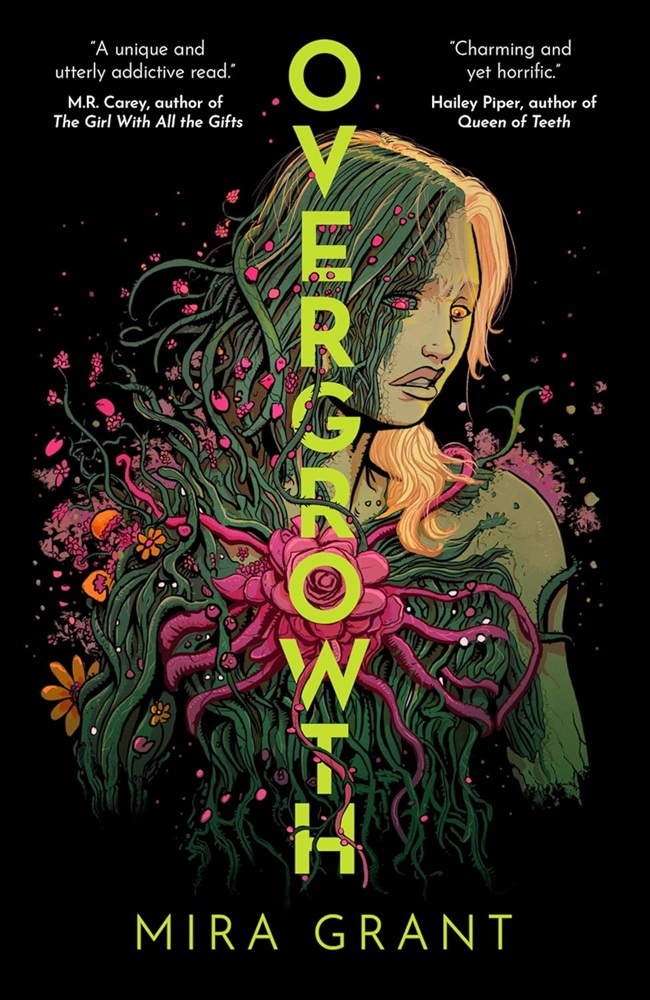
Genres: Adult, Horror, Sci Fi
Representation: trans boyfriend
PoV: First-person, past-tense
Goodreads

Day of the Triffids meets Little Shop of Horrors in this smart, charming, harrowing alien invasion story about being human, by a Hugo-award winning author.
Since she was three years old, Anastasia Miller has been telling anyone who would listen that she's an alien disguised as a human being, and that the armada that left her on Earth is coming for her. Since she was three years old, no one has believed her.
Now, with an alien signal from the stars being broadcast around the world, humanity is finally starting to realize that it's already been warned, and it may be too late. The invasion is coming, Stasia's biological family is on the way to bring her home, and very few family reunions are willing to cross the gulf of space for just one misplaced child.
What happens when you know what's coming, and just refuse to listen?
I’d like to try this again eventually, but right now I can’t get past the one tiny detail that doesn’t make sense.
Another character believes about the aliens, because View Spoiler »
This is such an unimportant detail that I imagine most readers don’t even notice, and DEFINITELY don’t care, but I can’t let it go. I keep obsessing over it. It makes no sense, and it really looks like it will never come up again/be explained (because it’s such a tiny detail).
(For the record, yes, I DO hate that my brain does this.)
I read to 30% and was otherwise enjoying this, but I gotta set it aside, at least for now.
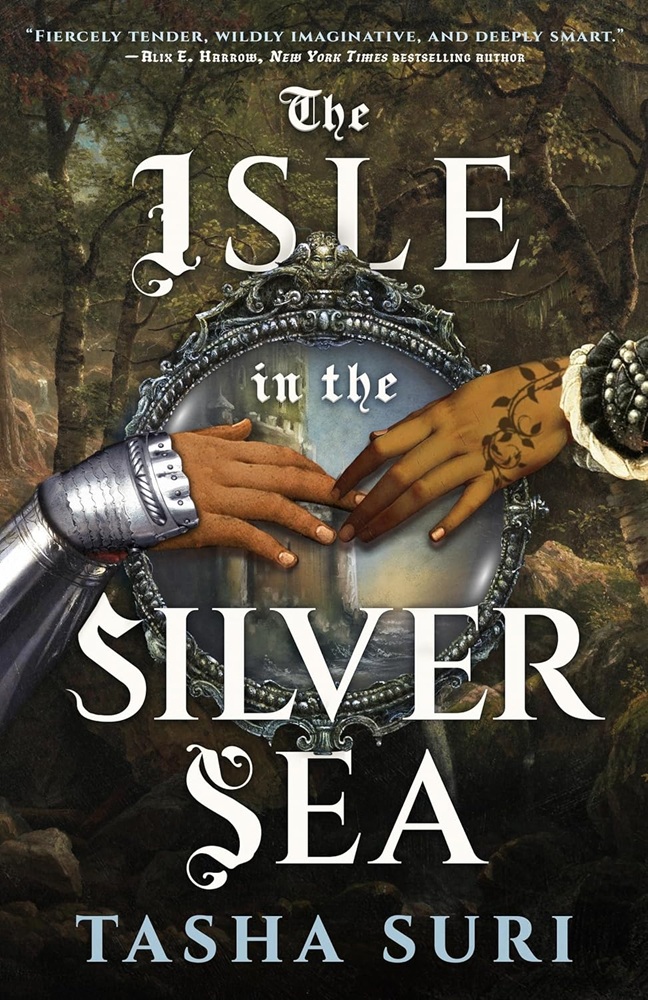
Genres: Adult, Fantasy, High Fantasy, Queer Protagonists
Representation: Sapphic Desi MC, sapphic biracial Desi MC, F/F, secondary trans character
PoV: Third-person, past-tense; dual PoVs
Published on: 21st October 2025
ISBN: 035652440X
Goodreads
From World Fantasy Award-winning author Tasha Suri comes The Isle in the Silver Sea, a heart-shattering romantasy of sapphic longing, medieval folklore and a love that spans the centuries.
In a Britain fuelled by stories, the knight and the witch are fated to fall in love and doom each other over and over, the same tale retold over hundreds of lifetimes.
Simran is a witch of the woods. Vina is a knight of the Queen's court. When the two women begin to fall for each other, how can they surrender to their desires, when to give in is to destroy each other?
As they seek a way to break the cycle, a mysterious assassin begins targeting tales like theirs. To survive, the two will need to write a story stronger than the one that fate has given to them.
But what tale is stronger than The Knight and the Witch?
I received this book for free from the publisher via NetGalley in exchange for an honest review. This does not affect my opinion of the book or the content of my review.
I give up. I made it to 63%, but my heart isn’t in it: every time I set it down, I don’t want to pick it up again. Final straw when we got the big revelation around the 60% mark re What’s Going On With the Queen, and it’s just told to us. We had no way to piece that together. The (really important!) messaging about diversity and change is just – flatly stated to us. We didn’t see it, we didn’t feel it, and honestly no, I don’t think the groundwork was laid for it.
I love the message, Suri is so completely correct – but story-wise, it came out of NOWHERE.
And this is after a lot of other very blunt reveals, too.
I don’t want to say this was objectively bad. But I was so, so bored. I think partly because of the setting – we’re in a magical sort-of-Elizabethan?-version of England, it’s hard to make me interested in that after I’ve seen it so many times. For all that this society is woven through with Incarnates, people who are destined/compelled to live out specific stories/folktales/legends, this hasn’t really changed it in any way from anything we’d recognise. The queen on the throne is immortal, but if that’s affected anything we don’t see it; the fae exist, and even appear at the human court sometimes, but again, we barely glimpse them, they’re only around the edges (I was genuinely miffed when a pov-switch meant we didn’t get to see inside Faerie when one of the characters was there overnight. Please show me Faerie! I will always want to see it!) The Archivists function as governmental censors, but again, we don’t see how that affects people’s lives on a daily, practical basis.
Simran is our witch, and I liked her: she’s spiky and Unimpressed and out to rescue and save her best friend. Vina took a while to grow on me; she has a carefully maintained facade of being a happy-go-lucky louche, but as the story went on we gradually saw more and more of what lies behind that facade. They’re both brown in a xenophobic England; Simran was born abroad, and Vina is biracial. On an intellectual level, I thought it was interesting to see Suri play with insta-love – because, compelled by the tale they’re Incarnates for, Simran and Vina are kind of magically pressured to love each other – while trying to balance that by having them develop not-magicked feelings too. But I wasn’t very invested in the romance; I found the characters more interesting as individuals than as a combination – I can’t believe I’m saying this of a sapphic romance, but I’d have been happier if things had stayed platonic instead of becoming romantic. I just didn’t think they had that kind of chemistry? But as partners working together to solve the serial murders, and dig into wtf is behind all the stories – there they make a decent team.
But on the whole…I was bored. Things happen, but they felt disjointed to me, and passionless? Not formulaic, but not hitting as hard as they were clearly meant to. There’s a lot of travelling, and the side-quests were sometimes intriguing but didn’t actually tell me anything more about the world or the Incarnates and all. Reveals came very abruptly and with a lot of telling, and I KNOW the archetypes Suri is playing with, this kind of folklore is my jam, but even being so familiar with them, I didn’t see them coming because…there was no way to. We didn’t get the clues we needed. There was no looking back, after the reveal about the assassin’s identity and mission, and thinking ‘oh! of course! how did I miss that?’ The same is true when we learn why the stories of the Isle are dying. I know this doesn’t bother everybody, but I HATE when books do this – I don’t need to figure everything out before it’s revealed, but I DO need to be able to see that the reveal fits perfectly into what we already know, that all these subtle or not-so-subtle details were clues or hints that I missed. And there’s none of that here.
We know the Archivists are evil because censors always are – because it’s a genre trope/convention. But even with the excerpts from censored or approved texts at the beginning of each chapter, all that’s clear is that the Archivists suppress anyone saying that the queen isn’t perfect, or that being an Incarnate must suck, actually. That’s bad, obviously, but it’s not EVIL. We have to be told, flatly, that they’re evil, because it’s not shown.
I love the idea. I love the core message. But as a book, this doesn’t work for me. The plot is really choppy. I can’t forgive the abrupt, careless revelations. The world is dull. The whole first half should have been showing us how stagnant the Isle is, laying the groundwork for The Truth, and for some reason it didn’t even try to do that. The protagonists are not bad at all, but they don’t stand out, either. The prose is lovely – Suri’s always is – though I think it suffers from the lack of beautiful, epic visuals that Suri’s previous books have always been full of. The magic system is neat. I can see why I’m supposed to love it, but it all feels…shallow and rushed.
I’m not forcing myself to read any more of it.

Genres: Adult, Queer Protagonists, Science Fantasy
Representation: Lesbian MC
Published on: First-person, past-tense
ISBN: 9798262226603
Goodreads

Fern Meldin wanted one night of fun with a woman she just met, not a legend.
One night of trouble, not a lifetime tethered to a myth. Somewhere between the kiss and the collapse, she astrally resonated with a black hole and woke up bonded to Vireleth the Closure, the most dangerous mythship in history.
A mythship with abandonment issues, a taste for dramatic entrances, and a tendency to hold grudges across lifetimes. She once served a legendary hero who saved the universe and died very, very dramatically, leaving behind one incredibly lonely ship with trust issues.
Now the government wants Fern contained. The ship wants a partner who won't leave. And Dyris Vaelith, brilliant Director of the Accord Emergence Division and the kind of woman who could negotiate peace treaties or start wars with equal flair, is about to discover that containing a disaster lesbian with reality-bending powers is significantly more complicated when you're falling for her.
A sapphic mythpunk space opera about haunted ships, disaster queers, and learning that sometimes the most dangerous thing in the galaxy just wants someone to stay. Perfect for fans of Gideon the Ninth, Mass Effect, and kissing while the stars collapse.
If you say ‘like’ seven times in the first page and a half, I’m sorry but we’re not going to get along!!! Fifteen times in the first six pages. NO.
(To be clear, the ‘likes’ are in the constant awkward similes, not used like when someone’s writing a bubble-gum snapping airhead forcing ‘like’ into every sentence.)
All these quotes are from the first six pages, okay?
I woke up on fire.
Not literally. Or maybe literally, if you counted the way my body vibrated with heat,
…So which is it??? I mean, if you’re NOT on fire then no, not literally? What??? These are out OPENING LINES.
Every cell prickled and ached, not quite pain, more like the aftertaste of pain, like someone had rewound the suffering and made me experience it again for fun.
But if someone makes you experience it again, shouldn’t that be ACTUAL pain, not an aftertaste?
A hideous gold and black blanket twisted around my legs like evidence at a crime scene.
This confused me greatly until I realised the author maybe meant the blanket is like the crime scene TAPE? Which I think is often yellow and black? But if that IS what you mean, then you’ve written it wrong. And if that’s NOT what you meant, then this is very odd?
Then the thought reversed itself inside out: there was no chance I was alone.
‘reversed itself inside out’?
All warmth left my body and left me frostbitten on every surface not touching another part of myself.
This is just very awkwardly phrased.
I hated how familiar this felt, a script rehearsed to perfection before you’re even aware you’re auditioning for the part.
As is this.
guilt. Not just any human guilt, but the kind that precisely knows which crime is etched on its face yet forgets why it ever believed it could escape unpunished.
Honestly, I’m not even sure what you’re saying at this point.
My lungs shriveled around themselves as if oxygen had become illegal overnight.
I think what you mean is ‘if oxygen had just become illegal’, but even that would be very awkward phrasing.
Vireleth, the gold-medal winner in every space’s worst-case scenario bracket.
This would have been fine if you’d just left off the ‘bracket’ at the end.
Every nerve under my skin lit up like it almost remembered pain that had been deleted from the time stream.
No. I’m sorry, this sounded SO COOL, the taco on the cover had me very excited that this would be adorable/silly/funny as well as mythpunk science fantasy – but no. NO.

Genres: Adult, Horror, Queer Protagonists
Representation: Trans MC, trans cast
PoV: First-person, past-tense
Published on: 7th October 2025
Goodreads

Manhunt meets Lord of the Flies in this blistering horror debut following a young trans woman after she arrives at the all-trans girl commune founded by her toxic ex-girlfriend, only to discover that demons, both literal and figurative, haunt her fellow comrades—and she's their next prey!
Herculine’s narrator has demons. Sure, her life includes several hallmarks of the typical trans girl sob story—conversion therapy, a string of shitty low-paying jobs, and even shittier exes—but she also regularly debates sleep paralysis demons that turn to mist soon after she wakes and carries vials of holy oil in her purse. Nothing, though, prepares her for the new malevolent force stalking her through the streets of New York City, more powerful than any she’s ever encountered. Desperate to escape this ancient evil, she flees to rural Indiana, where her ex-girlfriend started an all-trans girl commune in the middle of the woods.
The secluded camp, named after 19th-century intersex memoirist Herculine Barbin, is a scrappy operation, but the shared sense of community among the girls is a welcome balm to the narrator’s growing isolation and paranoia. Still, something isn’t quite right at Herculine. Girls stop talking as soon as she enters the room, everyone seems to share a common secret, and the books lining the walls of the library harbor strange cryptograms. Soon what once looked like an escape becomes a trap all its own.
While trying to untangle the commune’s many mysteries, the narrator contends with disemboweled pigs, cultlike psychosexual rituals, and the horrors of communal breakfast. And before long, she discovers that her demons have followed her. And this time, they won’t be letting her go.
I received this book for free from the publisher via NetGalley in exchange for an honest review. This does not affect my opinion of the book or the content of my review.
I recently learned the term ‘dirty realism’ – which is a literary movement/writing style – and thus finally have the words to explain why books like Herculine don’t work for me. I just don’t like this style! I understand what it’s doing, what the point of it is, and I think Byron is very good at it; it’s very effective here. I have no critiques; what I read of Herculine was objectively great. I don’t even have any nitpicky comments! (And if you’ve followed me for a while, you know how rare that is!)
But dirty realism is too freaking bleak for me, so. Alas, dear Herculine – we part as friends!
If you DO like dirty realism, then you will adore this, methinks. It’s bleak and sharp and wry and gritty, occasionally snarky; Byron has a great way with words (I highlighted several BANGER lines!); and the main character had me gently banging my head against the wall (complimentary). Myself, I’ll be paying close attention to whatever Byron publishes after this – I’ll be crossing my fingers that I’ll be a better fit for some future book of hers!

Genres: Adult, Fantasy, Urban Fantasy
Representation: Korean-American adoptee MC, elderly MC
PoV: First-person, past-tense; multiple PoVs
Published on: 21st October 2025
ISBN: 0756419697
Goodreads

Buffy the Vampire Slayer meets Golden Girls in this humorous contemporary standalone fantasy about a group of former Chosen Ones coming out of retirement to save the world one last time
Three former Chosen Ones have joined together to spend their retirement in peace and quiet, running Second Life Books and Gifts in Salem, MA. A calm, peaceful, tourist-filled oasis, where they never have to worry about saving the world. Until some of the locals start summoning ancient creatures best left where they were . . . and they discover that their bookstore basement just may be the portal to the underworld. These ex-heroes may have thought they were done . . . but if they want to finish their retirement in peace, they’ll have to join together to save the world one last time.
Why leave saving the world to the young? Cozy mystery readers looking for an extra dash of magic will eat this story fun, funny, and heartwarming, it's a novel about community, second chances, and the healing power of scones.
I received this book for free from the publisher via NetGalley in exchange for an honest review. This does not affect my opinion of the book or the content of my review.
My two main critiques are: the voices of the three protagonists are really hard to tell apart (I had to use the names at the start of the chapters, or context clues, to tell whose head I was in at any given moment) and I wish the two younger mcs had been a good bit older – I was here for elderly ex-Chosen Ones, specifically. Jenny and Annette are both around 50, and in great health, so theirs weren’t the kind of perspectives I was hoping for.
However! In all other ways, this is perfectly lovely. The prose and worldbuilding feel very standard; if you like urban fantasy, you’ll be very comfortable here. I did not get far enough to meet it myself, but I am assured that the tentacle cat does in fact appear in the second half of the book. If you like your characters badass but wry with long experience, you should have fun with Slayers of Old. It definitely helps that Hines is very genre-savvy; the story feels very self-aware, with casual inclusivity and low-key critique of some genre cliches. I giggled at moments like Jenny giving Artemis ‘tribute’.
It’s a fun little popcorn read. Which is not what I’m interested in – hence the DNF – but I think most readers who find the premise appealing will enjoy themselves!

Genres: Adult, Fantasy
PoV: First-person, present-tense
Published on: 21st October 2025
ISBN: 166808032X
Goodreads

A divinely-blessed warrior bound to the last living goddess plots deicide to win her freedom in this propulsive epic fantasy for fans of Godkiller and Gideon the Ninth.
The Devoted Lands was once home to many Salt, Stone, Storm, Green, Shadow. Now, after centuries of devastating wars, only Tempestra-Innara, the Eternal Flame, remains.
Conscripted as a child, Lys, potentiate of the Dawn Cloister, is outwardly a loyal servant to her goddess. If she harbors impossible dreams of deicide, that’s her business. But when a routine heretical execution erupts into a near-fatal assassination attempt on Tempestra-Innara, Lys sees a glimmer of hope for her freedom.
Lys is chosen to hunt down the heretics and find an ancient reliquary that holds the power to kill a god. Annoyingly, she’s not alone. Paired with Nolan, a potentiate from a rival cloister who is as pious as he is determined, Lys must feign devotion if she hopes to keep her own heretical thoughts hidden and god-killing ambitions within reach.
As they pursue a dangerous network of heretics linked to the assassination, Lys uncovers a world brimming with more possibility—and peril—than she ever anticipated.
I received this book for free from the publisher via NetGalley in exchange for an honest review. This does not affect my opinion of the book or the content of my review.
This is perfectly well written – it might even be great, though personally I found the mc’s very modern voice really, really distracting. (A modern voice is fine if the tone of the whole book allows for it, whether or not it technically makes sense. But in a Taking Itself Seriously High/Epic Fantasy? Nope, sorry, I hate it.) I didn’t click with it, mainly because of Lys’ first-person narration but also because Lost Reliquary didn’t seem to be doing anything new. After the first 20%, I started skimming – and was really disappointed by what I found.
Because I do, honestly, think it’s well-written – hence the four stars. But it’s also very, very predictable. If you’re a Fantasy lifer, you can call it from the synopsis, and you will be entirely correct: View Spoiler » I saw literally all of that coming. And I imagine a lot of others will too: we’ve read this book before. A few times!
If you don’t mind knowing where a book’s going – and you don’t mind a High Fantasy mc who says ‘yay’ – then I think this could be a great read. If you’ve never read a story with a similar set-up, then you might not predict the plot, in which case, this is definitely a great read! Because that’s the only critique I have of it – everything else I disliked, it was just a matter of personal preferences and taste, not objective flaws. (And most of those things were nitpicky, unlikely to bother most other readers. For example, Lys is very anti-Tempestra, anti-fundamentalist, anti-cruelty – all of which is great! But I have no idea why she’s like that when she went through the same upbringing all her peers did. In fairness, perhaps that came up more in some part that I skimmed.) The prose is good; the worldbuilding is easily up to the standard of most High Fantasies; the mc is sympathetic and quippy; the aesthetic is not displeasing. The endgame of the heretics was really freaking cool, probably my favourite part of the book – and the reason I’m interested in reading the sequel.
Because sure, this instalment was very predictable – but I have no clue where the story is going next, and with that endgame I mentioned in play? I think I could put up with Lys’ voice, to see where that’s going.
So this is an extremely odd DNF – I read 20%, skimmed most of the rest, read some of the more pivotal moments and the ending, and I’d like to pick up the sequel when it comes out. So this isn’t exactly a recommendation – but it’s not not a recommendation, and it is a recommendation for the next book!
Probably my strangest DNF review ever.

Genres: Adult, Fantasy, Queer Protagonists, Romantic Fantasy
Representation: Bi/pansexual MC, pansexual love interest, queernorm world
Published on: 23rd September 2025
ISBN: 035652454X
Goodreads

Love. Loyalty. Sacrifice.Grey Flynn has dedicated her life to her mage, Kier.
She will be his blade on the battlefield, his healer and protector. The deep well of raw power inside her is Kier's to use. Grey would do anything for Kier - be anything for him - if he would only ask.
When a quest to protect the child of an enemy kingdom pulls them into the dangerous heart of their nation's war, Grey and Kier will need to decide what they are willing to sacrifice to protect their secret.
For Grey is no ordinary magical well, but heir to the lost island of Locke - the root of all power. If she dies, all magic dies with her.The Second Death of Locke is a devastatingly romantic epic fantasy and about the undying bond between a knight and their mage, perfect for fans of Gideon the Ninth and The Six Deaths of the Saint.
I received this book for free from the publisher via NetGalley in exchange for an honest review. This does not affect my opinion of the book or the content of my review.
What if you took the Necromancer/Cavalier bond from the Locked Tomb verse and made it nonsensical???
The prose is…tolerable (albeit full of telling-not-showing, which, why) but the plot and worldbuilding are both disasters.
Mages can’t use magic directly; they have to bond with a person who is a well, and draw magic through that person. I have no objection to this whatsoever. I do have a problem with the fact that wells are not wells.
There was no magic without wells: mages had to draw power from them, tether into a well and siphon to perform any action. It was like a water wheel, generating power. As a well, she was the river, the source that made the magic move.
HI, I NEED TO SEE YOUR DICTIONARY, BECAUSE IN NO WAY IS THAT WHAT A WELL IS. THAT IS A WATER WHEEL. WHY AREN’T THEY CALLED WHEELS INSTEAD? WORDS MEAN THINGS!!!
Once a well is bound to a mage, the well who is not a well is known as a Hand. Why? I have no idea. Hands function as bodyguards for their mages. This means going with their mages into battle. Sure why not, no objection from me!
Now: 20 years ago, the Isle which is somehow the source of all magic was destroyed. No one knows who did it or why, which, sure, that’s totally a thing that could happen. Since then, no more wells have been born.
(Wells do not all come from the Isle, btw. They’re born all over the place at random. This annoys me because it would have been much more interesting if wells all came from one population, and would have made sense with the Isle being this special source. If the Isle is the souce, why do wells come from other places at all???)
Has this made wells more valuable, now they’re a finite resource? Nope! Do they at least work with multiple mages, now that mages outnumber them? Also nope! (By which I mean, mages do draw from different wells as circumstances dictate, but the mage/Hand system hasn’t been overhauled to create dedicated teams made up of multiple mages and one Hand – and the mages certainly haven’t started bodyguarding for their FINATE NUMBER OF wells, either.) Has the government decided it’s stupid to risk them in battle and assigned all Hands and their mages to safer but vital infrastructure tasks? Hahaha of course not. That would make sense, why would we do that???
It’s perfectly normal for Hands to not even be treated as people. Why do they put up with this, when they can prevent their mage from drawing on them? No clue. I bloody wouldn’t! They don’t have any say in whether they’re assigned to a mage, or WHICH mage. Again, no idea how this can be a thing when wells can break a mage’s tether.
We hit levels of straight-up-stupid almost instantly because Grey and her mage Kier are to go ‘decimate’ a convoy in order to steal a resource the convoy is transporting. But General Moron won’t tell them what the resource is.
“Matter Attis, surely…you understand that I cannot retrieve the resource if I do not know what it is.”
…
“You’ll know it when you see it,” Attis said, voice clipped. “That’s all you need to know.
Hi, no military would run shit this way. This is fucking STUPID, unforgivably so, AND makes no fucking sense. Not least because you told them to kill everybody! If the resource is a person (which, spoiler, IT IS) then that person is going to be killed by the soldiers you’re sending!!! Because you won’t tell them they’re there to get A PERSON!
(It’s not like you have to give them the person’s identity! Just a physical description, so they don’t kill the person you’re sending them to get!!!)
Why would I keep reading an author who insults me by writing something this stupid? Why would I trust that everything else will not also be this stupid? Clearly this is not someone who puts a ton of thought into making things make sense. Why would you even do this? Why NOT tell your characters they’re going to capture a person? If you wanted a sense of mystery, just don’t tell us who the person is, or why the characters are being sent after them! That would perfectly cover it!
(Also, they DO, upon finding this person, realise that this person is the resource, but HOW the fuck they know this is not explained!)
There, in the center of the hollowed-out carriage, unmistakeable–there was the resource.
MA’AM. MA’AM HOW THE FUCK DO YOU KNOW?!
Attis had asked for decimation, and she would have it.
See? Ordered to decimate the whole convey transporting this resource. Which they will do. But they won’t kill THIS person, because they somehow know that this person is the resource. SOMEHOW. INEXPLICABLY.
Moving on: to be clear, our mc Grey KNOWS she’s the solution to the no-wells-being-born thing, KNOWS that if she dies that’s it for ever and ever – but does not, in fact, have any kind of good reason for letting the continent’s magic die with her.
And the truth? She was afraid. She knew the death of each remaining member of her family–she remembered when word came of her beloved aunt Wren, who had been slaughtered in Nestria. She understood, then, how her godfather, Scaelas, immediately went to war with Nestria in retaliation–if Grey had been a sovereign and not a girl of eight, she too would’ve set the very seas on fire to avenge Wren’s death.
She knew of her cousins and aunts and uncles, those who had not been heirs to the Isle’s power and had instead been sent to marry into other nations to strengthen alliances. All of that fell away when Locke perished. None of them were safe, and Grey least of all.
She was a coward, at the end of it, willing to let the entire system die instead of putting herself at risk of the same fate.
She’s just scared that someone will try and kill her if they know who she is, which would be very, very fair IF YOU WEREN’T LIVING AS A SOLDIER IN THE MIDDLE OF A WAR.
Are you serious? Are you for real? What the fuck? YOU LIVE ON THE BATTLEFIELD! People are ALREADY trying to kill you, EVERY SINGLE DAY! How can fear of DYING be why you’ve kept quiet?! If you had run as far as you could and were living in secret in some tiny village somewhere as a baker or something, being afraid of being killed would be very believable. But you’re okay with being killed as long as the enemy soldier who kills you does so without knowing your real name?!
WHAT THE FUCK?
Not only does this make her a terrible, and terribly stupid, person – when she’s supposed to be likeable and sympathetic, which, HAH – but this is also objectively terrible writing.
OBJECTIVELY .
TERRIBLE .
I reiterate: why would I waste my time with an author who doesn’t even try to come up with reasonable reasons for things? Who’s more interested in the aesthetic~ and the pining~ than in coherent storytelling? Who apparently cannot be bothered to put the bare minimum of work in to make things make sense?
(Or come up with a reason for Grey to be pining and pining for years and NOT TELLING THE DUDE. There’s literally no reason she hasn’t told him how she feels. None. She just…doesn’t. And you want me to buy into this pining? Why on earth would I do that? This woman is a moron and a coward on multiple levels and this is entirely a problem of her own invention. Not her own making, her own INVENTION. Because IT’S NOT A REAL PROBLEM.)
I am so mad at this insulting idiocy, at every beta-reader and editor who didn’t call the author on it, and every reviewer who’s starry-eyed for it. NOPE.
DEFENESTRATED. GOODBYE. NEVER DARKEN MY DOOR AGAIN.

Genres: Adult, Queer Protagonists, Fantasy
Representation: Bisexual cast
PoV: Third-person, past-tense; multiple PoVs
Published on: 9th October 2025
ISBN: 0356523225
Goodreads
Adam has been in love with his best friend Nicola since college, but the closest he can come to admitting his feelings is inviting her to travel with him to Scotland in search of a legendary cave from his grandfather’s bedtime stories. When a storm washes out the road, Adam and Nicola find themselves at the mercy of Eileen, an eccentric aristocrat, and Finley, her brooding groundskeeper. The Americans quickly get more than they bargained for as they become entangled in Eileen and Finley’s world of mind games, kink, and ancient enchantment.
I received this book for free from the publisher via NetGalley in exchange for an honest review. This does not affect my opinion of the book or the content of my review.
I was pretty sure this wasn’t going to be for me, but I keep chasing the love I felt for Gibson’s Dowry of Blood. Alas, my instincts were correct: I am not the right reader for this one. The writing is fine, I have nothing to critique, but it wasn’t holding my interest in a way that is not its fault.
I think your primary interest needs to be the erotic/romantic elements, and you’re going to have a much better time if you already know you enjoy Gothic lit.
No hard feelings, and I’ll happily continue with Gibson’s more overtly fantastical sff! This one’s just not for me.
No rating because I am not qualified to assess this one!

Genres: Adult, Fantasy
Representation: Native American MC
PoV: Third-person present-tense; multiple PoVs
ISBN: 1778524028
Goodreads
For readers of N.K. Jemisin and Rebecca Roanhorse, a fast-paced, anti-colonial action-adventure fantasy that explores twisted power dynamics and the effects of settler colonialism
After the murder of T’Rayles’s adopted son, the infamous warrior and daughter of the Indigenous Ibinnas returns to the colonized city of Seventhblade, ready to tear the streets asunder in search of her son’s killer. T’Rayles must lean into the dangerous power of her inherited sword and ally herself with questionable forces, including the Broken Fangs, an alliance her mother founded, now fallen into greed and corruption, and the immortal Elraiche, a powerful and manipulative deity exiled from a faraway land. Navigating the power shifts in a colonized city on the edge and contending with a deadly new power emerging from within, T’Rayles must risk everything to find the answers, and the justice, she so desperately desires.
Loaded with complex characters and intricately staged action, and set in a fragmented, fascinating world of dangerous magics and cryptic gods, Seventhblade is a masterful new fantasy adventure from a bright, emerging Indigenous voice.
I’ve been fighting with this one since June: read to 20%, put it down, come back to it and started over, made it to 34%…and I’ve run out of spoons for it.
I’m fascinated by the worldbuilding, and I don’t hate the main character. (I don’t love her, either, but that’s not necessary for me to enjoy a book.) But the prose is – deeply arrhythmic? I feel like I’m being smacked upside the head at random; every time it seems to settle, and the writing flows for a few sentences – SMACK! It’s exhausting, makes me feel rattled in a way that has nothing to do with tension in the story. Reading this book is taking so much more effort than it should, not because the prose is dense or Laird is using semi-obsolete words I need to keep looking up, but because the writing seems determined to kick me out and it’s a fight to stay in.
It doesn’t help that everything is extremely drawn-out; it takes chapters and chapters to get through a single scene, and there’s long stretches of exposition that, for once, didn’t interest me. I did like how Laird scattered the worldbuilding – we have to pick it up as we go along, paying attention to catch sneaky references or brief mentions of things – even if I was also kinda frustrated at how long it was taking to find out anything about this world. There’s a lot of abrupt transitions, with people seeming to change their mind or feelings without warning mid-conversation. I had a lot of trouble with character motivations; I often had no clue why characters were doing what they were doing. There were way too many moments where T’Rayles or other members of the cast were having emotional reactions, but we didn’t know WHY the thing in question was getting that reaction. (For example, T’Rayles is outraged by the suggestion they temporarily bring her murdered son back to life so they can find out what happened to him, but I have no idea WHY she was so mad. What beliefs of hers does this contravene? Are there laws against it? Do her people believe this will have a negative effect on her son’s soul? EXPLAIN IT TO ME!) And then there were the leaps in logic I couldn’t follow, T’Rayles or someone else reaching a conclusion that seemed like a WILD reach – something I really, REALLY hate.
TLDR: Every time I pick this up, it gives me brain-fog. So I quit.

Genres: Adult, Queer Protagonists, Sci Fi
Representation: Queer MC
PoV: Third-person, past-tense; multiple PoVs
Published on: 30th September 2025
ISBN: 1645661962
Goodreads
Leverage meets Parasite meets Six of Crows in multi-award winning author Fran Wilde’s thrilling, high-tech adventure heist wrapped in a gaslamp fantasy where thieves are entertainment for the wealthy.
The Canarviers are the premier performance thieves in New Washington, blending astonishing acrobatics, clever misdirection, and daring escapes to entertain their rich patrons. As King Canarvier has always told his children, their work is art. Who else could titillate audiences with illicit history lessons and tease them through the gaps in their much-prized security?
Now that they’re adults, King’s children feel their divisions more than their bonds. Roosa attends an exclusive finishing university, blending in so well she’s unsure where she belongs. Her brother Dax craves a chance to prove himself, stifling under his father’s caution.
Then King disappears.
With only days to buy mercy before their father is lost forever, Roo and Dax must compete in a high-stakes Grand Heist, pushing down their resentments to work together. Against a technocrat wagering more than he can lose, a security chief with a taste for pain, and a society beauty with secrets of her own, any misstep promises catastrophic ruin.
But Canarviers are artists. And they perform best when the pressure is on . . .
I received this book for free from the publisher via NetGalley in exchange for an honest review. This does not affect my opinion of the book or the content of my review.
Another one that’s just not for me, alas. While I’m reading, the story flows really well, and I really enjoyed – not the worldbuilding itself, so much as how Wilde gives it to us. Basically, she DOESN’T, and we have to pick it up as we go, infer things from context, scrutinise the mixed-media (excerpts from in-world news, tabloids, and online discussion) to put the pieces together. I approve immensely, even while the world itself kind of horrifies me!
The prose is more of a problem: polished, and mostly great, but every now and then there’s a stunningly awkward sentence or phrase – and for some reason, the italicised thoughts of the characters go from first-person to third-person and back again within the same thought, sometimes within the same sentence. It drove me up the WALL.
Perhaps if they had enough credits left over after freeing King, I’ll ask Sasha to make a suit for Dax. He would like that.
Though I need to stress that I’m reading an advanced copy, and Erewhon (the publisher) is excellent at copy-editing between the advanced copies and the final, published book. So it’s extremely possible that the third/first-person mixes will get smoothed out before release day.
Plus, there are also mic-drop lines that beg to be quoted;
history was what the wealthy made happen to the poor.
And I liked Roo herself, a LOT. She massively ticked my competency-porn box, while worrying about her arrested dad and locked in power-struggles with her brother (a power-struggle she doesn’t care about, and that is mostly about the brother projecting his own insecurities, in my interpretation).
But…I was really bored. And I think the problem is me, not the book – I’m not generally a fan of heist stories, so I don’t blame Wilde for not being able to grab me with this one. I loved the details of how the heist was being pulled off – the futuristic tech and the code-and-costume switching undercover work – but I really didn’t care where the story was going at all.
I do want to give Wilde massive points for one thing in particular, though: HER AERIALIST SCENES ARE ACTUALLY GOOD. After running through so many circus-and-related stories recently where the authors are not up to describing performance art, I was so pleased that the aerialist scenes here were actually pretty great! Short and not overly detailed, but not blunt and choppy, either; there’s lots of beautiful sensory description, exactly what I’ve been craving. A GOLD STAR FOR WILDE, PLEASE! I’m genuinely adding a half-star to my rating just for that.
If you like heists with fab heroines and being dropped in the deep end of worldbuilding, I think you’ll love this. I’m even tentatively willing to give it another go in the future. But I read up to 35%, and right now, I’m not the right reader for it.

Genres: Adult, Fantasy, Queer Protagonists, Urban Fantasy
Representation: Gay MC, future M/M
PoV: Third-person, past-tense
ISBN: B07WZ4P381
Goodreads
An undercover demon Hunter questions his allegiance after he begins to develop feelings for the very pack he's been assigned to infiltrate.
____
Where there’s demons, there’s bound to be demon hunters and in Brooklyn there’s no shortage of either.Jasper Craig is a hunter at New York’s secret St. James Academy, and he’s one of the best. With superior strength, agility, and a handy ability to sense demonic energy, it’s like he was born for the job. Since he was orphaned at a young age, his parents took the secret of what, exactly, he is to their graves. And if his adoptive father knows, he’s not telling.
Crimson Apocalypse is one of New York’s oldest residents and the only known werespider in the north eastern United States. He’s the sort of guy who lives as fast as he talks and talks as fast as he drives, and if Jasper wants to get closer to the werespider he’s going to have to keep up. But getting closer might be dangerous in more ways than one and what Jasper learns may not be what he expects.
Strangers in the Night is a tense, action-filled urban fantasy. A story of self-discovery in a world where things are not always what they seem and the lines between good and evil are hard to draw.
I don’t think this is objectively bad, but the tone is very typical of urban fantasy and I can’t stand that.
What I mean by typical: our protagonist Jasper is aggressive, swears a lot in a posturing/aggressive way, is borderline macho, and thinks everybody supernatural is evil by definition and should be murdered (this despite being part not-human himself). I’m sure the horrible bigotry is something he’s going to learn out of, probably before the end of this first book in the series, but hi, thanks, I hate it. Being in his head is deeply unpleasant. SOMETHING about the reading experience needs to be enjoyable to keep me reading, you know? He’s also not terribly smart: I can understand him not reasoning his way out of his brainwashing, because it’s literally all he’s ever known, but he lets his bigotry blind him to the obvious constantly. No, the werespider is not trying to fuck with your head, why would he do that? The place IS booby-trapped and you shouldn’t touch the stuff he’s told you to leave alone! And so on.
If you’re going to give me male leads in urban fantasy – in any genre, really – I require a distinct lack of toxic masculinity and posturing bs, and a lot more smarts. Jasper, instead, would fit neatly into a B-list action movie, and that is not an objectively bad thing, I’m not taking points off the book for this. But it’s a taste thing, as in, Jasper is not-to-my.
The prose is perfectly adequate; nothing special, with occasional slightly awkward phrasing, but no worse than your average paranormal urban fantasy. I didn’t love the sort of grungey aesthetic, and the werespider future-love-interest being a chainsmoking alcoholic didn’t really do anything for me either. (I suspect he has a ton of trauma and am certain he has hidden depths, but like, you are giving me NO reason to stick around to discover them!) Nor did I like how he kept flirting/trying to get Jasper into bed after Jasper said no and claimed to be straight (he obviously isn’t, but also obviously hasn’t realised that yet). What am I supposed to like about either of these characters???
I was excited about WERESPIDERS, because I’ve never seen those before, but other than their existence the worldbuilding seems very generic, with vampires and werewolves and nothing unique done with either. (Why is paranormal urban fantasy so obsessed with vampires and werewolves??? DO SOMETHING NEW WITH THEM OR GIVE ME SOMETHING ELSE!) The Hunters are gross assassins out to kill everybody who isn’t human, for no apparent reason, and they do not function realistically (they don’t work with partners or in teams, for example, which, what? Most of you are humans going up against supernaturals! Why would you want to do that one-on-one???) being much more interested in looking badass. (Which in this case means, looking stupid.)
It’s pretty much everything you’ve seen before if you’ve spent any time in this sub-genre at all, and if that’s what you LIKE I see no reason why Strangers would not be fun for you. It’s not what I like, but that’s not the book’s fault. So I’m not going to hold my dislike against it. It seems fine – nothing very special, but not objectively bad, either.

Genres: Adult, Fantasy, Queer Protagonists
Representation: Queer MC
PoV: Third-person, past-tense; multiple PoVs
ISBN: B0DS1GLGZW
Goodreads
When he's called to a distant tower, Esor an Amen believes he's taking an ordinary teaching job. Instead, he finds a dangerous family with ancient secrets...and a dark lord obsessed with him.
Lord Corvin stalks Esor through shadow and controls his every movement. Though Lord Corvin is set to marry a lady, he makes it clear there is only one prize he desires: Esor bound in his bed forever.
The Dwarven Warlord approaches the port city. No army can stop him. He seeks a hostage as revenge, and he will not settle for less than Lord Corvin's lover. But there is more to this pursuit than Lord Corvin will reveal.
They will tear the world asunder for his heart.
A complete standalone novel of 300,000 words.
I picked this one up after seeing the author talking about it on bluesky, but unfortunately it didn’t take me long to realise this wasn’t going to be for me. I’m a huge fan of dropping us in the deep end of worldbuilding, but there’s doing it well and there’s doing it clumsily, and I think this is the latter. We’re bombarded with elaborate fantasy-nouns from the first paragraph, which immediately threatens to be overwhelming – but the real problem is that there are zero context-clues to work out what the hells these words mean. Xilcadis? Kerotera? Vosaik? I love the words but I don’t know what they MEAN.
A Herald sprinted through the entryway’s pillars to speak with a guard, who gestured to a kerotera, who leaped up the staircase three steps at a time.
What am I supposed to picture here? Probably a kerotera is a person, a job like a guard or herald is a job, but for all I know it could be some kind of magical automaton or a trained animal. If it IS a human-shaped person, is this an adult? In Fantasy the role of ‘page’ is often filled by children or teenagers; what if a kerotera is something like that? All I know for sure is that a kerotera is not a Herald or guard (or, from the next sentence, an usher). That is immediately and immensely frustrating.
And it keeps happening. I’m not going to quote every example, but trust me when I say there’s a lot of it.
For me personally, the bigger issue is the awkward phrasing that litters the prose; a lot of lines like this
They looked boredly at nothing.
or this
In his embarrassment, he signed without a single thought further.
I don’t think either of these examples is grammatically incorrect or anything, but with my oversensitivities to prose it’s like listening to someone running a fork down a blackboard.
On a much weirder note, I was surprised by how much I disliked the lack of scene breaks. Without marking a break, it was jarring whenever we switched PoVs between paragraphs, or went from one place to another several days journey away without either a break or writing out the journey. Being bothered by this feels very petty, but petty or not, it was still annoying.
It’s a shame, because context-clues or no, it’s clear that a ton of (very cool!) work has gone into this worldbuilding, and what I could make out of it was fascinating and often very unique. (The ‘melody’ by which you speak the High Tongue is basically a whole ‘nother sentence from what you actually said with your words; pregnancies last YEARS, presumably because this is a race of near-immortals and physical development is slower than it is with humans; etc! Very cool etcs!) I wish the writing were just a few notches better, because I think I could easily have fallen in love with this.

Genres: Adult, Fantasy, Contemporary Fantasy
Representation: MC with clinical anxiety, secondary Black disabled character, tertiary nonbinary characters
PoV: First-person, past-tense
Published on: 7th October 2025
ISBN: 0369763440
Goodreads
In this incisive, irreverent, and whimsical dark academia novel for fans of Heather Fawcett’s Emily Wilde series and R.F. Kuang’s Babel, a struggling mage student with intense anxiety must prove that classic literature contained magic—and learn to wield her own stories to change her institution for the better.
First-generation graduate student Dorothe Bartleby has one last chance to pass the Magic program’s qualifying exam after freezing with anxiety during her first attempt. If she fails to demonstrate that magic in classic literature changed the world, she’ll be kicked out of the university. And now her advisor insists she reframe her entire dissertation using Digimancy. While mages have found a way to combine computers and magic, Bartleby’s fated to never make it work.
This time is no exception. Her revised working goes horribly wrong, creating a talking skull named Anne that narrates Bartleby’s inner thoughts—even the most embarrassing ones—like she's a heroine in a Jane Austen novel. Out of her depth, she recruits James, an unfairly attractive mage candidate, to help her stop Anne’s glitches in time for her exam.
Instead, Anne leads them to a shocking and dangerous discovery: Magic students who seek disability accommodations are disappearing—quite literally. When the administration fails to act, Bartleby must learn to trust her own knowledge and skills. Otherwise, she risks losing both the missing students and her future as a mage, permanently.
I received this book for free from the publisher via NetGalley in exchange for an honest review. This does not affect my opinion of the book or the content of my review.
I don’t want to call this terrible, but it wasn’t wowing me, either.
It’s really funny to me that so many of the critical reviews of Higher Magic say it’s too accademic – because I really didn’t think it was academic enough. It was maddening how vague and handwavey the mc’s thesis was, how much I struggled to understand her reasoning. I was so excited by the idea that classic lit could be literally magical, but how or why that was supposed to be so made no sense. The experiments that were supposed to prove it… I couldn’t follow how they were meant to work, or why such and such result would prove her right or wrong. There seemed no connection between the results and the conclusion/s drawn from them.
Writing about characters with clinical anxiety is always difficult, because being inside such a person’s head is not comfortable – less comfortable the more accurate the representation. And the rep here is very accurate! (I’m starting so wonder why we see so few characters with anxiety getting medicated for it, in fiction. My psych team started me on meds the moment I was diagnosed. Though to be fair, Bartleby is, like many of us, too hard on herself to understand she needs and deserves help, at the start of the book.) It’s one reason I would have preferred this story be written in third-person instead of first- – I think it would’ve made it a bit easier to handle Bartleby’s anxiety.
I massively approve of the amount and exploration of disability rep in this book, and the casual inclusion of nonbinary characters. Floyd walks the walk re inclusivity and diversity among the cast, and also in literally writing a book centring the experience of being disabled within academia. Higher Magic is one big metaphor (unsubtle, but no less appreciated for it) for how people with disabilities are pushed out of academia – a pushing-out that is violent even when it doesn’t include people laying hands on each other. It is deeply depressing that this story is so relevant in 2025.
But even if the themes were compelling, the story really wasn’t. Trying to be cosy while in the head of someone with anxiety is already incredibly hard, and Higher Magic is dealing with genuinely awful events and themes, which clash badly with the cosy tone. The prose isn’t bad, but it’s very plain and basic; the characters are all pretty one-dimensional; the magic is very handwavey and confusing (though what I did understand seemed pretty cool) without the elements of the numinous I demand from soft magic systems; the worldbuilding made very little sense to me, most maddeningly re the objective existence and societal role of ghosts. And even accepting that academia is very, very bad, I couldn’t buy into things like Bartleby only getting two shots at graduating and being barred from magic forever if she doesn’t manage in two tries, or her being given only six weeks between attempts. That is utterly bonkers, and felt really contrived.
All in all – it’s fine? I can see why some people love it; if your brain is less stupidly nitpicky than mine, you’ll probably have fun with this, as long as you don’t mind a fairly simple/predictive plot. (Which after all is not automatically a bad thing!) If you prefer your prose straightforward, your romance present but minimal, and your cast refreshingly diverse, Higher Magic should do it for you. And even though it didn’t do it for me, I’ll be keeping an eye on Floyd’s future works, because I’d really like to see what she writes next.

Genres: Adult, Fantasy, Horror, Queer Protagonists
Representation: MLM MC, secondary sapphic character, M/M
PoV: Third-person, past-tense; multiple PoVs
Published on: 30th September 2025
ISBN: 9789887073451
Goodreads
What happens when the person you’d burn the world for forgets you entirely?
When Xaraan sacrifices himself to destroy an archdevil he once made a pact with, his soul is cast into Hell. But his husband, Kyarlin, refuses to let death be the end. He descends into Hell to reclaim the soul of the man he loves, only to find Xaraan transformed into Suneelon, a devil bound to Astaroth’s will and stripped of all memory.As Kyarlin navigates a war-torn underworld rife with political manipulation, infernal monstrosities, and damned souls, he must decide whether to save who Xaraan was—or love who Suneelon has become.
In an unforgiving hellscape where love is weakness, souls are currency, memory is fractured, and obsession is power, Kyarlin’s devotion may be either salvation or damnation.
We Were Men Once is a dark romantic fantasy inspired by Dante's Inferno and Orpheus and Eurydice (with some Baldur's Gate 3 vibes sprinkled in).
Bored out of my skull. By 22% we still weren’t in hell, and not one single character interested me. I don’t mind characters being unlikeable, that can be most excellent, but they’ve got to be interesting, compelling, something, and nobody here was.
I didn’t realise this isn’t technically a standalone, but I don’t think you need to read the first book (but this book is listed as #1…? I don’t even know) – I actually approved of Xaraan’s death having happened before WWMO started, since at no point did the events around it sound like something I needed to read or know about in detail; I thought the author was being very smart and focussing on the story we were here for. I have to retract the points I gave for that, because they DID write it, a whole book of it, and I can’t imagine why. WWMO ended up being/having the same problem: so much pointless build-up. Kyarlin’s quest to find Xaraan’s soul was so boring! There were so many little side-quests or mini-plots involved, all set against a backdrop of Oh No The Cult We Thought We Stopped Is Still Here Actually – the magic rings are stolen, they get one back, they track the other to a jewellery shop, the shop’s already sold it, the person who bought it is very anti-Xaraan because he killed their family, I DO NOT CARE! They need a way to get to hell but they can’t go questing because the king will be pissed if they abandon their posts so can they invent a pretext to summon the one knight who knows the way to hell – AHHHHH. And why on earth does Xaraan’s sister have a PoV? Her parts added nothing. None of this is what I’m here for! Why are you making me read it???
And meanwhile Xaraan’s in hell being tortured and that is also incredibly dull. He kills a spider and is damned for it. Okay.
It’s all very abrupt, choppy, and there are occasionally quite quotable lines but for the most part it’s… not bad, exactly, but often overwritten, often confusingly phrased (lots of instances where there are multiple ‘he’s and it’s unclear which character is doing what). The writing failed to make me feel anything, and there was so much telling-not-showing. This is also a very D-and-D inspired setting, which is not an objectively bad thing but is not to my taste at all.
It was all so flat. Nowhere near as lush as it needed to be to pull off what it was trying to do. Yet again I am struck by the urge to send the author a copy of Poppy Brite’s Exquisite Corpse and tell them to take notes.
Sigh. I had such high hopes for this!

Genres: Adult, Sci Fi
PoV: Third-person, past-tense
ISBN: 0648663566
Goodreads
Fifteen prisoners. One prize. Only one survivor allowed.
A wayward culinarian investigates the wrong secret and finds himself dropped on the strangest and most dangerous planet in the multiverse. He’s here alongside murderers, exiles, and adrenaline-seekers to participate in a battle royale race, forced to hunt for an eons-buried mystery or die trying. The prize? Being allowed to live…and join the cruel organization that put them all here, which might just mean the creative freedom Sentace has craved all his life.
Wait, wait, wait. If passing a substance into another universe transforms it into something else – why doesn’t it change back when you return it to the universe it started from?
Cooking based on multi-universal ingredients is a really, really cool idea – and the foundation of this novella – but. Um. ??? If an ingredient transforms after passing through another universe, doesn’t it need to stay in that universe if you want to serve it in that form? If you wanted to serve a meal like this, wouldn’t you need a universe made of several others merged together (or maybe overlapping?) to serve it in, so all the variously-transformed ingredients are in the form you want simultaneously?
Or am I missing something really obvious???
It’s so confusing to me that Hansen comes up with really beautiful imagery, and uses lovely language – but something about her writing keeps falling flat for me. I’m hoping that this one’s a case of, I was reading it at a VERY BAD TIME and perhaps ANY book would have rubbed me wrong just then, no matter how excellent. In which case I can try it again later.
But only if someone can explain the ingredients-not-changing-back thing, because that is ITCHING at me and ruining every scene where it comes up!

Genres: Adult, Fantasy, Historical Fantasy
Representation: Biracial hispanic MC
PoV: First-person, past-tense
ISBN: 0999762176
Goodreads
THE JOB
It was supposed to be simple.
Help Marshal Sebastian Hardin escort his prisoner one stop on the railway to Charter Oak.
Just one stop.
But when that prisoner is a savant who talks to ghosts, even the simplest plans have a way of falling apart.THE LAW
Sheriff’s Deputy Ruth Cortez always does the right thing. Lucky Boy is a company town, dependent on the rich and powerful Carnarvon family. Besides which, the charismatic Sebastian Hardin isn’t an easy man to say no to. When his transport derails in the middle of the prairie, Ruth begins a relentless manhunt that leads straight into the dark heart of the Carnarvon empire.THE FUGITIVE
Lee Merriweather favors sharp suits and fast trains – especially when he’s stealing them. At the ripe old age of 18, he’s managed to become the most wanted criminal in three territories. Lee can’t resist playing cat and mouse with a small-town deputy, but what starts as a game becomes deadly serious.THE FIXER
Sebastian Hardin is the Carnarvons’ right hand, loyal to the death and willing to keep any secret to protect the family. They want Lee alive, but with the young savant’s disturbing abilities it won’t be an easy proposition. Whoever catches Lee gets the keys to the kingdom and the Carnarvons aren’t the only ones hunting him down. Sebastian has enough problems without falling for Deputy Cortez – but you can’t always choose who you love.THE PHANTOMS
They terrorized the settlers until Calindra Carnarvon learned to speak their language. Her empire relies on controlling their telekinetic powers, but Lee Merriweather could destroy it all. And not even Lee suspects the shocking truth of the phantoms’ real nature.
I think this is great, actually! I really, REALLY liked the main character, who is – I can see a lot of people calling her a goody-two-shoes, she won’t even let people curse in her presence, but it never came across as annoying, only – really admirable? It puts her in stark contrast to the vast majority of protagonists, so she’s immediately interesting just because of that contrast. (I must make a note to remember that, on my cheat-sheet for character-creation.) She’s brave and driven and loves her (pretty desolate) hometown. She’s excellent at judging people – at seeing past the surface level of a person, being able to tell if they’re decent beneath some annoying tendencies or dodgy behind a shiny mask. She’s practical (one of my favourite character qualities.)
But – kind of hilariously – I started getting bored as the plot picked up. At the point at which the fugitive had gotten away and Ruth was being held responsible for an Immense Fuck-Up, and weird magic put the town square under water and surprise, Ruth’s mother is a phantom-tamer for a CIRCUS and here’s her act – strangely, I stopped being interested. It felt like the language was getting simpler and blunter and more tell-y, and Ruth was crossing the line into self-sacrifice, about to ‘turn herself in’ for something she DIDN’T DO. This is something that always annoys me, and when Ruth herself stopped captivating me, I realised I really didn’t care about the story itself.
That being said, I recommend it to anyone intrigued by the blurb, because it’s extremely readable and I can see many readers having fun with it. I may come back to it sometime myself: no promises.

Genres: Adult, Fantasy
PoV: Third-person, past-tense
ISBN: 1966510039
Goodreads
Only teachers know what really happens at a magic school…
Chintor Academy is celebrated as the place where the best music mages are forged. But beneath the surface, bullies rule with cruelty, teachers scheme against each other, and the student destined to save their nation is far from ready.
Kalina didn’t know what she was getting into when she agreed to teach at Chintor. Now, as a first-year teacher, she’s tasked with finishing the training of this prophesied violinist. Their nation’s sworn enemies are nearing victory, and she has mere months to prepare him before their country collapses.
When Kalina uncovers the abuse of a vulnerable student, she’s thrust into a dangerous dilemma. Exposing the school’s underbelly means she’ll be fired and unable to prepare their hero. Keeping quiet means her students will suffer.
The fate of the nation—and her soul—hangs in the balance.
I noped out when they gave her no training and just tossed her in to teach the class that will determine the fate of their nation. That’s a level of straight-up-stupid I’m not interested in engaging with.
(Then I found out it’s Christian Fiction of all things, which, thanks-but-nope!!!)
At least a new record means the odds are good for fewer DNFs next month…right?




Your review for The Second Death of Locke was especially funny. Thanks for another month of DNFs!
You’re welcome, glad I can entertain!