
soupçon/ˈsuːpsɒn,ˈsuːpsɒ̃/ noun
1. a very small quantity of something; a slight trace, as of a particular taste or flavorSunday Soupçons is where I scribble mini-reviews for books I don’t have the brainspace/eloquence/smarts to write about in depth – or if I just don’t have anything interesting to say beyond I LIKED IT AND YOU SHOULD READ IT TOO!
Two books from opposite ends of the spectrum!

Find Me Where It Ends by Cassandra Khaw
Genres: Adult, Fantasy, Contemporary Fantasy, Horror, Queer Protagonists
Representation: Bi/pansexual MC
PoV: Third-person, past-tense
Published on: 6th October 2026
ISBN: 1250877903
Goodreads
A woman wakes up to find the black hound of Death at her front door in this hauntingly beautiful tale from USA Today bestselling author Cassandra Khaw.
Antigone is no stranger to death.
For the women of her family, death always comes in the form of a black dog.
When Antigone’s own black dog arrives, she isn’t afraid. She invites it inside, where it soon becomes a daily source of companionship and comfort. It also forces her to reflect on the life she’s led—the parts of herself she’s hollowed out for the sake of others, and the bone-deep exhaustion that’s hounded her every step.
Her Death’s arrival must be a sign, permission to finally let go. To rest. Because while mortality is inevitable, living is a choice.
But a good death comes at a price.
I received this book for free from the publisher via NetGalley in exchange for an honest review. This does not affect my opinion of the book or the content of my review.
Trigger warning for frank discussion of suicide and depression ahead.
I don’t have anything smart to say about this one, really. It’s beautifully written, it’s very poignant, it’s going to make a lot of people cry. If you pay attention to the details, Khaw’s done some really fun worldbuilding re the magic (humans can spend their life-force/time in some kind of magic? CATS can do magic?? Our protagonist maybe created some kind of god, as a child???)
death was like a spouse, a promise you grew old with, whose dowry was a whole wild life before the inevitable.
This is a book about being suicidal. About how…eminently rational suicide is as an option, actually, when you’re inside a brain that isn’t working right. I really appreciated that it’s a depiction of depression that we don’t see in popular culture very often: depression as, not overt, obvious misery, but exhaustion. Greyness and heaviness and self-loathing. I have no data to back this up, but I suspect this kind of depression is a lot more common than the obvious-misery kind, which I think makes depicting depression this way even more important.
“It’s not like I want to do this, Lisa,” said Antigone haltingly, her voice become a stranger in its softness, its distance. “I just don’t know how to stay.”
This is also a book about how completely fucking useless and horrific most people are when confronted with someone’s suicidal thoughts! How spectacularly useless and evil it is to accuse a suicidal person of being a coward! Or weak! Or selfish! How entirely most people make it all about them, not the suicidal person! Etc. Honestly, I want to throw this book right in the faces of so many people – is it being released in hardback? I hope so, I want it to BRUISE when I chuck it at their heads! Khaw puts it all so much better than I ever could.
And equally, this book is a very soft and tender pointing-out of all the reasons you might feel like you want to die, how fair it is to feel like that, but also, how much there is to stick around for. Your trauma is real. Your exhaustion is real. But also – hey, have you eaten today? Have you had a hug? Those things matter. Eating and hugs help.
All of it is extremely accurate to my own experience, both from when I was suicidal and in helping others who were. Which is not surprising, because Khaw talks in the author’s note about how much of this is drawn from their own experience.
Gods, the way ‘coward’ is woven into this book – the way it’s both a whip driving Antigone to suicide, and driving her away from it! Just. Fuck. Yeah, no one who hasn’t been there could put that on the page. Or the scene where Antigone gets suddenly, blazingly angry, and it feeling ‘like being properly alive’. YES. All of this. All of it.
Find Me Where It Ends isn’t really horror in the usual sense. It’s not the psychopomp Black Dog that’s scary, not really. What’s horrifying is the protagonist’s so-called friends, and relatives, and even peripherals. How uncaring their care is. For some readers, maybe it’ll be horrifying to see what their attempts at ‘care’ look and feel like from the inside of the person receiving it. And what’s less horrifying and more heartbreaking is how many reasons Antigone has to stay – how obvious that is to us – and how she just can’t see them. Or if she sees them, can’t believe she deserves them. The cat she’s been trying to win over for ages, who clearly adores her, and the way she can’t see it…just breaks me.
And yet this book is not bleak. It’s ultimately a story of hope, of gentleness, of being gentle to yourself. And it approaches ‘hey, don’t kill yourself’ from an angle that makes fucking sense to someone suicidal. Which is: the dark will wait. You don’t have to say no, never. But try saying not right now. Try saying later.
If Antigone’s Death loved her at all, it would wait.
I think this one…is going to mean a lot to anyone who has been, or is currently, suicidal. It reads like a very gentle, genuine hug, to everyone suffering this from someone who’s been there. And I also think this is an important read for anyone who does not want their ‘help’ to hurt a suicidal loved one. I think it will be eye-opening. I’m hopeful that it might change the attitudes of quite a lot of people.
Now if you’ll excuse me, I’m going to go cuddle some cats.
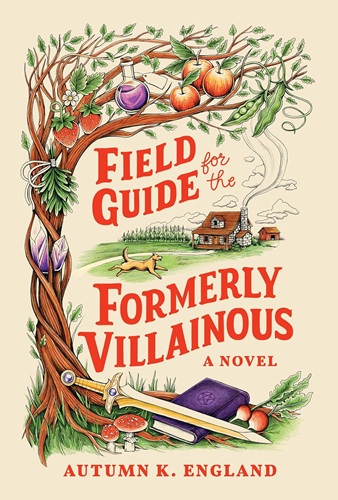
Field Guide for the Formerly Villainous (Everyday Magic, #1) by Autumn K. England, M.K. England
Genres: Adult, Fantasy, Cosy Fantasy, Queer Protagonists
Representation: Nonbinary MC, NB/F, queernorm world
PoV: Third-person, past-tense
ISBN: 146424331X
Goodreads
STARDEW VALLEY meets STUDIO GHIBLI in a charming cozy fantasy about healing, redemption, and the subtle magic of simple living. Perfect for fans of Can't Spell Treason Without Tea and The Spellshop. Welcome home, weary traveler.
When Oaklin Nettlewood accidentally joined an evil world-ending cult, mind control magic forced them to do unspeakable things. Years later, the realm's heroes have finally saved the day, defeated the villain, and shattered the last remnants of the spell...leaving destruction in their wake. And so, with a spell-damaged memory and whole bushel of trauma, Oaklin escapes to a small farm on the edge of Mossley's Rest and swears an After all the things they were forced to do with their magic, they will never use it again. Ever.
The no-nonsense ghost granny who lives in Oaklin's house has other ideas. As she coaxes Oaklin out of their shell and back into the world, they find companionship (a grumpy horse and a very good dog), friendship (a local bard and magical baker who should just kiss already), and tentative romance (a paladin-librarian who makes Oaklin's heart come alive for the first time in ages.) Magic even seems possible again—though strictly for foraging magical mushrooms and protecting the farm from bugs.
Healing comes in gentle waves, and Oaklin doesn't have to do it alone. So what does it mean when an inquisitor comes to town to hunt former cultists just as Oaklin begins to think that maybe, just maybe, they deserve a happy ending after all?
I received this book for free from the publisher via NetGalley in exchange for an honest review. This does not affect my opinion of the book or the content of my review.
I feel like I’ve been seeing a lot of cosy fantasy lately that wants to be cosy but also tackle hard, difficult issues, and authors: I don’t think you can have both. England is not the author to convince me otherwise. Oaklin’s guilt and trauma over being in the cult just did not mesh with the cosiness, the sweetness. And I think part of that is because Oaklin’s trauma feels so forced. That Oaklin has decided never to use their magic again – felt only superficially reasonable, and far more Because Plot, and when Oaklin manages to get over their fear of their own magic, it happens so abruptly that it didn’t feel at all earned to me.
Other parts of Oaklin’s trauma felt a lot more believable, like their fear of anyone related to the church that slaughtered a lot of the cult Oaklin was in, and their dread of their new community finding out about their time being mind-controlled. Their general social awkwardness, which was not trauma but just their personality, was endearing and plenty understandable.
As a book, it’s fine. It’s not actively bad. It just – so much of the premise felt very contrived. Oaklin’s whole purchase of the farm in the beginning makes less and less sense as the book goes on, as it becomes clear that Oaklin has no idea what they’re doing re farming. On the one hand, I can understand a rash impulse-purchase given the circumstances under which Oaklin made it…but I also kind of want to bop them on the head and ask are you stupid???
The book description is super misleading; the inquisitor is not a big part of the book, and their arrival again felt very – contrived, forced, Because Plot. The mandatory third-act Source Of Tension.
Speaking of the inquisitor, I can’t make sense of the general population’s opinion of the cult and all that went down there. The paladin Oaklin ends up dating refused to fight the cult because they were all mind-controlled, and slaughtering mind-controlled folk is obviously wrong – but the church went ahead and did it anyway. And yet, when Oaklin is outed as having been in the cult, everything is just…fine. Nobody minds. So what IS the general opinion, then? If no one blames the cult members for being mind-controlled, why did the church go ahead with killing so many? And since they did, why aren’t the general populace mad at the church for doing so, if most people don’t blame mind-controlled cultists for being mind-controlled? It was all really confusing and hand-wavey.
Also, I remain disappointed that the potential job at the bakery is a Chekhov’s gun that was never picked up. It seemed like England was telegraphing SO HARD that Oaklin was going to join the bakery, throughout most of the book, but then…that never happened. I guess it was just set-up for a sequel.
I don’t know. It’s fine, but I can’t honestly recommend it. It took me months to get through it because I had to force myself through most pages (though any time we had descriptions of the farm and farming, or foraging in the woods – really anything nature-related – was really lovely). To be blunt, it’s boring. I finished it by using it as a bedtime-book, ie I read it before falling asleep every night because…it put me to sleep.
I will not be picking up the sequel!





I remain miffed that they gave the title “Field Guide for the Formerly Villainous” to a book about a mind-controlled minion. He clearly is not a villain! Villain implies deliberate evil, particularly of the moustache-twirling, evil laughing, fabulous cloak, scenery-chewing variety! “Villain learns to be good” can be so fun and campy, whereas “traumatized mind-control survivor” is a very different story.