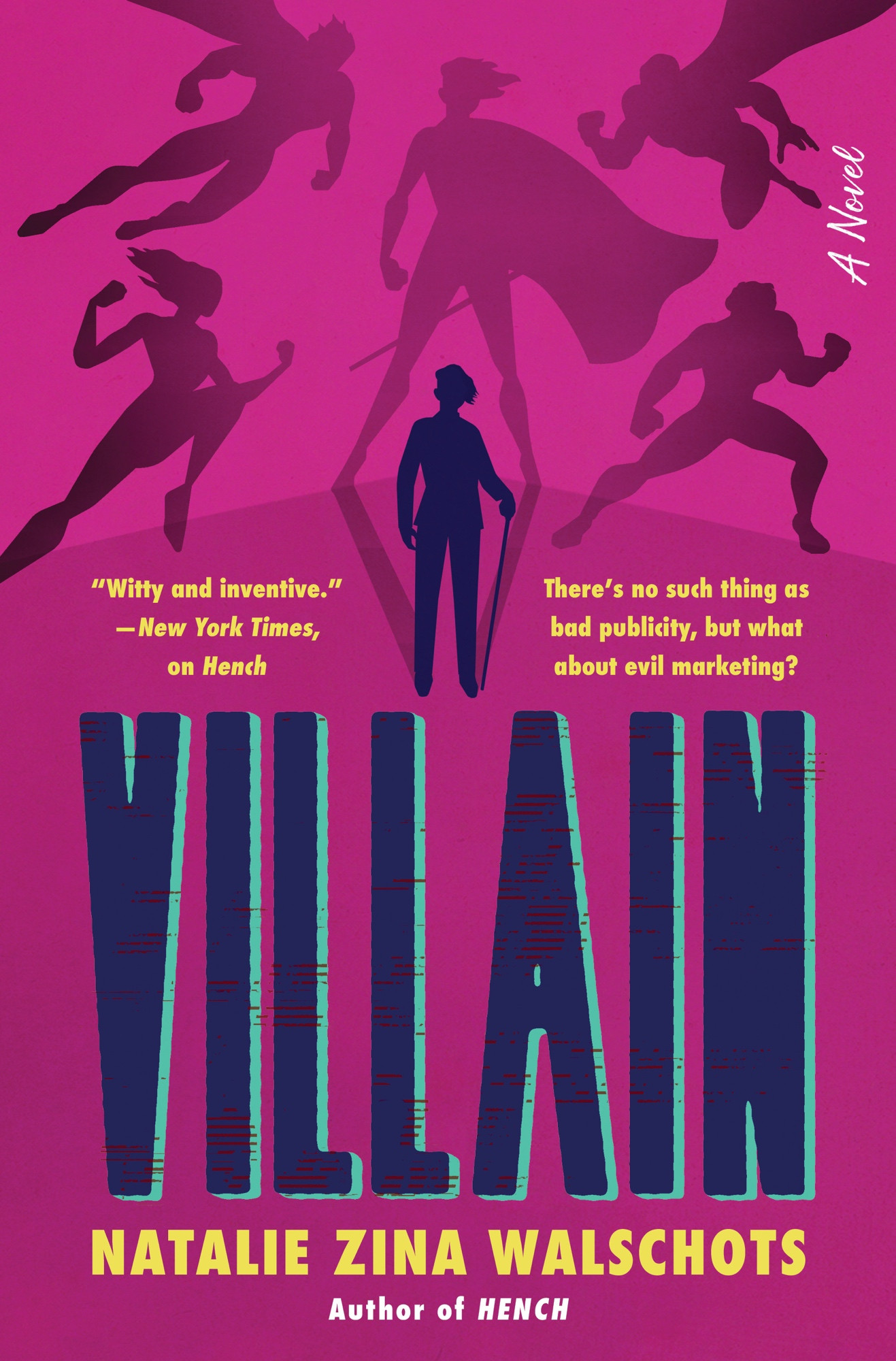

Villain (Hench, #2) by Natalie Zina Walschots
Genres: Adult, Queer Protagonists, Sci Fi
Representation: Disabled bisexual MC (walks with a cane), secondary Maori character, minor queer characters
PoV: First-person, past-tense
Published on: 19th May 2026
ISBN: 0063236958
Goodreads
The Boys meets Starter Villain and Assistant to the Villain in Natalie Zina Walschots’s electrifying, sharp, violent, and hilarious sequel to the highly acclaimed novel, Hench, in which the Auditor must confront the near-impossible in order to right the many wrongs in the superhuman industry…or cause more of them. She’s not picky.
Anna, better known to superheroes as the Auditor, has carved out a name for herself. Any hero unlucky enough to cross her path knows her potential and powers. Surely, success should taste she has an incredible job with lots of perks, and her boss will literally annihilate anyone who crosses her, and her greatest enemy, the former hero Supercollider, has been utterly defeated and literally ground to a pulp.
But Anna still has her sights set on a greater destroying the Draft, the organization that makes, trains, and manages the world’s most powerful superheroes. These “heroes” have shown time and time again that they do more harm than good, and now is the time to stop the damage at its source.
Yet all is not well for the Auditor and her fellow evildoers. Her employer, Leviathan—the world’s most feared supervillain—is not coping well with Supercollider’s defeat at someone else’s hands. Moreover, her unlikely ally and unexpected friend, Quantum Entanglement, has vanished without a trace, leaving Anna to examine all the ways they deceived each other. Tension and uncertainty fill the air, and fear that this moment of triumph is about to crumble looms over all of them.
Anna soon finds herself facing down an opponent unlike any she’s taken on before—not another superhero, but someone like her…someone much more the Draft’s Chief Marketing Officer. This isn’t a test of physical prowess, but ideas, and as the fight spirals deeper and deeper, with new foes popping up every day—she’ll need more than just her superpower—data research—to keep ascending through the supervillain ranks.
It’s guerrilla ad warfare, and the Auditor might have finally met her match.
I received this book for free from the publisher via NetGalley in exchange for an honest review. This does not affect my opinion of the book or the content of my review.
Highlights
~the un-nice reality of being a villain
~brace for OUCH Feels
~supervillain x supervillain romances are Complicated, okay
~when morally grey edges into outright black
~oh dear
My review of book one, Hench
:this review contains spoilers for the previous book!:
As you would expect of the transition from hench to villain, Villain levels UP from book one.
By a LOT.
To anyone who wants to complain about how long it took for us to get a sequel, I say: SHUT UP, IT WAS SO WORTH THE WAIT. But it’s not hard to see why it took a while to get Villain just right: this is a very complicated book, messy and introspective, pulling no punches whatsoever, delving deep into some very dark places indeed.
It must have been incredibly hard to write. But Walscots pulls it off beautifully.
At the end of Hench, Anna and her allies had quite thoroughly dealt with Supercollider, the superhero who left her permanently disabled and completely disillusioned about the superhero complex. (And let’s not forget, he would have had her lobotomised if she hadn’t been rescued!) It should have been an unmitigated triumph, but Leviathan, Anna’s supervillain boss, was…pretty badly shaken by having his nemesis destroyed by someone else.
When Villain opens, almost no one knows that Leviathan is still alive; he’s basically in hiding, grieving and (hopefully) healing. Anna is covering for him, pretending to run his empire while actually following his (minimal) orders. Anna hates it for a bunch of very understandable reasons, not least because she is lying to all of her friends, coworkers, and employees – and because she is lying, she can’t tell them why they’re actually forbidden from getting back to work, causing mayhem for superheroes. The truth is that Leviathan has forbidden it, but when she can’t explain that…
It’s a thorny, emotionally tangled situation, believably messy in that way that Walscots is so good at. And even once Leviathan retakes the helm and things get back to some kind of normal, that realistic, morally grey, awfully complex complexity continues; it’s Villain’s defining characteristic. Which makes perfect sense, because while Hench didn’t feel morally complicated (in the sense that, yes, Anna and her team were doing awful things, but they were doing them to unmitigatedly awful people!) Villain is a darker read, with Anna progressively taking more and more steps that fewer and fewer readers will be willing to cheer on. This is a natural continuation on from Hench’s ending – which was much darker than the rest of it – so if you flinched at that ending? Then you probably do not want to pick up the sequel.
Villain is also incredibly messy romantically. It’s difficult to talk about without spoilers, but let’s just say, the romance Anna ends up in is not terribly healthy – there’s one scene which (I think deliberately) reads as if Anna’s trying to escape domestic abuse. It’s hard to read! But Walscots does such a great job at – not making us approve of Anna’s choices or anything, but making us BELIEVE in them, making us understand why she does what she does, why she puts up with (or tries to put up with) what she does for so long. It’s not at all NiceTM, it’s – pretty awful and messy and very deserving of a big red PROBLEMATIC stamp. But if it wasn’t – it wouldn’t feel believable? It makes perfect sense that this relationship is as messed-up as it is – in a way it’s kind of a microcosm for the whole book, for Anna’s entire story. We’re not supposed to hold Anna and her partner up as a romantic ideal, but we are supposed to get it, and I very much got it.
I finally felt what it would be like to fit somewhere perfectly. A tooth in a socket. A hand in a hand. A grave dug just for me.
And I was really impressed with where Walscots took it – that the book leans into the messy vicious awfulness, rather than trying to excuse it or Serve A Moral to the reader. This is another way in which the romance is a microcosm of the whole story, because leaning into the spiky complicated morally-greyness of it all is what this book is all about. Walscots is digging into what it really means for Anna to turn on the rest of the world, what the practical aspects of it are, what the consequences are, how it changes her, how she has to change because of the decisions she’s made (and keeps making). And a whole lot of it is not pretty, or easy to read. Villain made me anxious and uncomfortable and furious and appalled, and it is so clearly meant to that it’s magnificent.
Especially because – Walscots walks a very fine line with all the grace of a tight-rope dancer in depicting Anna as a woman with agency. Even at Anna’s lowest, even at her most conflicted or doubting or uncertain, we’re always sure that Anna is the one making the decisions, is the one responsible for those decisions (and their consequences). Sometimes they are not-great decisions! Lots of them were decisions that horrified me! But they are HER choices, not anyone else’s, and that’s impossibly important, ESPECIALLY in a story like this. I think agency was a huge theme of Hench, culminating in Anna’s incredible triumph over Supercollider. In that book, Anna was left permanently disabled and built a whole new life for herself in order to be a person with agency on the board of superheroes, in order to become someone who was not helpless. Villain is a continuation of that, a very necessary one that was always going to be inevitable after Leviathan’s reaction to Anna taking down Supercollider.
It’s just that, in Hench, it was about being able to face off against superheroes. In Villain, Anna has to claim her agency as a villain – a subtle difference, but at the same time an immense one.
It’s marvellous. It is OUCH and YIKES and WHY WOULD YOU DO THAT, it’s many different kinds of merciless, it refuses to be nice and simple. This is the exact opposite of an MCU movie, and I mean that as the HIGHEST of compliments.
I loved Hench. I loved Villain. I am sure I will love any future books in this series – honestly I’m pretty sure I will love anything Walscots writes, at this point.
IT’S OUT THIS TUESDAY.
IF YOU HAVEN’T PREORDERED IT YET…GO DO THAT!





Would you happen to know exactly which chapters in Hench have the most graphic content? I’ve decided that I do want to read it after all, but I want to avoid any potential gore or body horror ahead of time.
I’d love to read Villain, too, but it’s $18 on Kobo, so I’m praying to the RNG-Book-Deities that it’ll be on Kobo Plus so I can read it for free. Otherwise, if I end up liking Hench enough to buy a physical copy, I’ll buy Villain at the same time and read it that way.
There, I’ve made a Plan. It’s more official with a capital letter. :D
That’s extremely fair! The chapters are very long though – there’s only 8 of them – so I don’t think you can just skip a chapter that has awfulness in it… This might be tricky.
I don’t remember any of the awfulness being graphic, gore-wise. It’s more emotionally awful. Like, there’s a scene in chapter one where a mind-controlled teen cuts off his own finger. It’s not gory, but that’s probably the kind of thing you want to avoid? The only thing I’d call graphic is in the final pages, where the awfulness is quite gross as well as horrifying. That’s very much body-horror.
You know what, I’ll email you, it’ll be easier to talk away from public comments!