Truly an ungody number of DNFs this month!
I had a hard time reading for most of July – my brain didn’t want to concentrate on anything at all. So I’m a bit worried that some of these are books I would have loved if I’d tried them when my brain was behaving better. Take my DNFs with a bit more salt than usual, please!
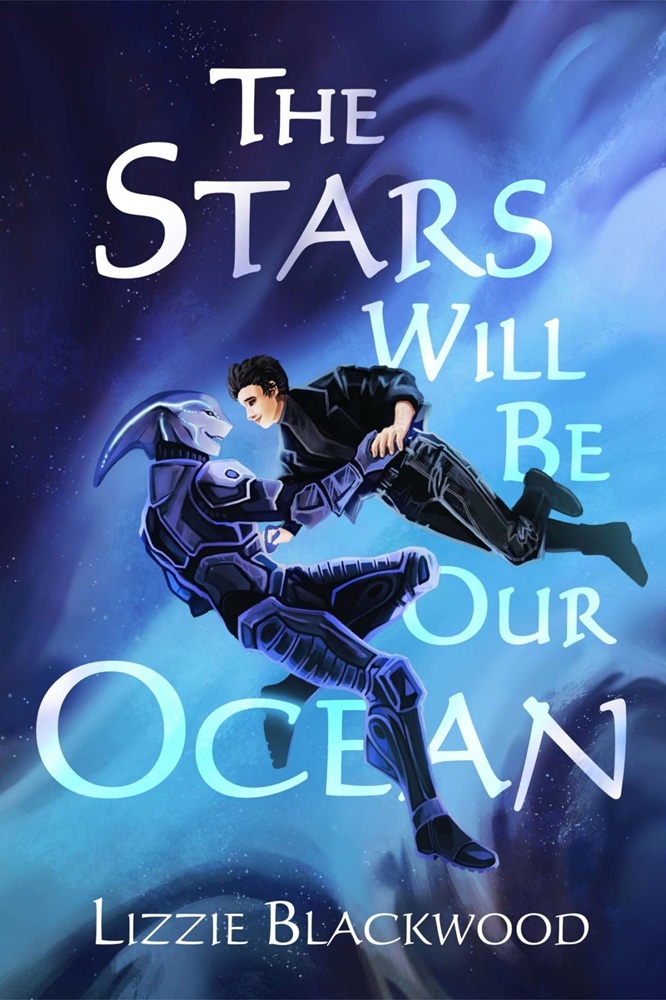
The Stars Will Be Our Ocean by Lizzie Blackwood
Genres: Adult, Queer Protagonists, Sci Fi
Representation: Pansexual MC, major lesbian character, major nonbinary character
PoV: First-person, past-tense
Published on: 14th July 2026
ISBN: B0H3JHYW8L
Goodreads
For fans of Mass Effect, A Memory Called Empire, and The Shape of Water comes a story of love between outcasts caught in the mire of intergalactic politics.
First contact with the vast spacefaring empire of the Reshketh seemed like a miraculous boon for Humanity, trapped on a dying Earth. But in pursuit of an alliance, something has gone terribly wrong, and it’s up to cultural advisor Jenna Kalandra to figure out why before it’s too late. The only problems are that she has no information, no connections, and her own Ambassador hates her just for existing.
Jenna isn’t one to give up easily, but she’ll need the help of a mischievous AI, an inventive Human tech, her no-nonsense ex-girlfriend, and one charmingly unprofessional Reshketh security guard named Tarek to survive her Ambassador’s wrath. Can these misfits find a way to save the alliance (and themselves) before prejudice dooms Humanity? And can Jenna’s friendship with the roguish Reshketh become something deeper when no one knows who to trust?
I received this book for free from the author in exchange for an honest review. This does not affect my opinion of the book or the content of my review.
This isn’t BAD. But it’s not what the comps made me think it was going to be.
Stylistically, this is nothing like Memory of Empire or Shape of Water. (And by Shape of Water, I’m referring to the novel, which if you haven’t read, YOU SHOULD. It’s great!) The prose is plain, direct, written in first-person. It’s much easier to read, more accessible, than Memory or Shape, which should give it a broader audience than those books had. But it’s a style I find really dull – I prefer my prose rich and descriptive – so I was struggling with it right away.
Though there is a content warning for it at the beginning of the book, I didn’t realise how much the toxic work environment was going to stress me out. Poor Jen is responsible for making sure her Ambassador knows the right gestures and language to smoothly interact with the Reshketh – but all she has are the dossiers the Reshketh themselves sent the humans, and it’s almost instantly clear that the dossiers are full of misinformation, meant to make the humans look bad. That would have been an interesting enough plot for me – who’s responsible, and why, and how on earth (or off it) is Jen going to find the accurate info her embassy needs? – but the issue is the Ambassador.
He’s not an actual ambassador – he’s an oligarch who fought for the role so he could benefit most directly from any trade deals with the Reshketh. (Jen’s world, which is ours plus a century or so, is ruled by ultra-conservative billionaires and it’s all extremely depressing.) And because he’s a billionaire, he’s a terrible person. (That’s not sarcasm: I don’t believe it’s possible to get that rich without abusing tons of people.) He blames Jen for the misinformation in the dossiers and threatens to kill her – in front of so many witnesses! – if she doesn’t fix the situation. In fact, we gradually figure out that the majority of the team he’s brought with him to meet with the Reshketh are there because they’re disposable to the ultra-rich.
And the whole situation was giving me ridiculous levels of anxiety, in a way that I did not at all enjoy. I thought I’d be able to handle it, after the content warning, but nope, it was too much for me. Not fun at all.
But what killed it for me was how not-alien the Reshketh were. Not only are they humanoid, but Jen and Tarek are almost instantly able to read each other’s body language (HOW?), their societies have similar power structures, they can understand each other’s humour… Even the fact that they’re talking to each other through translator gadgets isn’t really touched on, when you would think that in practice, talking to someone that way would feel different than talking directly (do the gadgets convey tone, or are they flat like a satnav voice? Is it strange to hear a flat voice when the topic is so passionate? etc) By a third of the way into the book, the only vaguely significant difference between Reshketh and humans is that Reshketh have a bunch more sexes and genders than Western humans and regularly switch them up. Which is just not that alien – we have had and still have human cultures with a more varied gender system than the Western male/female binary. I want my aliens to FEEL alien, and the Reshketh absolutely did not.
But you will notice, everything I didn’t like about this book was a matter of taste, not quality. I didn’t like the plain prose, how depressing humanity’s future was, the work anxiety, or the unalien aliens – but there’ll be plenty of people who love those things. If you’re one of them, check out this book, because from an objective standpoint I think the writing’s solid and the characterisation is great.
It’s just not for me!

A Voice of Wrath by Brittany Cook
Genres: Adult, Fantasy, Queer Protagonists
Representation: Queer brown MC, M/M
PoV: Third-person, present-tense
ISBN: 1648985688
Goodreads
He has twenty-nine days to live. Just enough time to save a kingdom-or burn one down.
Rafa, prince by blood and smuggler by trade, has always known the clock on his life is ticking. A prophecy sealed his fate twenty years ago, and now, with only twenty-nine days left, he's ready to meet the end on his own terms.
But first…he has a promise to keep.
His twin sister should be queen, if not for the tyrant wearing their father's crown. To secure her rebellion, she sends Rafa on an impossible mission: smuggle a masked stranger across enemy lines and recover the stolen magic that could turn the tide of war.
Simple, right? Except the country they're infiltrating is barricaded by stone walls, guarded by the world's only magic users, and filled with the kinds of monsters Rafa thought only existed in bedtime warnings.
As corpses pile up and secrets unravel-including some from his sister-Rafa finds himself torn between duty and desire. Especially when the silent, mysterious man he's meant to escort proves far more captivating than he expected.
With death looming and fate sharpening its blade, Rafa must decide if helping his sister steal a throne is worth dooming the world he'll never live to see.
A Voice of Wrath, a queer reimagining of The Little Mermaid, is a slow-burn fantasy romance filled with treacherous journeys, impossible choices, and a doomed prince discovering that sometimes the most dangerous thing you can do is want more time.
I received this book for free from the author in exchange for an honest review. This does not affect my opinion of the book or the content of my review.
DNFed under my straight-up-stupid rule. The task the sister asks of him, when he’s about to die? NOPE. She wants him to smuggle a person into an unbreachable city, because this will help her claim the throne. But she won’t tell him who this person is? AND HE DOESN’T ASK? (Well, he does, but lets her brush him off, and when she gives him the opportunity to ask questions, that’s not one he asks.) And…she asks this of him when it’ll mean his death-day will come during the mission??? No. Appallingly dumb. Absolutely not.
This is aside from…weird lines like these. All quotes taken from my advanced reader copy, so bear in mind they could all be edited or even removed from the final published edition of the book.
inexplicably feels like he’s intruding, despite the room not remotely belonging to the stranger.
This is very awkward phrasing.
Brother. It’s been years since she last used an honorific to address him.
Since when is ‘brother’ an honorific?
Housing the only magic users in the world, it’s no surprise they would want to keep everyone else out, to keep their own people in.
Possibly I’m just very stupid, but no, it is not at all obvious to me why a nation with the only magic users in the world would lock down its borders. This is not self-evident. What am I supposed to infer here?
the sheer graceful fluidity of his signing, as if he does so underwater. It’s simultaneously as fast as Raza’s yet also painstakingly languid, resembling anything but the natural movements of a human.
What does this mean? How can you be signing (as in, sign-language) fast but also be languid? And ‘resembling anything but the natural movements of a human’ is very clunky phrasing.
What does a legacy matter to a man soon to die?
…Quite a lot, actually??? Not to everyone soon to die, but to quite a lot of people it matters very much? This is a very weird sentiment to me, the idea that no one near death cares about their legacy.
Etc.

Destiny's Edge by M.L. Wang
Genres: Adult, Fantasy, Queer Protagonists
Representation: Chinese-inspired setting and cast, sapphic MC, F/F
PoV: Third-person, past-tense
Goodreads
The most powerful warlord in the steppe sends a convoy consisting of his ten best men and his fourth wife, Chi, to escort his newest bride home—an easy journey. At least, it was supposed to be.
Since losing her family and her right eye to cursed fire, Chi has been adrift, struggling to find her place within the Champion’s household. Unable to bear children due to her family’s blood curse, she has spent most of her married years training the Champion’s sons in the sword techniques she inherited from her father. When an undead monster attacks the bride’s party, killing all ten of the Champion’s men, Chi’s sword skills barely keep her alive, leaving her as the last line of defense for the young bride, Sangya.
After a lifetime cloistered in a remote temple, Sangya is maddeningly inquisitive about everything around her, including Chi. While Chi scrambles to guide the chirpy nun through the wilderness, Sangya slowly pries her way through the walls Chi has built around her soul and wakes something forbidden.
With enemies closing in, Chi realizes that the thing she wants most from life might be the one thing she can’t have. And in the dark of foreign woods, she decides that the best thing she can do for the world is die protecting the Champion’s bride. Better that than face a desire so dangerous.
Apparently I still do not enjoy this author even when she writes sapphic. Sigh. I was really hoping Destiny’s Edge would be the cure for my FOMO!
If you have enjoyed Wang’s other books, I see no reason you wouldn’t enjoy this one too. For me…the prose is plain, the violence/gore feels over the top, and all the stuff with the magic gems felt more like a videogame than a novel’s magic system. (I realise that’s not a very clear descriptor, but I don’t know how else to put it.) The writing feels unpolished, but to be fair Wang says in the author’s note that this is not the final version of the book, that this will be polished and possibly expanded a bit for the ‘real’ release, so I’m not holding that against Edge. There’s something very…grimdark-esque about it though, the same kind of vibe I got from (what I read of) Brighthaven.
I don’t know how to judge whether this is objectively good or bad, but it’s not a me-book, for sure.

Blood Cute by Rachel A Stine
Genres: Adult, Fantasy, Contemporary Fantasy, Queer Protagonists
Representation: Neurodivergent and queer cast
PoV: First-person, present-tense; multiple PoVs
ISBN: B0GSLQV5L6
Goodreads
When eight children go missing in the small town of Bayhorn, the only ones who seem to care are a vampire (Ori), a zombie (Zelda), and a hume (Juniper). The three band together to crack the case and track down their missing loved ones.
Through coffee runs, lemon squares, and stakeouts, the three manage to keep their spirits high and their caffeine intake higher as the investigation leads them to an internet predator and a local woman who might be a child-napping witch.
And the more time they spend together, the stronger their feelings for one another become. But can their newfound relationship survive the investigation as secrets are revealed?
I wanted to love this one SO MUCH, but the prose is – clunky as hells. The first-person perspective was a really bad choice here; our 30-something year old protagonist has the voice/psychology of someone half her age. It’s probably meant to be funny, but I couldn’t stop cringing at it. Nope nope nope.

Humanity for Beginners by Faith Mudge
Genres: Adult, Fantasy, Contemporary Fantasy, Queer Protagonists
Representation: F/F
PoV: Third-person, past-tense
ISBN: 1620049465
Goodreads
Gloria did not intend to start a halfway house for lesbian werewolves. It just sort of happened. Between running a small bed-and-breakfast with her friend Nadine, helping one young lycanthrope adjust to life after the bite and soothing ruffled fur when the other brings home an unexpected cat, Gloria has more than enough to keep her busy, but one thing is definite: she is not nor ever will be an alpha, whatever Nadine says. And the ever-expanding circle of misfits in her guesthouse is certainly not a pack. If only Nadine and the rest of the world were as simple and clear cut as she kept wanting them to be.
21,000 words
I absolutely ADORE this premise, but I hate the prose. Awkward and clunky. Noped out after the first page (which is why I’m not giving this one an actual rating, because that seems unfair).
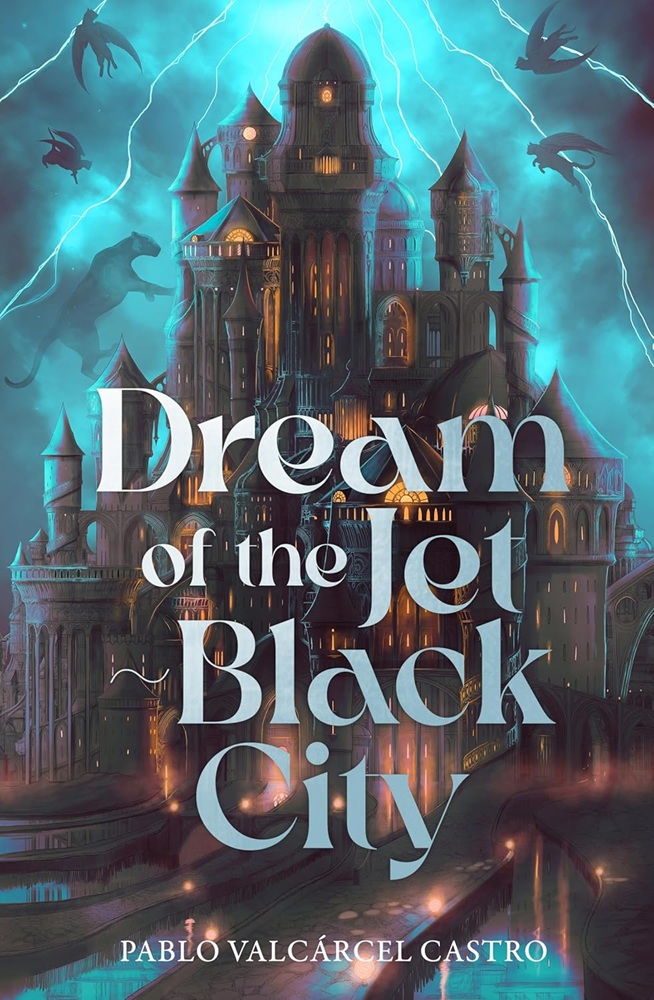
Dream of the Jet-Black City by Pablo Valcarcel Castro
Genres: Adult, Fantasy
PoV: Third-person, past-tense; multiple PoVs
ISBN: 1785125451
Goodreads
Strange the Dreamer meets The Shadow of the Wind in this exciting and innovative fantasy with intricate worldbuilding, political twists and turns, a magic system based on dreams and nightmares being twisted into reality, a mythic storm overshadowing a dark and shaded city - and secrets from the past that threaten an entire nation.All such Nightmares were born out of Dreamers' minds - angry, cruel, terrible Dreamers, yes, but still men and women. Here, in the Library, the Nightmares have sparked from dying stories, from the anguished echoes of poets and scribes carved into the crevasses of codexes.
Lightning-Hunter, Ash, chases living lightning over the dark rooftops. This energy the jet- black city depends upon, is all that stands between him and starvation. When a monstrous nightmare attacks his gang, death is all but certain - until Ash manages to dream a shadow creature to protect him. But this new power comes with a price and will see him either sent to the harrowing Academy to weaponise his gift or under the thumb of an Archdreamer patron who will use him to their own ends.
Geil is a Nightmare-Hunter and Dream-mutt; half-human, half-dream creation. Torn between the desires of her violent dragon's heart and a need to pacify the guilt she feels for her lover's death she seeks a balance to bring her peace. But upon returning to the city, she stumbles across a plot by her old master and nemesis to unseat the Archdreamers. She must find a way to accept the dragon within her to stop a nightmare being unleashed that will destroy her home and everything she cares about.
The Motherstorm rages eternal over the city and only the Wailers, a devout sisterhood of singers, can calm it. When Daerna's order insists on ignoring the mysterious Wilting plague that is infecting the city's populace, Daerna chooses to find the root of the disease even if it leads her into the darkest heart of the city - and her own death.
As each draws closer to their goals, they discover a connection between the plague, the city and those who have been manipulating the dreaming power for their own ends. If they can't find a way to learn from the secrets the city has buried within its past, then their whole world will turn into a living nightmare.
Perfect for fans of Brandon Sanderson, Mark Lawrence and Adrian Tchaikovsky.
Pretentious twaddle, with appallingly bad dialogue (including the thoughts of characters) and worldbuilding that breaks itself in trying to justify itself. (Spoiler: you don’t have to justify magic! It’s MAGIC! But when you start building rules for it and don’t notice your story has already broken those rules…) Everything has to be DramaticTM, making sense is very much secondary. So much posturing. Naturally the love interest is the only good nun. So much straight-up-stupid everywhere. I cannot take ‘your Sorrowfulness’ seriously as an address of respect. 28% and I’m calling it quits. THANKS FOR WASTING MY TIME.

Everybody's Perfect by Jo Walton
Genres: Adult, Fantasy, Queer Protagonists
Representation: At least one queer MC with a chronic illness
PoV: First-person, past-tense; multiple PoVs
ISBN: 1250314062
Goodreads
Piranesi meets Swordspoint in an elegant relay race through fantasy Venice from Hugo award-winning author Jo Walton
The Serenissima is built from mist and belief, a mythical shadow sister to Venice and crossroads of the nine worlds.
When a laborer called Tiry has a dream that Serenissima will have a doge, and that they will marry the sea, he tells it to a fortune teller named Khadsha. She tells her apprentice, a gondolier called Taddeo, who tells a cop named Gom, who's heard it from five people this morning already. And by that point, it's already settled into the bones of the Serenissima, more than half-fated.
Everybody's Perfect is a gentle, shifting, structurally inventive narrative of startling beauty that will make you rethink everything you think you know about fantasy.
Walton has said that she wrote this to get over/recover from burnout, and I can see that: Everybody’s Perfect is Walton indulging herself in her favourite things to write. Fair enough! Unfortunately, it didn’t end up being one of my favourite things to read. It’s rambly and meandering, functionally plotless, and the setting is far less overtly magical than the book’s description makes it sound. It’s very clearly a Jo Walton book, it very obviously belongs to the same family tree as Among Others and My Real Children and the rest – but those books worked (in part) because the characters were brilliantly compelling. Here, each chapter is written from the POV of a different character, so we’re never with any of them long enough to really fall into their story. And to be honest, the characters themselves bored me terribly.
Also I am sick of non-humans who don’t feel truly alien, and the ones here really don’t. It’s not about making them clannish or giving them a different way of determining gender, they need to THINK fundamentally differently to humans. And I have an irrational, baseless dislike of anthropomorphised animals/humans with animal heads, which is what a lot of the ones here are. None of that is objectively bad writing, obviously, it’s a taste/preferences thing, but alas, it did mean I was annoyed by the non-humans when I expected to be fascinated.
When I said it was plotless, I wasn’t kidding. Each chapter is its own slice-of-life thing, but they don’t go anywhere, they’re not (at least as far as I could tell) tied to the other chapters at all, and there’s something so abrupt about how each chapter we’re with a different character. We follow one character around for a day and then BAM, they’re gone, we’re with somebody else who has virtually no connection at all to the character we were just with. I don’t have time to care about any of them, and the story doesn’t have time to craft any kind of narrative with any of the characters. I can’t even call this a short story collection because there’s no story to the chapters!
And beyond all of that…it just felt really heavy to me. Not thematically, but in the mind-numbing way that makes me sleepy.
Bored senseless, massively disappointing, thanks but no thanks. Whoever called this Piranesi meets Swordspoint should be banned from marketing forever.

The Castle & the Cloister (Daughters of Light #1) by Laura E. Weymouth
Genres: Adult, Fantasy
PoV: Third-person, past-tense; multiple PoVs
Published on: 4th August 2026
ISBN: 1668069679
Goodreads
The Priory of the Orange Tree meets Black Sun in the thrilling launch of a political fantasy duology following three people—a refugee, a heretic queen, and a priest—as they attempt to shape the fortunes of a continent shattered by war.
Two hundred years ago, the warmongering Inver clan conquered the nation of Honoria, suppressing its pacifist goddesses, and ushering in an era of blood and battles. Now, after a brief but fraught peace, a king’s whims threaten to reignite the engines of war.
At the sun goddess Raea’s cloister, the last stronghold of Honoria’s matriarchal religion, Fia and her infant daughter are in search of a safe haven. Fia aims to offer her child more than the poverty and abuse she was raised with, but the price of the cloister’s protection will tear her from what she loves most and thrust her into a game more complex than she could imagine.
Within the Invers’ mountain fortress, Ariana is known as the apostate queen. Once a follower of the goddess of stars, she left her faith for the sake of a king. But old loyalties are not easily severed. Ariana treads a dangerous path, striving for peace in a court made for conquest.
Deep in the heart of the mountain, the Inver Priest bides his time, presiding over his people’s brutal religion. Blinded in the fight for the throne, he harbors a bitter grudge—one that could lead to Honoria’s ruin or renewal.
Amid a treacherous landscape of enemies, allies, and intrigue, three lives will intertwine. Each will have to risk the wrath of gods and kings alike to alter the course of nations.
I received this book for free from the publisher via NetGalley in exchange for an honest review. This does not affect my opinion of the book or the content of my review.
The worldbuilding around the goddesses and their religious orders was great, but as a story I found this really leaden. The first quarter of the book is very tell-don’t-show, which got old fast, and most of the characters were so…basic? They felt stolid, all of them, plodding. Even the ones with Super Important Secrets did not feel like complex, multi-layered people, just collections of very obvious tropes. The prose turns pretty when it’s describing nature – trees or fields or whatever – but otherwise it’s… Honestly, I’m confused, because the prose seems like it SHOULD be lovely, but it sounds just a little off to my inner ear. I can’t pinpoint why.
I had a lot of trouble believing in a lot of the conversations, a lot of the actions of the various characters. Dialogue often sounded really forced, and I couldn’t figure out how or why this character or that one had ended up where they had, why they were doing what they were doing. For example, the king’s Priest (capital p) secretly smuggles refugees through the cave system he lives in. But he…has no idea where the tunnel he leaves them at goes? It makes perfect sense for someone part of an underground railroad like this to not know who or where the next person on the railroad is; what bothered me was that he lives in these tunnels, but he…doesn’t know where this one tunnel comes out? Why not? Sir, you live here. Or the way the queen is giving birth, but all the attendants are rude and awful and not helping her – even though a) the king adores her, and b) she is giving birth to the heir to the throne. It’s BONKERS for them to not take the best possible care of her, even if they don’t like her, because the king will STRING THEM UP if she comes to any harm, or the baby does. But no, we need to have them be awful so we can have a moment of the Priest telling them off. Or, the almost-priestess who is sent to take an (unsealed?!) letter to the queen – the guards on the gate check out the letter (?!), then she is SHOWN INTO THE ROOM WHERE THE QUEEN IS GIVING BIRTH.
A COMPLETE STRANGER.
A REPRESENTATIVE OF A LOATHED RELIGION, AT THAT.
IS ALLOWED…INTO THE ROOM WHERE THE QUEEN IS GIVING BIRTH TO THE HEIR OF THE THRONE. ON WHAT PLANET WOULD THIS HAPPEN?!
Oh, and the priestess is actually there for more than delivering a letter. But she only realises that when she sees the queen, because gods forbid the head of her order actually explained anything.
It’s all so contrived. Things don’t have to make sense, they have to be Dramatic, I guess.
I found myself thinking that this story is set too late – I needed a novel set, I don’t know, fifteen years earlier, to set up the events of this book. As it was, I felt like we’d skipped over or hand-waved a lot of backstory – when it wasn’t clumsily info-dumped on the reader, anyway. So much info-dumping, and so much of it repeated several times, especially all the stuff about the officially-not-a-war going on up north. You do not actually need to give me the exact same info four or five times in a handful of chapters!
Trying to read this just wasn’t any fun, so I’m tapping out.
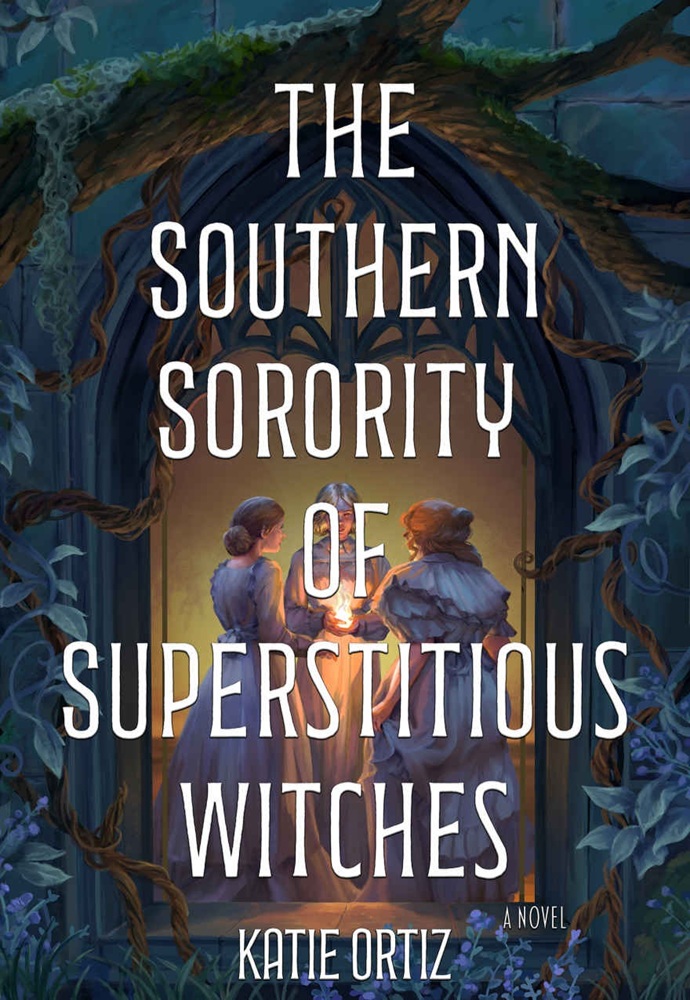
The Southern Sorority of Superstitious Witches by Katie Ortiz
Genres: Adult, Fantasy, Historical Fantasy, Queer Protagonists
Representation: Sapphic MC
PoV: First-person, past-tense; multiple PoVs
Published on: 6th October 2026
ISBN: 9798892426442
Goodreads
In this spellbinding Southern Gothic novel, three women weave together old Southern folklore and magic to fight sexism and educational discrimination in post-Civil War Alabama, perfect for fans of Hester Fox and Louisa Morgan.
When Lucille, Catherine, and Victoria are invited to participate in a trial semester for women at Alabama's most prestigious university, they each have their own reasons for accepting. Lucille wants freedom from both her father's control and reminders of her traitorous first love. Catherine wants to escape an arranged marriage meant to halt her attraction to women. And Victoria wants to run from the guilt that haunts her after the death of one of her fellow mill girls.
The trial semester will determine whether or not women across the state will be allowed to attend other universities. But the enrolled women quickly learn that success is not guaranteed, and some of their male cohorts are determined to see them fail. When the men's pranks go too far, Lucille, Catherine, and Victoria form a coven under the guise of a sorority and call upon witchcraft steeped in the traditions of southern folklore to fight back.
As they gather their fellow witches, they discover there is something darker at work at the university, a force that is determined to expel all the women at the university, and they'll need all the allies they can get if they want to succeed.
For fans of Witchcraft for Wayward Girls and Weyward, this historical speculative novel explores the darker side of human nature and the ways in which women navigate—and survive—oppressive, male-dominated societies.
I received this book for free from the publisher via NetGalley in exchange for an honest review. This does not affect my opinion of the book or the content of my review.
Reader, I seriously considered DNFing before we even got to the first page.
See, this book has an epigraph, but it isn’t a quote, it’s something written by the author. This is what it says;
Southern women are known for their hospitality and honey-laced words.
Southern witches are not.
Down in the South, where the temperature is closer to that of hell, one would expect the witchcraft to be just as sinister.
Reader, I paused.
I will allow that, if you have picked up this book, you understand that when the author says ‘the South’, they mean the Southern states of the USA, so it’s okay not to specify that. But… ‘one would expect the witchcraft to be just as sinister’? As sinister as what? You have not described anything sinister.
Presumably I’m supposed to understand that the author means, as sinister as the temperature. But that’s nonsensical. How is temperature sinister? Because it’s hot? Hot temperatures are inherently sinister now? Wtf are you talking about? That’s such a stupid thing to imply/say!
My heart sank. If the epigraph was already badly-phrased and nonsensical… But still, you can’t really DNF before you even get to the first chapter. That would be outrageous. That wouldn’t be a did-not-finish, it would be a did-not-start. So I turned the page.
In the first paragraph of the first chapter, one of our main characters slices open her palm to get blood for a spell. This is an unbelievably stupid thing to do and I hate how common a thing it is in Fantasy. If you don’t have superpowered healing, this will render your hand semi-useless for DAYS. Only a dumb-ass would do this. This did not bode well for either the main character’s intelligence, or the author’s – one or the other. (It could be that we’re meant to take away from this that the main character is an idiot, in which case it wouldn’t be the author being thoughtless/stupid.)
Especially when you tell us, in the same paragraph, that magic has only ever required a few drops from a pricked finger. So you’re screwing up your hand for no reason at all?! (Don’t even get me started on, this woman has lots of physical chores to do around a farm, so she will NEED HER HAND CONSTANTLY. Making her decision to cut open her palm even dumber than if she at least had reason to think she wouldn’t need that hand much in the near future.)
Reader, I should have DNFed right there. It only got worse.
The quotations below are all taken from my advanced reader copy, so they might be edited or even removed from the final, published edition of the book.
Blood bubbled up.
This is what happens after she cuts her palm. Ma’am, is something grievously bodily wrong with you? Blood doesn’t BUBBLE UP from a human’s wound. From the wound of any living thing I’m aware of. Wtf.
An unusual wind cut through the humidity of the Alabama summer heat.
What’s ‘an unusual wind’? In what way is it unusual? I think the author probably means a rare wind, as in, wind is not common in this place at this time of year. But that’s not what was written. (This is followed up a few times, as the wind is called ‘strange’ later in the chapter.) ‘Unusual’ can mean ‘uncommon’, but in context I don’t think that meaning is clear – though you could make it clear if you elaborated just a little.
The cicadas’ and bullfrogs’ screams screeched louder
They what? The screams…screeched louder???
A lifeless body lying in my arms, caused by my own hands.
’caused by my own hands’ is such an awkward way to phrase that.
Sharp leaves scraped my skin, making small, bloody cuts as I ran through the rows of corn. I barely felt them against my flesh, toughened over the years, like the hard shell of a boll weevil.
Yeah, that’s not how toughened skin works. If your skin was actually like the shell of a weevil, you would not be getting cut. Unless you have proper nerve damage, you don’t get bloody cuts and just not feel them.
As I burst through the last of the stalks my body collided with another.
From context, what this means is that she ran into another person. This is such terrible, clunky phrasing!
I ran at the sound of my name again, heavier, angrier, demanding my presence.
What you probably mean is that the voice calling her name is heavier, angrier, demanding. What you’ve written is that her running is heavier, angrier, and demanding.
Chipped paint, missing shingles, and half-fallen shutters appeared even more improper when reflected off the carriage’s spotless black paint.
There’s a shiny new carriage, and in contrast the broken-down house looks even worse. I don’t know why you would phrase it the way the author has phrased it. Why describe it as ‘improper’? Why say ‘reflected off’ when you presumably mean ‘reflected in’?
Pa hadn’t taken well to that either.
When you say ‘either’, it means there is at least one other thing you’re referencing. Pa is unhappy about this thing, but also some other thing. Except there ISN’T another thing being referenced here. There’s just one (that this character cut her hair short). What does the ‘either’ here mean???
She made tea so sweet one could practically taste the Southern hospitality infused within it.
This could have been a really great image if you had just tweaked the phrasing a tiny bit. ‘infused within it’ sounds so awkward.
Reader, I DNFed this book. Which is heartbreaking, because I was really, really looking forward to it. Sigh.

The Blue Moon Café & 24-Hour Occult Emporium by Lexie Sharabianlou
Genres: Adult, Fantasy, Cosy Fantasy, Queer Protagonists
Representation: Sapphic MC, F/F
PoV: Third-person, past-tense
Published on: 18th August 2026
ISBN: 9798217094691
Goodreads
A magical witness protection program, a town in need of saving, and a sorceress-in-training . . . oh, and the human woman she’s not supposed to fall for. The Blue Moon Café has a little bit of everything (except, you know, decent coffee).
In the tiny town of Pine Hollow, barista and fledging sorceress Talula Smith runs The Blue Moon Café & 24-Hour Occult Emporium, aka the worst coffee shop in town. The café’s horrible reputation hides its true providing new identities and safe passage to at-risk magical beings while keeping humans far, far away. That is, except for town local Dahlia. Dahlia’s devastating dimples, addiction to Talula's cocoa recipe, and keen observation skills keeps the smitten barista scrambling to ensure that her magical abilities (or, lack thereof) stay a secret.
But when big game hunters start preying on magical beings, her powerful sorceress mother is called away to track them down, leaving Talula and her barely-there magic in charge of The Blue Moon. With the impending Samhain festival to organize, magical refugees to help, half of the town turning against her, and her ever-growing feelings for Dahlia, Talula’s magical destiny feels further away than ever. But as the hunters set their sights closer to home, it’ll be up to Talula to master her craft, trust her heart, and bring her magical and human communities together . . . before she loses everything she loves.
I received this book for free from the publisher via NetGalley in exchange for an honest review. This does not affect my opinion of the book or the content of my review.
This isn’t a bad book by any means (at least, what I read of it), but it wasn’t wowing me either. It’s fine? Perfectly fine? The writing rhythm is a bit off, character names are repeated too often, and the prose in general is a little over-written – quotes taken from my advanced reader copy, so they might be edited/removed from the published version of the book.
She always wore something a little eye-catching and different, like a horde of golden butterfly hairclips holding back her black, spirally tresses or a pair of brightly embroidered loafers.
…The butterfly hairclips also hold back her loafers?
The woman’s face could certainly launch a thousand ships, but she could just as easily sink them with the effort it took to twirl a lock of her silky hair.
Second half of the sentence runs too long without a break! Needs rephrasing or a comma somewhere.
Dahlia searched her human brain for words that would hold up to Sara’s etherealness.
Specifically her human brain, huh.
If these quotes don’t bother you, great! You do not have whatever deeply weird, impossible-to-articulate THING I have that makes me hear prose like music and gets Very Upset if the ‘music’ is ‘out of tune’. You can completely disregard my dislike of the prose here!
I’m also not a fan of mind-control being a casual magical thing that no one acknowledges is a violation. Possibly this comes up later in the book! But I’m not betting on it, going from the context of its use in the first chapter.
Dahlia, the love interest, stole my heart immediately: she’s adorable and ridiculous in the best kind of way, and I adore her. Talula, though…calling her a wallflower would be putting it kindly. She doesn’t seem to have a lot of personality, and is also maybe a bit of an idiot: it is specifically her job to make all the coffees etc undrinkable and inedible, to keep humans away from the magical witness-protection waystation the cafe is a cover for. But she sees a pretty face and just throws all that out the window, making her an incredible hot chocolate just because? Ma’am. What. WHY. You just. Compromised the safety of the waystation for nothing at all???
That’s how Dahlia and Talula meet, and I was surprised that that occurred before the start of the book. Which means the first chapter is very tell-don’t-show, because instead of seeing the events take place on the page, we’re being told about the events, because they happened earlier. I thought that was an odd writerly decision.
I really wish Dahlia and Talula had met in some other way: I can’t really forgive Talula making Dahlia’s drinks delicious, given what’s at stake. It would have been so funny if it turned out that Dahlia LIKED the deliberately-terrible hot chocolate, for example!
Talula’s not a character I want to spend time with, and the prose here is making me twitchy, so I’m calling it quits!
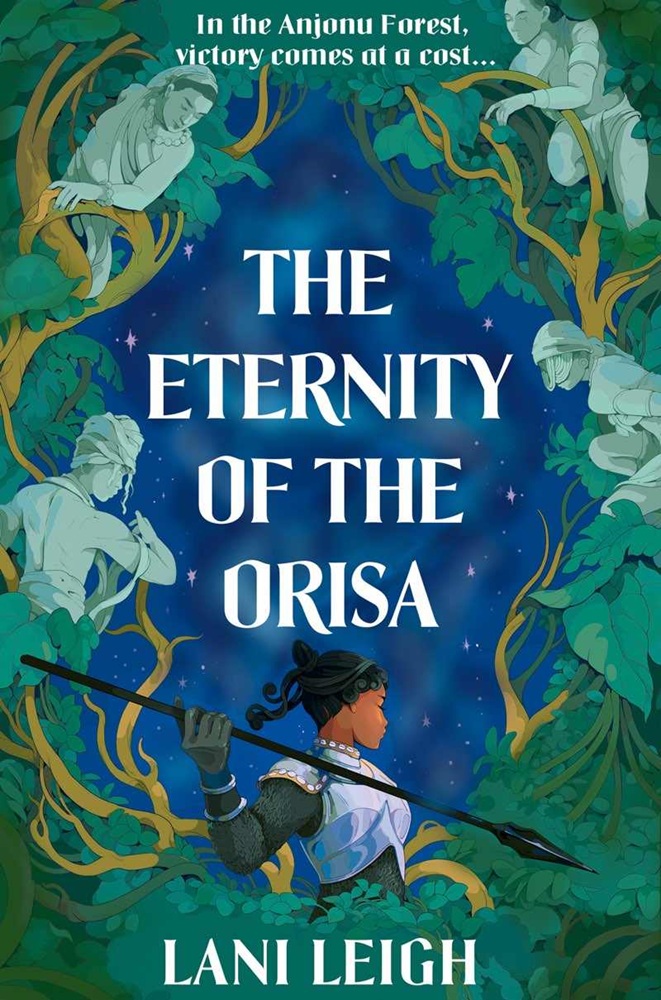
The Eternity of the Orisa by Lani Leigh
Genres: Adult, Fantasy
Representation: West African-inspired setting and cast
PoV: Third-person, past-tense
Published on: 21st August 2026
ISBN: 000867938X
Goodreads
Forged by Blood meets Children of Blood and Bone in this thrilling fantasy debut inspired by West African mythology
A brand new West African-inspired adult fantasy, for fans of Tomi Adeyemi and Ehigbor OkosunIn the kingdom of Ile-Ife, General Mosebolatan is a warrior of unmatched valour. But when she refuses the king’s marriage proposal, she is forced into her most dangerous mission yet.
Sent into the treacherous Anjonu forest, Mosebolatan must track down the fierce shape-shifting Egbere and recover the sacred artifact they have stolen. But the forest is home to more than just the Egbere and soon she will discover that, here, victory comes at a cost…
Caught up in an ages-old battle for celestial power, Mosebolatan must make a embrace a destiny she never sought, or risk the fate of all she holds dear.
I received this book for free from the publisher via NetGalley in exchange for an honest review. This does not affect my opinion of the book or the content of my review.
It sure is a Choice to open your book – which is not erotica – with an explicit threesome sex scene. Not for prudish reasons, but because I have no idea who any of these people are yet, which makes this sex scene completely meaningless to me.
It is even more of a Choice when you can’t write sexy sex to save your life. The writing is unbelievably cheesy and cringe-inducing; I kept wincing at the terminology and phrasing. (If you call a clitoris a ‘pleasure bud’ in a book you want me to take seriously, your best-case scenario is that I laugh in your face. Best-case.) Also, please settle on what terms you’re using for the various body-parts; I swear not a single one was repeated in the scene. Every time any body-part came up, it was called something it hadn’t been called before. WHY.
I honestly can’t believe the literary agent and publisher agreed that opening the book with a sex scene that bad was a GOOD IDEA.
Now, some people just suck at writing sex scenes. Sex scenes are difficult! I think a good writer should be aware that they are not good at sex scenes…aware enough not to open their book with one…but nonetheless: it’s perfectly possible to be bad at writing sex scenes, but great at writing most everything else.
Not the case here! The writing is clunky, the rhythm is all over the place, there are commas where there should not be and no commas where there should be. Tenses change multiple times in a single sentence. There’s so much info-dumping. So much is overwritten. The sentence structure and language is way too simple for what I expect from Adult fiction. I could go on.
Behold some quotes taken from my advanced reader copy (meaning they may well be edited or removed from the final version that goes live on release day.)
Her swollen clit was itching, on fire.
This is near the start of the sex scene. From context, this is meant to mean the character is aroused. But ‘itching’? That’s not sexy, that sounds like an STI.
I’m not going to quote the usage of ‘pleasure bud’, but it’s said twice. That is twice too many.
She bedded men out of need and power, and only when she needed it.
That phrasing is TERRIBLE. What do you mean, ‘she bedded men out of power’? Why would you say it like that?
muscles coiled in quiet readiness.
I’m sorry, her muscles what? They’re coiled? Like spirals? Like a slinky? Are you sure???
Body full of unease, a chill crept over her skin. Did she have a spiritual husband or husbands? Was she spiritually polygamous – that made her laugh. Good thing she didn’t say it aloud, men thought they were the only polygamous species.
The book’s established that it’s possible to be accidentally bound/married to a spirit, that’s not the issue. ‘Body full of unease’ is very clunky. The character is alone in the room, so what does it matter if men hear her? That comma after ‘aloud’ would work better as a semi-colon. And since when are men another species from women? (That one in particular raised red flags for me, because I have less than zero interest in books that think men are from Mars and women from Venus, or whatever. That’s a mentality I despise.)
Carved from dark mahogany, it was draped in rich, indigo and crimson cloth, the faint scent of camwood and old prayers lingered in the air, wrapping around her like an unseen presence.
‘Rich’ isn’t a colour, so there shouldn’t be a comma after it there, and the comma after ‘cloth’ should probably be a full stop. If it was a full-stop, I think the last bit would be fine, but as the end of a long sentence ‘wrapping’ strikes me as off, the wrong tense.
Time at home should be treasured; the softness and care, was a reprieve from the chaos of the battlefield and mind games of the palace.
Why is there a comma after ‘care’?
Sometimes there’s a lot of editing between the version that goes out to early readers, and what gets released on publication day. I hope this is one of those times, because as it is, this is abysmally bad.

The Splintered Sun (Flan's Crows, #1) by Tad Williams
Genres: Adult, Fantasy, Queer Protagonists
Representation: Queer MC
PoV: Third-person, past-tense; multiple PoVs
Published on: 6th October 2026
ISBN: 0756419069
Goodreads
New York Times bestselling Tad Williams delivers a thrilling new tale set in the legendary world of Osten Ard, perfect for fans of John Gwynne and Brandon Sanderson
A swashbuckling bandit and his band of misfit rebels navigate a kingdom menaced by dark sorcery and war in this fast-moving epic fantasy
With the old King of Hernystir's health failing, warlords carve up the land and rival factions clash over the rightful heir. Into this chaos steps Flann, joined by allies both noble and common, to help the King’s one legitimate heir claim his father’s blessing and restore stability. But enemies, human and inhuman, stalk their every move, determined to end Flann’s quest before it begins.
Packed with action, unforgettable characters, and the sweeping imagination that has made Tad Williams one of fantasy’s most beloved voices, this is Osten Ard as you’ve never seen it before.
I received this book for free from the publisher via NetGalley in exchange for an honest review. This does not affect my opinion of the book or the content of my review.
All right, so, not terribly surprisingly, this turned out not to be for me. It’s been something like fifteen years since I last tried to read a Tad Williams book, and I was hoping my tastes had evolved enough that I could have a fun time with Splintered Sun. Alas, it is not to be!
It’s just. Kind of plodding? The setting feels so generically Medieval Fantasy; I can’t take half the place names seriously (what do you mean the capital city is called Hernysadharc?); the dialogue often reads as very forced, very flat, there’s no natural flow to it; I feel like I’m being beaten over the head with telling-not-showing. Several things that should be very exciting happen in the opening chapters – there’s a magical vision of demony-creatures, murder and arson, and a meant-to-be-terrifying boar hunt – but I found it all really boring. I think that’s due to the prose, the writing rhythm, which just…plods along. It’s not actively BAD, but it’s plain and straightforward, and it massively undercuts the scenes that are clearly meant to be tense and exciting.
TL;DR: if you already enjoy Tad Williams, probably you will like this too. If you don’t already like this author, this isn’t going to be the book that convinces you otherwise, methinks. And if you’ve never tried him at all…well, I wouldn’t recommend starting here.

Locusta (The Poisoned Empire Duology, Book 1) by Emily Dexter
Genres: Adult, Fantasy, Historical Fantasy, Queer Protagonists
Representation: Sapphic MC
PoV: First-person, past-tense
Published on: 15th September 2026
Goodreads
Circe meets The Lost Apothecary in the first book of this historical fantasy duology featuring Ancient Rome’s most infamous poisoner who changed the course of history to save the woman she loved.
Born in the ancient region of Gaul, Locusta is the last of her kind—a Druid whose communion with the spirit world grants her the dangerous gift of identifying and wielding deadly substances. When Roman soldiers attack her home and slaughter her mother, Locusta is captured and enslaved, taken to the heart of the empire where political plots abound and death commands a high price. Guided by Arawn, the god of death, she must learn to survive within the brutal, glittering world of ancient Rome.
Her strange talents soon catch the attention of the Roman elite, and she becomes ensnared in a double life—poisoner by night for the cunning Antonia Augusta, and lady-in-waiting by day to Livia, the Emperor’s ambitious cousin. As Locusta plants the seeds of revenge against those who destroyed her home, her connection with Livia deepens into a passionate, forbidden romance that threatens them both. Surrounded by danger and deceit, Locusta’s poisons become their only protection against the increasingly unstable Emperor Caligula and the enemies lurking in every shadow.
Locusta reimagines the rise of one of history’s most complex women through a lens of myth, power, and feminine rage. Rich with ruthless twists, deadly magic, and a sapphic love story that burns from sweet to spicy, this is a story of survival, defiance, and the dangerous alchemy of love and death in a world ruled by men.
I received this book for free from the publisher via NetGalley in exchange for an honest review. This does not affect my opinion of the book or the content of my review.
I know most people have no idea what I’m talking about when I talk about writing rhythm. I have run into a few other readers who ‘hear’ it like I do, but clearly most people are not cursed with this ridiculous sensitivity. I envy you!
If you do hear it, then you will immediately discover that the rhythm of Locusta is…not-great. It’s choppy and discordant, and every time it starts to settle, there’s suddenly a far-too-long sentence with no commas or other pauses in it, kicking the rhythm ‘out of tune’ again. I was grinding my teeth before I got to the end of the first chapter.
Even if you don’t hear writing rhythm, though, I’m not sure you’re going to enjoy this book. The prose is pretty bland, there’s a lot of telling-not-showing, and the phrasing/wording is often odd, clunky. There are a lot of instances of thesaurisitis, ie, instead of using a typical word, there’s a synonym of it – but synonyms often have different connotations from each other. ‘Murmur’ and ‘mumble’ are synonyms, but if you mean one then the other is incorrect, and that kind of thing is rampant in this book. And even when that’s not the problem, metaphors and similes are often overwritten, with extra details that detract from the power of the image the author’s going for.
Examples of clunky prose below, all taken from my advanced reader copy, so they might well be different or even removed from the final published version of the book.
she smiles a smile that rips open my chest with more efficiency than a short sword.
‘with more efficiency’ is so clumsy for what you’re trying to say. ‘rips open my chest like a short sword’ would have been fine!
a blast of the horn that vibrates my very soul
I’m not sure this is grammatically incorrect, but it sounds/feels off. ‘that makes my soul vibrate’ would have been a way to say it that flowed more naturally.
There were stories–so many I cannot begin to recount them all–of war horns and shining golden weapons and treasure made of the finest stone and holy places and cedar groves that the Druids used to preside over.
This needs a boat-load of commas to break up that long sentence!
She was a priestess, to use the Roman equivalent, a bridge between the world of gods and spirits and our own–a power the Roman Vestals claim to be but are not.
‘a power they claim to be but are not’? That doesn’t make sense. ‘a power they claim to have but don’t’ would work.
Magic was a novelty that Romans seemed unable to resist possessing.
From context, this is talking about how Romans kidnap and enslave any magic-users they find. But ‘unable to resist possessing’ is an incredibly awful way to phrase that. ‘Taking’ or ‘stealing’ or ‘enslaving’ could all have worked there instead of ‘possessing’.
Prose aside, Locusta’s character is not very coherent. By which I mean, she doesn’t act in such-and-such a way because her personality and history manifest in that action; instead, she’s doing things because the plot requires her to do them. And it’s not even really For Plot so much as it is For Drama, the vast majority of the time. Her personality is all over the place, keeps contradicting itself; in the second chapter there’s a big moment which she tells us is the first time she ever defied her mother – but we just spent the whole first chapter with her not wanting to be a druid (which her mother’s teaching her to be) and going against her mother’s teachings, so???
The book is written from the perspective of an adult Locusta looking back on her life. This is a framing that often doesn’t work for me, and didn’t here. There’s no commentary on her child-self’s behaviour or beliefs, which means there’s no sense that Locusta has grown and changed as a person from the child we meet after the prologue. For example, as a child Locusta hates the Druid-training her mother basically forces on her – it would have been interesting to hear adult-Locusta say that now, as an adult, she understands why it was important to her mother, that she understands why her mother tried so hard. The lack of anything like that…in my experience it means the character isn’t going to develop at all over the course of the book.
I could obviously be wrong; this is a DNF review, I didn’t finish the book, so I can’t know. But Locusta has given me no incentive to keep reading and find out whether I’m correct about that or not, so this is where it and I part ways.

A Fate Worse Than Drowning by Sarah L. Hawthorn
Genres: Adult, Fantasy, Horror, Queer Protagonists
Representation: Sapphic MC, MC with asthma
PoV: First-person, present-tense; dual POVs
ISBN: B0FRHTS8JC
Goodreads
For fans of A Dark and Drowning Tide and The Lighthouse Witches comes a queer speculative novel about a lighthouse keeper who made a devil's bargain to save her sister, but when a shipwrecked survivor washes ashore, she is left with an impossible choice...
One deal with the devil makes a fool. Two? A villain...
A year ago, Elle made a deal with the devil to save her sister. Now, they live on a desolate spit of land beyond Halifax harbor. Elle, as lighthouse keeper, steers unsuspecting sailors to their destruction; those are the terms of her bargain. Liney need never know the cost. Her safety is worth every drop of blood.
But a sinner's pact is not so simple. When the devil returns, demanding more – more shipwrecks, no survivors – Elle knows what she must do to keep Liney safe...
Another ship. Another crew killed in the devil's name.Then a woman washes ashore. Is she a soul to be sacrificed, or part of a darker design? As Liney and the stranger grow closer, Elle faces an impossible kill, and break Liney's heart, or forfeit her own soul.
Danger arises from all the merciless sea, ruthless men on the mainland, and the infernal bargain itself…
Souls and sisterhood, fate and fire – what must be sacrificed for the devil to get his due?
I received this book for free from the publisher via NetGalley in exchange for an honest review. This does not affect my opinion of the book or the content of my review.
Nothing about this strikes me as bad, or even clumsy. It’s just a mis-match between book and reader. The story itself just isn’t my…flavour? Really, I probably shouldn’t have picked it up (and I’m a bit worried that this is an issue of, it’s a headspace/brain fog thing, and I’d enjoy it a lot more at another time when my head’s better); this one wasn’t aimed at me at all.
There’s a lot here that’s meant to be interesting, and that SHOULD be, but I’m just not gelling with the barren lighthouse thing. I do massively appreciate that Hawthorn does not info-dump us at all – it’s clearly going to be ages before every facet of the mystery/horror is revealed, which is my favourite way of doing things!
Also, some of my dislike is probably the surprise that the sisters share the narration – the book goes back and forth between Elle and Liney, both of them narrating in first-person present-tense. And they both have a ghost-companion! (Well, Liney’s is probably not a real ghost. But I don’t buy that she’s an imaginary friend, either, which is what Liney seems to think. THE NOT-GHOST IS DEEPLY SUS, MY FRIENDS.) The relationship between the sisters is believably, realistically complicated – Elle is overprotective and paranoid, but given their history that’s not surprising; Liney has always been physically fragile because of her asthma, and wants more freedom than Elle is willing to give her. They’re both trying to be great sisters (and house-mates, since they’re living together without anyone else in this lighthouse) to each other, but…things are very strained.
Liney’s not the kind of character I find interesting, and I wasn’t expecting her POV. It’s not her fault she’s been sheltered, but…she’s still not a character I want to read about. (Though from an objective writerly perspective, I suspect it was the right move to include her; if we only had the outside view of Liney, through Elle, we’d be missing a lot.)
So. Not for me, but not due to any objective flaws! If the premise sounds interesting to you, consider this a thumb’s up from me. Objectively, Fate Worse Than Drowning seems great – I’ll definitely be interested in Hawthorn’s future books, in case any of the premises suit me better!

All the Beastly Things by Eilish Quin
Genres: Adult, Queer Protagonists, Sci Fi
Representation: Sapphic MC, major brown character
PoV: First-person, present-tense
Published on: 17th November 2026
ISBN: 1668203693
Goodreads
In a post-apocalyptic matriarchy that has erased men, capitalism, and hierarchy, a devout novitiate destined for a sacred lunar abbey faces a crisis of faith when her best friend begins receiving visions of a forbidden masculine archangel—forcing her to choose between spiritual purity and human desire.
The year is 2171, and the Earth is not what it once was. The natural world once again reigns supreme, wild and ungovernable, after a series of wasting plagues and unmitigated climate disasters, the twin coups of fascism and AI, and a final, catastrophic nuclear fallout. Small monastic communities have emerged from the carnage—self-sufficient, female-only religious utopias governed by a strict codex and surrounded by walls to keep the wilds at bay. The new world is harmonious, and blissfully free from structures of oppression such as hierarchy, capitalism, and time.
Seventeen-year-old Igraine has never known life beyond the cloistered walls of the Field or seen a human male. Brilliant and devout, she spends her days in the gardens and scriptorium beside her closest companion, Ophelia. Their studies will culminate in twin posts at the Lunar Abbey—a gothic cathedral on the Moon reserved for the most venerated Sisters. Their futures fracture when Ophelia begins receiving visions of a mysterious, alluring, and damningly masculine archangel. As doubt spreads and rumors surface about the Order’s darker underpinnings, the girls venture beyond the convent’s walls and into the wilderness—while navigating the volatility of their deepening bond. When Igraine’s formidable mentor, Sister Agathe, takes a romantic interest in her, devotion blurs into jealousy and illicit desire. In the aftermath, Igraine must confront her unraveling faith in a system that demands her complete surrender.
I received this book for free from the publisher via NetGalley in exchange for an honest review. This does not affect my opinion of the book or the content of my review.
Another one that I don’t think is bad, but I wasn’t clicking with it at all.
I think I probably would have loved this if it had been written with really lush, decadent prose, but alas, it isn’t. The prose isn’t bad, but it’s pretty plain and straightforward. It reads like YA – which makes sense, because the main character is 17. But it’s not at all the tone or style I was hoping for. (The first-person present-tense did not help.)
The worldbuilding is kind of shallow? I was so excited for a post-nuclear apocalypse matriarchy, but it’s just…meh. There doesn’t seem to be any digging into gender, any actual deconstruction of capitalism, the patriarchy, any of the other systems this order of nuns was supposedly founded to oppose. Nor is there a very clear picture of what the rest of the planet looks like outside of the dome Igraine and the others live within. Where does the food come from? And all the other supplies? New children join the order from elsewhere; what’s that elsewhere, and what is the order’s place in any kind of wider network between them and other human habitats? It all felt very hand-wavey, reminiscent of all the Hunger Games knock-offs we got in the 2010s – surface-level worldbuilding only.
In fairness, I didn’t finish this book, so maybe it gets way more in-depth with the worldbuilding later. I don’t think it will – it just doesn’t have that feel to it. But I could be wrong!
This is supposed to be Adult, but like I said, it reads like YA, particularly with how Igraine is very clearly in love with her best friend Ophelia (and has no clue how to deal with it). Reading her mooning about after this girl was exhausting and incredibly dull. I feel like I’ve come across her character a gazillion times before: the Good Girl who keeps her head down and drinks the kool-aid happily, the teacher’s pet, who will then will be all Le Gasp when the truth starts coming out. She is so, so boring. Ophelia is vastly more interesting – to be honest, I’m baffled that she wasn’t the main character. Mysterious background, which she can’t remember because the nuns mind-wiped her! Visions! Uneasy with the System! Why couldn’t we have been in her head instead?
The whole aesthetic…I was just expecting more, I think. More weirdness, more darkness, more gothic-ness. The author’s borrowing bits of the aesthetic from Catholicism, but, speaking as someone raised Catholic, clearly does not get why Catholicism and the Gothic are so entwined. It’s all tangled up with why the Protestants hated Catholicism so much! The sensuality, the over-the-topness, the decadence-as-glory. None of that’s present in this book, and I get that these nuns are anti-capitalist so maybe they don’t have gold treasure all over the place – but even the prose doesn’t feel Gothic. It’s stripped bare – except for whenever Igraine is swooning over how pretty Ophelia is.
I don’t know. This whole thing feels shallow, feels like lip-service to the issues it wants to mess with. It’s giving me 2010s YA dystopia and I’m just not here for that. I still don’t think it’s BAD, but it’s not what I was hoping for. Alas, because this was one of my most-anticipated this year.

Fruits of Our Labor by Ian Patterson
Genres: Adult, Queer Protagonists, Sci Fi
Representation: Assorted BIPOC, queer, and QBIPOC cast
PoV: Assorted
Published on: 25th August 2026
ISBN: 1970458089
Goodreads
A new world is emerging, one parthenogenetic birth at a time.
In a near-future America where women have just achieved asexual reproduction, Samara yearns for freedom from her dying relationship, and a child of her own—fully her own.
As parthenogenetic birth takes hold and the role of men in the survival of the species diminishes, protest and outcry sweep across the nation. Sierra, one of the first “partho babies”, is bullied relentlessly as she grows up and seeks her place in this new pressure cooker of changing gender roles and norms.
And in the aftermath of the “Days of Horror”, a period of violent backlash from displaced men, a professor of history looks back on the rise of PG birth in an attempt to understand the impact of this era of upheaval on the world.
Together, these three converging perspectives tell the story of a profound societal transformation that asks who gets to have autonomy, who gets to write the future, and who that future is for.
I received this book for free from the publisher via NetGalley in exchange for an honest review. This does not affect my opinion of the book or the content of my review.
I just felt like I was being lectured and info-dumped to death.
Is this a really, REALLY cool premise? Yes. And the author’s note at the beginning was wonderful.
But every bit of dialogue read like it was just there as an excuse to get info to the reader. Not-dialogue is often massively overwritten. There’s a great amount of queer and bipoc characters front and centre, but (according to other reviews) non-binary genders never come up, despite a lot of this being about redefining gender roles.
It’s not terrible. I think the biggest thing ‘wrong’ with it is that I don’t want to read what it turned out to actually be – I’m tired of reading about these issues, about all the rage and hate. So why did I request this on Netgalley, I hear you ask? Valid question! And the answer is, this is not what I thought I was getting. I thought the premise was interesting and wanted to see the ramifications of it explored, the way Lois McMaster Bujold uses her Vorkosigan Saga to explore the cultural effects of uterine replicators. Instead, reading this felt like being lectured on all the things I knew already. I wouldn’t call it preachy exactly, but it’s definitely heavy-handed.
I do kind of wonder who this is for – I think the people who most need it will bounce off the first few pages and never come back, if they even pick this up in the first place. I’m not sure what intersectional feminists are supposed to get out of it. I guess it’s for readers in the middle, then? But I suspect a lot of them, too, are going to feel like they’re being lectured.
The actual prose isn’t bad. The timeline illustration above each chapter number is extremely clever and something I hope other publishers take note of, because that was SO helpful in keeping my mental place in the overall timeline. But I don’t want to finish the novella, even at its short length, and I have no idea who I’d recommend this to.

Strange Lights by Mira González
Genres: Adult, Queer Protagonists, Science Fantasy
Representation: Nonbinary possibly-autistic MC
PoV: First-person, present-tense
Published on: 6th October 2026
ISBN: 1967967156
Goodreads
Parenting is never easy, but it’s a hell of a lot harder when your toddler is a chupacabra.
Paranormal investigator and cryptozoologist Reggie has embraced her fate as parent to an adopted toddler, Eldi—a blood-sucking chupacabra with a fondness for goats. Reggie wants nothing more than to put her complicated past in the rearview mirror and fade into as much obscurity as her toddler will allow. But a rash of UFOs in the night sky and a couple of crop-circle-carving Roombas force Reggie into an investigation that attracts the attention of an old enemy, an anti-supernatural agency hunting for creatures like Eldi. To outwit them, Reggie must team up with Calvin: a podcaster-turned-werewolf whose charm is a real threat to Reggie’s rule against romantic attachments.
With Reggie’s history quickly catching up to her and Eldi in the agency’s crosshairs, any shred of normalcy evaporates. Reggie must decide: Can she confront her dark past to save Eldi—and an entire alien species—from getting wiped out of the universe?
I received this book for free from the publisher via NetGalley in exchange for an honest review. This does not affect my opinion of the book or the content of my review.
This is a perfectly NiceTM book, but a) it’s not what I thought it would be, and b) it has the common cosy fantasy problem of absolutely zero tension.
I was expecting Eldie to be Reggie’s adopted daughter, but that’s not the dynamic they have. Reggie is Eldie’s guardian and carer, for sure, and Reggie cares about her a lot. But Eldie is more like a sidekick or complicated pet. Also, Eldie has continued to look and act like a two year old for over a decade – that’s got to be skewing their relationship in a less-traditional direction too. Also-also, she’s not actually a chupacabra. I was disproportionately disappointed by that.
Strange Lights is perfectly cute and very readable, very accessible. I can see it being a fun popcorn read for the right reader. But it’s so placid – on the one hand, I appreciate a lack of info-dumping, that a book does not immediately explain all the mysteries to me. But Reggie’s reaction to every mystery is to just…shrug and carry on. It makes for a suffocating emotional flatness. There’s no tension to anything; none of the Big Questions actually feel important; I never feel even a prickle of concern or worry for any of the characters. There’s zero momentum to the plot, no urgency, no incentive to keep turning pages if you want more than Reggie’s banter and general cuteness.
I mean…in ten years, Reggie has learned NOTHING about Eldie or her origins! Doesn’t know where she came from, what species she is, whether she’ll ever age physically, the full extent of her powers, how the mysterious watch she came with works or who made it – nothing! And there’s not a lot to suggest Reggie ever tried all that hard to investigate. I think that situation encapsulates my issue pretty neatly: where’s the curiosity? The drive to know, to get answers? Reggie has spent A DECADE looking after this little girl and…seems perfectly content to keep doing it for another few decades? It’s both difficult to believe in a character that blase about something so huge, and difficult to care about a character who…doesn’t seem to really care about anything? Not really?
And it’s not like it would be hard work: everything is easy for Reggie. She doesn’t have to worry about money, because she stole it (or something) from some billionaire clients back in the day. Her campervan thing is semi-sentient and full of magic rooms with everything from top-tier lab equipment for running tests, to a library of actual spellbooks. It would have been very believable if Reggie’s life-on-the-road was difficult, somewhat hand-to-mouth, but no, even THAT tension is missing here.
Things are so easy for Reggie that she even has a whole Robin Hood thing going on, refusing or returning the fee she charges for her paranormal investigations (usually returning a lot more than they tried to pay her). But there’s no passion to it, no sense of genuine feeling behind it. I have no idea why Reggie does it. It’s just…something written to make Reggie likeable, not a natural extension of Reggie’s character.
Nice. Cute. Unobjectionable. Toothless. I can see the right reader having fun with this one. For me, it’s like – biting into an overly-fancy pastry; looks SO GOOD, but there’s nothing but air inside.

Half Moon Bay by Richelle Manteufel
Genres: Adult, Fantasy, Historical Fantasy
Representation: F/F
PoV: First-person, past-tense
ISBN: 9798991019071
Goodreads
Betray humanity and risk insanity to love a siren queen.
Cape Althea whispers of a wraith guarding the bay. Capricious weather and the glint of iron scales betray an ominous presence, but nothing more… until Laura Rivell sets sail.
Embarking on a revival cruise with her childhood friend, Laura is reborn into darkness instead of the promised A fate of ethereal dirges, kindred spirits, and a treacherous siren that the sheltered Miss Rivell cannot resist. Now Laura must decide whether to turn her back on religion, society, and humankind itself to love a monster—
And perhaps become a monster.
Seize the lure of Half Moon Bay, a Victorian-inspired romantasy inspired by Eggers' Nosferatu and Andersen's Little Mermaid for souls that embrace the villain within.
Title Information* Closed door sapphic romance (fade-to-black)* Categorized NA for mature themes including violence and gore. Full CA available on the copyright page.
I so, SO wanted to love this – the tagline is literally ‘betray humanity and risk insanity to love a siren queen’, WHAT IS NOT TO LOVE ABOUT THAT?
Alas, the prose is pretty clunky, and I noped out when, in chapter two, the author couldn’t be bothered to explain how the MC got off the ship when she goes after the mermaid/siren. Like??? Literally just hand-waved it and said the protagonist was in such a fugue/hypnotised state that she has no memory of how she managed it.
When I came to my senses, I was lost at sea.
Somehow, in a state of complete disassociation, I’d wrenched one of the rowboats free, clambered in, and lowered it. How I’d accomplished it was beyond me. I was far from frail, having taken care of myself and walked instead of ridden in carriages most of my life, but I was no hardened crewman, either. My own strength surprised me.
You’ve said she shouldn’t be physically strong enough to have dealt with the rowboat by herself, but we’re just…not gonna address that? You can’t just handwave tricky moments for your character! You do actually have to deal with them! What!!!
Also the way Laura’s ‘dark side’ goes from being, you know, a dark side in chapter one, to manifesting as a full-on secondary identity with its own capitalised name in the second chapter… Something about that rubbed me entirely the wrong way. I’m not sure how to articulate it. I don’t really like it when characters (or real people) insist their own darkness is another person entirely, someone talking in their head but not themself, and if that IS what we’re doing here, why wasn’t Shadow like that from the get-go? Laura told us she keeps her shadow locked up, but also, she’s at peace with it. Splitting her shadow into Shadow only makes any kind of sense if she’s distancing herself from that part of herself – but if she’s already at peace with it, why the distancing???
I’m so disappointed it HURTS.
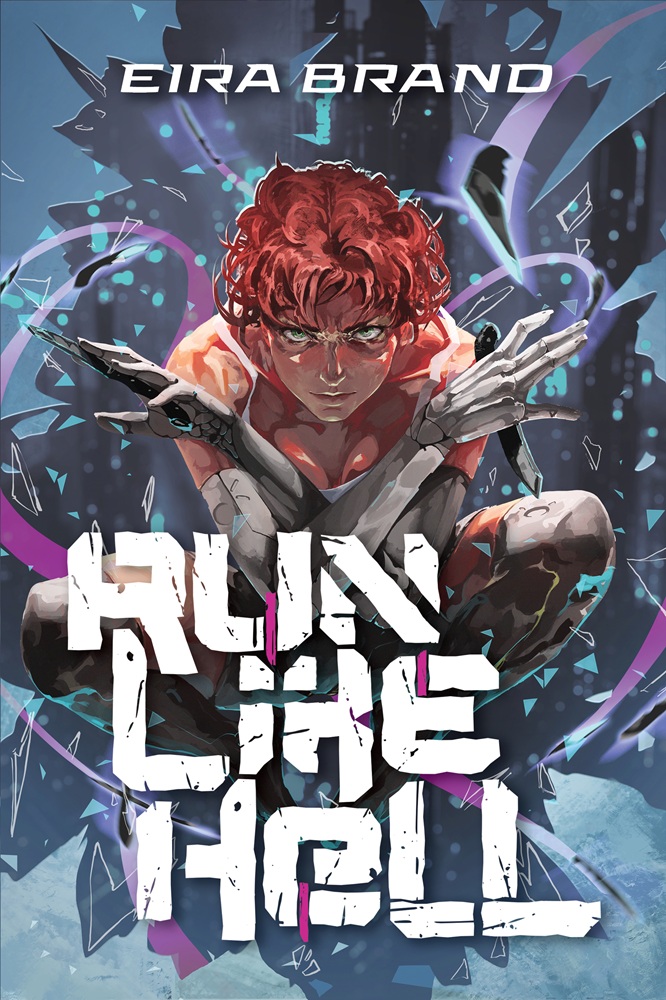
Run Like Hell by Eira Brand
Genres: Adult, Queer Protagonists, Sci Fi
Representation: Trans MC
PoV: First-person, past-tense
ISBN: 9798992518801
Goodreads
Starving to death in the lowest layer of the Megatropolis of New York City, Raide will do whatever it takes to survive.
When a chance encounter with her best friend ends with his murder, Raide soon finds herself risking her life to complete his last gig, all while in search of answers and vengeance.
But with corporate mercenaries on her heels, a strange new virus mutating ordinary people into grotesque monsters, and the sinking realization that this was more than a simple contract gone sideways, Raide is soon left with two options:
Lie down and die or run like hell.
I received this book for free from the author in exchange for an honest review. This does not affect my opinion of the book or the content of my review.
This is really clever and surprisingly funny, and if you are not as unreasonably, ridiculously picky about prose as I am, I think you’ll love it.
The prose is not bad, it’s just…a tiny bit overwritten, the writing rhythm just ‘off’ enough that I can’t settle into the story properly. It’s sentences like this
“Let’s not get bogged down in the details,” I said, perhaps a little quieter than I’d intended.
‘perhaps more quietly than I’d intended’ would make that flow better.
My shoulders slumped a little and I almost sunk into what remained of the drink Jin had bought me.
‘sunk’ is jarring – is that the right tense? It should be ‘sank’, surely?
Jin instinctively shifted away from me as if I’d had an infectious disease.
From context, this is about the MC currently having a low reputation score. So it’s not like having had and no longer having an infectious disease (and who needs to pull away if someone had an infectious disease and no longer does?). It’s as if the MC currently has an infectious disease.
If those examples don’t bother you, as I suspect they won’t bother most people? Then good! Great! Please go check this book out! Because prose aside, I want to give this four stars. I’m fascinated by this dystopia, where everything from housing to job hires depends on your reputation score, and some people (like our MC) are made, not born. Bodies are super editable – you can buy new faces, new sex organs, whatever you like. Some clothing is alive and requires feeding!
And Raide is a great character – scrappy, snarky, desperate, more than a bit feral. At the start of the book, he still thinks of himself as a man, doesn’t figure out she’s a woman until later on – but even at the start, there’s hints that ‘he’ isn’t comfortable in ‘his’ gender identity. There’s a running gag about Raide living in a box – really, it’s a decommissioned heating unit hidden inside an apartment building, and she’s very proud of it. There’s a lot of bits and pieces like this, things that are simultaneously cute and alarming. Her little ‘box’ is very sweet, but also, your heart breaks for her because she’s living in a heating unit.
I think I would love this if the prose were just a little more polished. It’s much, MUCH better-written than any of the other books I DNFed this month for their prose. So if you like dystopia stories, I hope you give this one a try!

Serendipity (Son of the Moon, #1) by Janelle Cressida
Genres: Adult, Fantasy, Contemporary Fantasy, Queer Protagonists
Representation: M/M
PoV: Third-person, past-tense
ISBN: B0DWBXQPWQ
Goodreads
"Don't come crying to me if he somehow manages to actually kill you!"
Twenty-one-year-old Jesse leads a pretty ordinary life until he encounters Jamie, who, covered in soot and ash, can't even remember where the blood on his hands came from.
Aware of the risk, Jesse offers him a place for the night, and what starts as simple act of kindness quickly deepens into a profound connection. Jamie explores the world anew, curious and with an endearing innocence, but things change rapidly when their first intimate moment nearly ends in tragedy. Even worse, Jamie begins to experience vivid nightmares; and discovering mysterious powers inside of him, the question of who he really is becomes all the more pressing. What did he do before he met Jesse? Is Jamie truly the harmless person he seems to be?
SERENDIPITY is the beginning of an epic, unique love story that connects two different worlds forever - and encounter that changes more than just one life.
I received this book for free from the author in exchange for an honest review. This does not affect my opinion of the book or the content of my review.
I just don’t think it’s a good sign that I didn’t know where the prologue was happening until the final lines made it clear we were inside a house.
Mostly, the issue is that it’s overwritten. Too many unnecessary details clog the sentences, and the sentences themselves are too long, making for a really wonky writing rhythm. We spent a whole paragraph talking about road traffic, even though there is none in this scene!
The dialogue sounds very false, very forced – like the worse made-for-Netflix things, where the characters are narrating/info-dumping out loud because the writers expect the movie (or whatever) to be playing in the background with no one watching the screen. So you can keep track of plot without watching. This was a lot of that.
No thank you!
Crossing my fingers for fewer DNFs in August!



You ever read Steering the Craft by Ursula K Le Guin? Because that finding the rhythm of a narrative is one of the exercises she tries to teach in that book. I could never do it myself; I can’t even hear the rhythm in music. She seems to have been able to do it and found it be a useful skill. I have a friend who hears punctuation in her head (and would always get after me for writing sentences all the same length) but she’s also worked professionally as an editor.
I have not! But I’m not sure what I’m talking about could be described as the rhythm of the narrative; what I mean is specifically a prose thing. It’s like – the length of the words, the placement of commas, all of that creates a beat, a rhythm, and a truly great author manipulates that beat for different effects. Shorter, blunter sentences or long run-on sentences can make a fight-scene seem like it’s moving faster, for example. But a lot of writers don’t seem aware of prose rhythm, or are just bad at utilising it.
I’ve only run into a handful of people who know what I’m talking about, so if that’s nonsensical to you, don’t worry, you’re very much in the majority!
I’d like to take a peek at the Guin book, though, just in case it IS the same thing that she’s talking about. So thank you for the suggestion!
“A good reader has a mind’s ear. Though we read most of our narratives in silence, a keen inner ear does hear them. Dull, choppy, droning, jerky, feeble: these are all faults in the sound of prose, though we may not know we hear them as we read. Lively, well-paced, flowing, strong, beautiful: these are all qualities of the sound of prose, and we rejoice in them as we read. And so good writers train their mind’s ear to listen to their own prose– to hear as they write.”
I always fail the very first exercise in the book which is to write a paragraph of narrative that’s meant to be read aloud using onomatopeia, alliteration, repetition, rhythm, names and dialect but not rhyme or meter. (I can’t hear these things to save my life, I can’t hear meter either when it comes to it.) I’m a little better at the next one which is to write a scene that has no punctuation to create a sense of hectic action. The next one after that is writing a paragraph where no sentence is longer than seven words but which also includes no sentence fragments. (That one’s more my kind of thing.) The exercises start getting more complicated after that and have parts but you get the drift. I still think the way Le Guin was trying to teach people to be is just how you naturally are.
Okay, this is probably silly, but I teared up reading this. That IS exactly what I was talking about and I cannot tell you how much it means to me that URSULA LE GUIN heard it too! Thank you so incredibly much. I’m definitely pouncing on that book! Meep. I AM HAVING AN EMOTION ABOUT THIS.
Hahahahahaha thank you SO MUCH for highlighting how stupid it is to do a palm slice for blood! This is one of my absolute pet peeves.
My main other pet peeve is comas. Just, no.
IT IS SO INCREDIBLY DUMB!!! I will never forget the first Kate Daniels book, when the main character puts part of her forearm, not her hand, into the flame, because that way she’ll keep as much of her mobility as possible. It’s the exact same thing!
(Also would you not be TERRIFIED of doing permanent damage to the tendons or something in your hand? I would be!)
I THINK the epigraph of the southern witches book was trying to compare the hellish temperatures to hellish magic… there probably was a better way to write that where hell was emphasized more than temperature.
Anyways thanks for the DNFs! I was looking forward to this post all week.
You’re probably right, but it is genuinely alarming how often lately I’m running into prose that doesn’t say what it means. Where the structure of the sentence does not accurately convey the meaning probably intended. EEK.
XD You’re welcome! Can’t tell you how much it delighted me, knowing someone was waiting for this post!
I got A Voice of Wrath on Kobo after reading the sample, and I guess I managed to miss the disconnect between 1) protagonist having one month to live, and 2) protagonist’s sister trying to rope him into a dangerous mission. I was lured in by the prospect of ‘queer Little Mermaid’. I’ll still read it, but if the nonsensical nature of the set-up starts annoying me as much as it has annoyed you, then I’ll just drop it.
I also had my sights on Strange Lights, so, I’ll read that, too, once it releases in September, and see what I think of it.
I hope you have a better time with both than I did! (This always seems to be the only reasonable response to someone reading a book I didn’t like – it’s not like I’d wish bad reads on you!)